Close Menu
  • Home
  • UNSUBSCRIBE
  • News
  • Lifestyle
  • Tech
  • Entertainment
  • Sports
  • Travel
Facebook X (Twitter) WhatsApp
Trending
  • Lemur used in ‘lemur yoga’ session dies of human herpesvirus, study finds
  • ‘A fine line between reducing stigma and trivialising conditions’: Social media, self-diagnosis and the glamorization of ADHD
  • New 2D memory device stores data on just a single electron
  • Before we ban kids from social media completely, here’s what we should try first | Jonathan Bellack and Mariana Olaizola Rosenblat
  • Scientists uncover a better way to beat ‘the bends’ — using deep-diving pigs
  • Mars may have been losing its water more than 4 billion years ago, oldest-known Martian meteorite suggests
  • ‘The lance head was still inside the pelvis’: Mass grave found in Austria may hold casualties of unknown ancient Roman battle
  • ‘Full-on berserker mode’: Archaeologists solve mystery of medieval soldiers with gruesome square holes in their skull
Facebook X (Twitter) WhatsApp
Baynard Media
  • Home
  • UNSUBSCRIBE
  • News
  • Lifestyle
  • Tech
  • Entertainment
  • Sports
  • Travel
Baynard Media
Home»Lifestyle»Apulian rhyton: A 2,300-year-old Spartan-hound-shaped cup that was likely used at boozy bashes
Lifestyle

Apulian rhyton: A 2,300-year-old Spartan-hound-shaped cup that was likely used at boozy bashes

EditorBy EditorApril 28, 2025No Comments3 Mins Read
Share Facebook Twitter Pinterest LinkedIn Tumblr Reddit Telegram Email
Share
Facebook Twitter LinkedIn Pinterest Email

QUICK FACTS

Name: Apulian dog head rhyton

What it is: A terracotta cup in the shape of a dog’s head

Where it is from: Puglia, Italy

When it was made: 340 to 330 B.C.

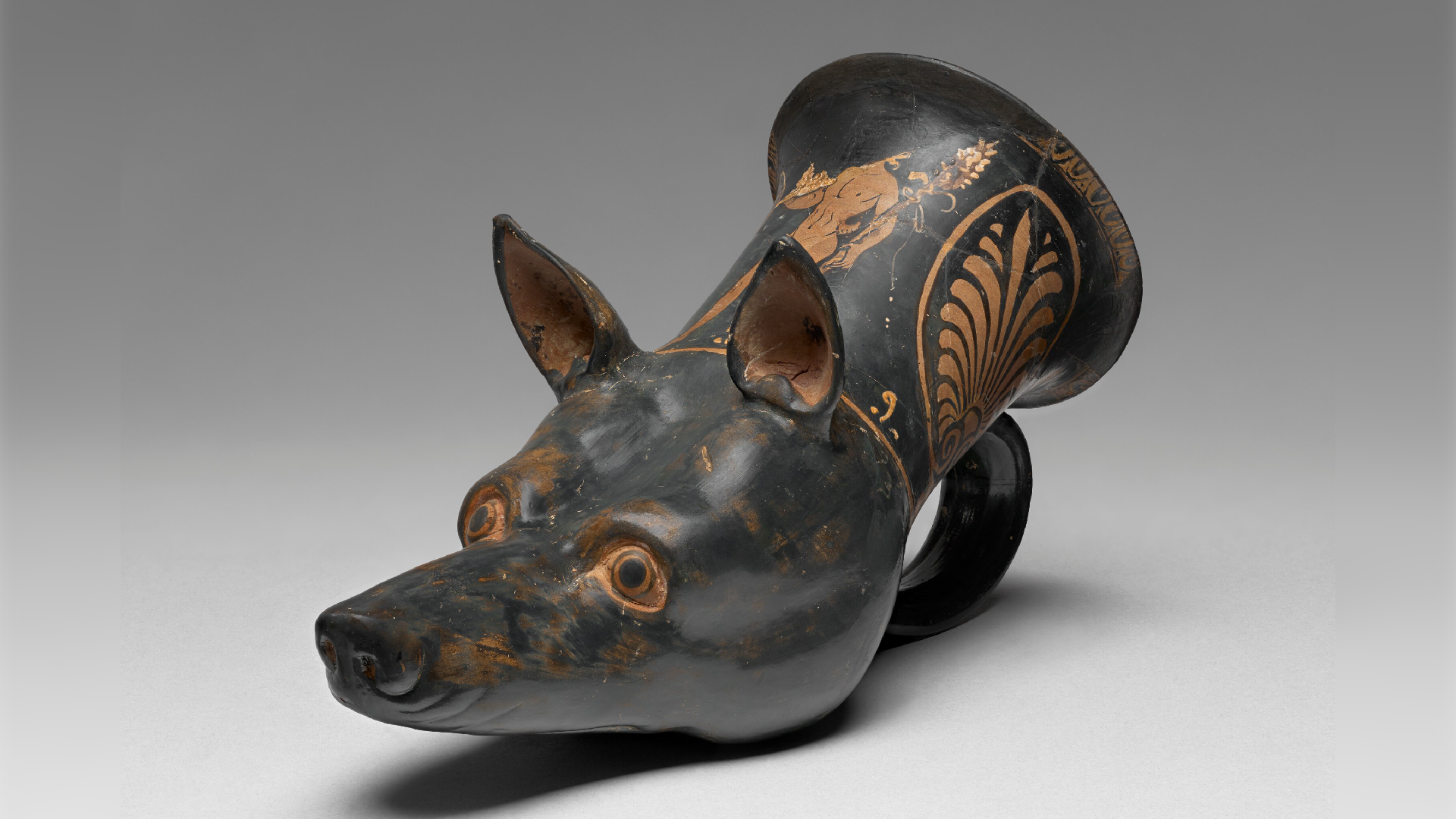
This terracotta cup was made to resemble the head of a Laconian hound, an extinct Greek hunting breed also known as a Spartan hound. Discovered in the “heel” of Italy’s “boot,” the rhyton — a kind of drinking vessel — shows the influence of Greece on southern Italy 2,300 years ago.

This rhyton, housed at the Getty in Los Angeles, was likely made in the workshop of the Darius Painter, a modern name for the artisan whose vase-painting style was well known throughout Puglia and who was particularly prolific between 340 and 320 B.C.

Measuring approximately 8 by 4 inches (20 by 10 centimeters), the rhyton is covered in a black glaze, save for the dog’s ears and nostrils, and its eyes are coated in a diluted glaze. On the bowl of the cup, a satyr — a half-man, half-goat woodland mythological creature — holds a plate and a staff, surrounded by leaf- and egg-shaped patterns.

Related: Lviv pysanka: World’s oldest Easter egg

The dog, whose face makes up the lower part of the rhyton, is a hound breed that originated in Laconia, a region of ancient Greece where Sparta was located. Because the Laconian hound was well known for its hunting abilities, it was depicted on numerous mosaics, gravestones and drinking cups.

MORE ASTONISHING ARTIFACTS

Ancient Greeks used rhytons at drinking parties or in ceremonies. It is notable that these vessels did not have flat bottoms, so they could not normally be set down on a table. Rhytons as a style likely evolved from earlier drinking horns common in Eurasia in the Bronze Age (roughly the second millennium B.C.), but with a Greek twist: Many rhytons depicted satyrs, which were symbols of debauchery and drunkenness. Dogs were not the only animals whose heads were made into cups; horses, stags, cats, rams, boars, lions and even mythical creatures, like griffins, adorn ancient rhytons.

In addition to being cool cups at boozy bashes, rhytons may have been used ceremonially to pour offerings of wine, oil or blood, particularly during animal sacrifices.

Get the world’s most fascinating discoveries delivered straight to your inbox.

This Laconian hound rhyton shows the strong influence of Greek culture on southeastern Italy, which was called Magna Graecia (Greater Greece) in the fourth century B.C. This area was not annexed by the Romans until 205 B.C.

Source link

Share. Facebook Twitter Pinterest LinkedIn Tumblr Email
Previous ArticleWhat was the fastest dinosaur?
Next Article What is artificial superintelligence (ASI) and what could it mean for humanity?
Editor
  • Website

Related Posts

Lifestyle

Lemur used in ‘lemur yoga’ session dies of human herpesvirus, study finds

August 15, 2026
Lifestyle

‘A fine line between reducing stigma and trivialising conditions’: Social media, self-diagnosis and the glamorization of ADHD

August 15, 2026
Lifestyle

New 2D memory device stores data on just a single electron

August 15, 2026
Add A Comment

Comments are closed.

Categories
  • Entertainment
  • Lifestyle
  • News
  • Sports
  • Tech
  • Travel
Recent Posts
  • Lemur used in ‘lemur yoga’ session dies of human herpesvirus, study finds
  • ‘A fine line between reducing stigma and trivialising conditions’: Social media, self-diagnosis and the glamorization of ADHD
  • New 2D memory device stores data on just a single electron
  • Before we ban kids from social media completely, here’s what we should try first | Jonathan Bellack and Mariana Olaizola Rosenblat
  • Scientists uncover a better way to beat ‘the bends’ — using deep-diving pigs
calendar
September 2026
M T W T F S S
 123456
78910111213
14151617181920
21222324252627
282930  
« Aug    
Recent Posts
  • Lemur used in ‘lemur yoga’ session dies of human herpesvirus, study finds
  • ‘A fine line between reducing stigma and trivialising conditions’: Social media, self-diagnosis and the glamorization of ADHD
  • New 2D memory device stores data on just a single electron
About

Welcome to Baynard Media, your trusted source for a diverse range of news and insights. We are committed to delivering timely, reliable, and thought-provoking content that keeps you informed
and inspired

Categories
  • Entertainment
  • Lifestyle
  • News
  • Sports
  • Tech
  • Travel
Facebook X (Twitter) Pinterest WhatsApp
  • Contact Us
  • About Us
  • Privacy Policy
  • Disclaimer
  • UNSUBSCRIBE
© 2026 copyrights reserved

Type above and press Enter to search. Press Esc to cancel.