Close Menu
  • Home
  • UNSUBSCRIBE
  • News
  • Lifestyle
  • Tech
  • Entertainment
  • Sports
  • Travel
Facebook X (Twitter) WhatsApp
Trending
  • New robotic heart mimics common, mysterious condition to help researchers study it
  • Canon EOS R6 III review: A wildlife wonder
  • Medieval babies and adults buried together in Sweden were not related, archaeologists discover — raising big questions about early Christian burial practices
  • NASA is creating a fifth state of matter on the ISS, thanks to an upgrade to a mini-fridge-sized quantum lab
  • New sodium metal battery design charges in just 4 minutes and retains its capacity for years
  • Quantum computing wielded to create extremely rare material critical to nuclear fusion
  • Scientists build tiny ‘diving suit’ for cockroaches, turning them into search-and-rescue cyborgs
  • Physicists develop the first working model of quantum mechanics using only ‘real’ numbers
Facebook X (Twitter) WhatsApp
Baynard Media
  • Home
  • UNSUBSCRIBE
  • News
  • Lifestyle
  • Tech
  • Entertainment
  • Sports
  • Travel
Baynard Media
Home»Lifestyle»‘Another piece of the puzzle’: Antarctica’s 1st-ever amber fossil sheds light on dinosaur-era rainforest that covered South Pole 90 million years ago
Lifestyle

‘Another piece of the puzzle’: Antarctica’s 1st-ever amber fossil sheds light on dinosaur-era rainforest that covered South Pole 90 million years ago

EditorBy EditorNovember 16, 2024No Comments3 Mins Read
Share Facebook Twitter Pinterest LinkedIn Tumblr Reddit Telegram Email
Share
Facebook Twitter LinkedIn Pinterest Email

For the first time, researchers have discovered a piece of fossilized resin, or amber, in Antarctica. The tiny golden fragment, unearthed beneath the seafloor, contains microscopic remnants of an ancient dinosaur-era rainforest that sprawled across the continent 90 million years ago, a new study reveals.

Amber is fossilized resin, or tree sap, that can trap plants, insects, small animals or other organic matter with it as it hardens. The golden-yellow casing is airtight and mostly see-through, meaning it both perfectly preserves and displays whatever is inside it, like a transparent time capsule.

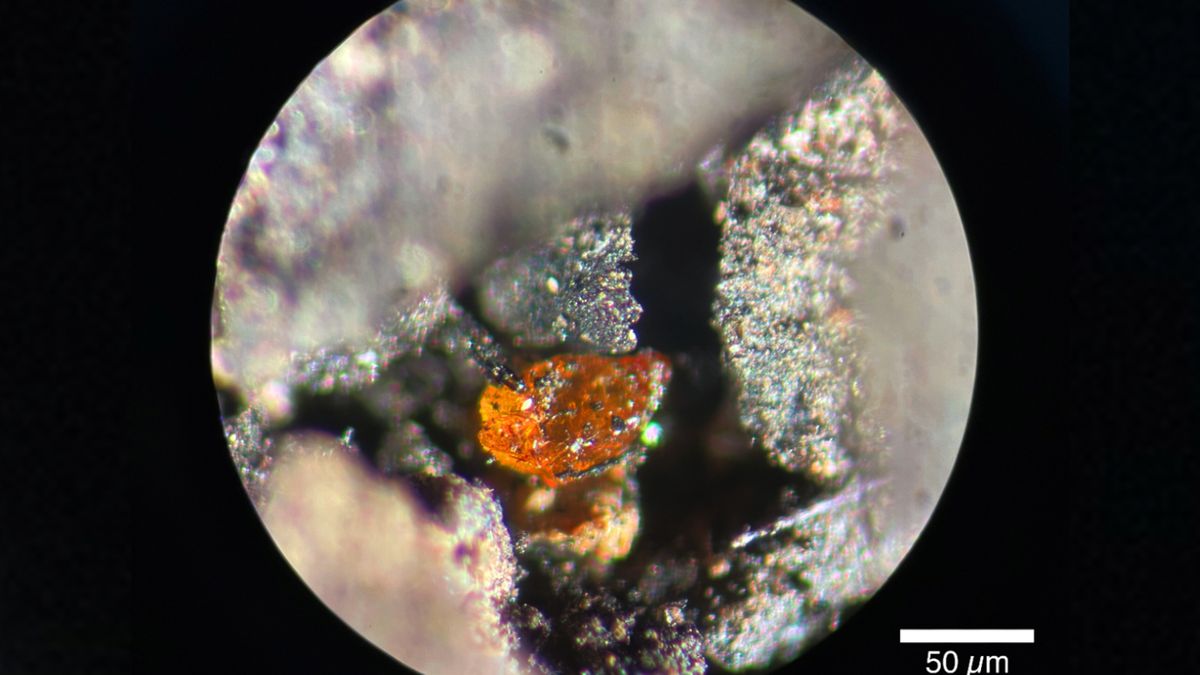
Until now, amber fossils had been found on every one of Earth’s continents, except for Antarctica. But in the new study, published Tuesday (Nov. 12) in the journal Antarctic Science, researchers identified a tiny piece of amber, around 0.002 inch (70 micrometers) across, in sediment cores collected beneath the seafloor at a depth of around 3,100 feet (950 meters) off the coast of Pine Island Glacier on Antarctica’s west coast.

The tiny fragment dates back to around 90 million years ago during the Cretaceous period (145 million to 66 million years ago). At this time, large parts of Antarctica were covered by a temperate rainforest, similar to those found in New Zealand today, that thrived in warmer climatic conditions — and a tiny part of that lost ecosystem is trapped within the amber.

“This discovery allows a journey to the past in yet another more direct way,” study lead author Johann Klages, a sedimentologist at the Alfred Wegener Institute in Germany, said in a statement. “Our goal now is to learn more about the forest ecosystem.”

Related: Wildfires burned Antarctica 75 million years ago, charcoal remnants reveal

Artist's interpretation of a Cretaceous-era rainforest in Antarctica

During the Cretaceous period, large parts of Antarctica were covered by a subtropical rainforest. (Image credit: J. McKay/Alfred-Wegener-Institut)

The sediment cores used in the study were first collected in 2017 and were later revealed to contain fossils of roots, pollen, spores and other remains from flowering plants, which represent some of the best evidence of Antarctica’s Cretaceous-era rainforest.

Get the world’s most fascinating discoveries delivered straight to your inbox.

The amber fragment was only recently discovered as researchers broke up the remaining materials into thousands of tiny pieces and painstakingly scanned each one using fluorescent microscopy. Further analysis revealed that it contained “micro-inclusions” from bark that would have likely once lined a conifer-like tree that lived in the ancient forest.

The bark also shows some signs of “pathological resin flow” — a strategy used by trees to seal up damage done to their woody shielding by parasites or wildfires, by creating a chemical and physical barrier with resin.

Microscope images of bits of bark in the amber fossil

Microscope images of the amber show tiny pieces of bark entombed in the fossilized resin. (Image credit: Johann P. Klages)

While the new fragment is small, it is unusually well-preserved despite it being buried under the seafloor.

“Considering its solid, transparent and translucent particles, the amber is of high quality,” study co-author Henny Gerschel, a consultant at the Saxony State Office for the Environment, Agriculture and Geology in Dresden, Germany, said in the statement. The fragment must have spent most of the last 90 million years near the seafloor’s surface, “as amber would [normally] dissipate under increasing thermal stress and burial depth,” she added.

The researchers believe that their findings could open the door to finding more Antarctic amber, which could unlock even more secrets about this ancient rainforest and the dinosaurs that lived in it.

“Our discovery is another piece of the puzzle,” Gerschel said.

Source link

Share. Facebook Twitter Pinterest LinkedIn Tumblr Email
Previous ArticleWould a 20-Mile Bridge With 2,000lb Limit Collapse if a Bird Landed on a 2,000lb Car Halfway Across?
Next Article Jake Paul beats Mike Tyson in manufactured mismatch as Father Time comes calling | Boxing
Editor
  • Website

Related Posts

Lifestyle

New robotic heart mimics common, mysterious condition to help researchers study it

July 11, 2026
Lifestyle

Canon EOS R6 III review: A wildlife wonder

July 10, 2026
Lifestyle

Medieval babies and adults buried together in Sweden were not related, archaeologists discover — raising big questions about early Christian burial practices

July 10, 2026
Add A Comment

Comments are closed.

Categories
  • Entertainment
  • Lifestyle
  • News
  • Sports
  • Tech
  • Travel
Recent Posts
  • New robotic heart mimics common, mysterious condition to help researchers study it
  • Canon EOS R6 III review: A wildlife wonder
  • Medieval babies and adults buried together in Sweden were not related, archaeologists discover — raising big questions about early Christian burial practices
  • NASA is creating a fifth state of matter on the ISS, thanks to an upgrade to a mini-fridge-sized quantum lab
  • New sodium metal battery design charges in just 4 minutes and retains its capacity for years
calendar
July 2026
M T W T F S S
 12345
6789101112
13141516171819
20212223242526
2728293031  
« Jun    
Recent Posts
  • New robotic heart mimics common, mysterious condition to help researchers study it
  • Canon EOS R6 III review: A wildlife wonder
  • Medieval babies and adults buried together in Sweden were not related, archaeologists discover — raising big questions about early Christian burial practices
About

Welcome to Baynard Media, your trusted source for a diverse range of news and insights. We are committed to delivering timely, reliable, and thought-provoking content that keeps you informed
and inspired

Categories
  • Entertainment
  • Lifestyle
  • News
  • Sports
  • Tech
  • Travel
Facebook X (Twitter) Pinterest WhatsApp
  • Contact Us
  • About Us
  • Privacy Policy
  • Disclaimer
  • UNSUBSCRIBE
© 2026 copyrights reserved

Type above and press Enter to search. Press Esc to cancel.