Close Menu
  • Home
  • UNSUBSCRIBE
  • News
  • Lifestyle
  • Tech
  • Entertainment
  • Sports
  • Travel
Facebook X (Twitter) WhatsApp
Trending
  • If humans are getting smarter, why are our brains shrinking?
  • ‘Feuding tech bros’ go head to head in legal showdown. But what does it mean for the future of AI?
  • Pregnancy quiz: Can you deliver on the science of growing babies?
  • Science news this week: The latest on the cruise ship hantavirus infections, a shortcut to Mars, and a fast-charging quantum battery
  • Hantavirus cruise LIVE: Cruise passengers monitored in at least 5 US states as American passengers set to receive repatriation flight
  • Mangroves clean up $8.7 billion of nitrogen pollution every year, study finds
  • Flowering plants transformed into ‘hopeful monsters’ in 9 dire bursts across evolutionary time, study finds
  • US government declassifies nearly 200 UAP files, including strange sightings from Apollo astronauts
Facebook X (Twitter) WhatsApp
Baynard Media
  • Home
  • UNSUBSCRIBE
  • News
  • Lifestyle
  • Tech
  • Entertainment
  • Sports
  • Travel
Baynard Media
Home»Lifestyle»Ancient ‘superfood’ discovered in 2,500-year-old bronze jars in southern Italy
Lifestyle

Ancient ‘superfood’ discovered in 2,500-year-old bronze jars in southern Italy

EditorBy EditorJuly 30, 2025No Comments3 Mins Read
Share Facebook Twitter Pinterest LinkedIn Tumblr Reddit Telegram Email
Share
Facebook Twitter LinkedIn Pinterest Email

Globs of sticky goo discovered in the bottom of 2,500-year-old bronze jars from southern Italy have been chemically identified, settling a 70-year archaeological debate.

It’s honey — the sweet leftovers of an offering to an ancient god.

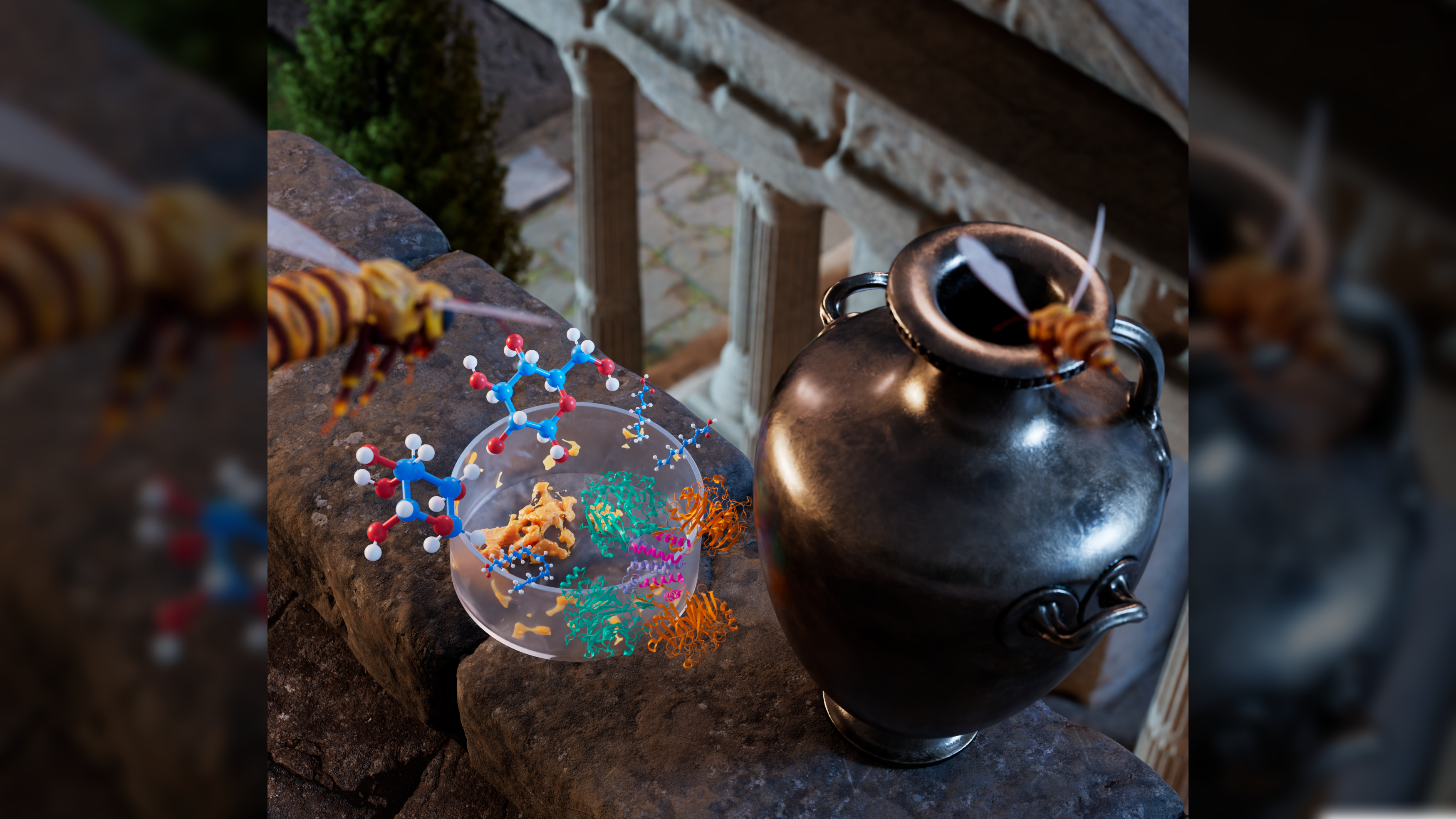
A team of chemists and archaeologists used cutting-edge analysis techniques to test the paste-like residue. They concluded that the jars, which were found in the sixth-century-B.C. city of Paestum, originally contained honeycomb.


You may like

“What I find interesting is that the ancient Greeks did think that honey was a superfood,” study lead author Luciana da Costa Carvalho, a chemist at the University of Oxford, said in a video. The researchers published their findings Wednesday (July 30) in the Journal of the American Chemical Society.

Honey and honeybees were important in ancient Greek and Roman medicine, rituals, cosmetics and food. So when archaeologists found eight bronze jars in an underground shrine in 1954, they assumed that the jars contained honey as a symbol of immortality. Despite at least four attempts over seven decades to confirm the presence of the sticky, sweet substance, no evidence of sugars was ever found.

Related: Does honey ever go bad?

But Carvalho and colleagues decided to take advantage of recent advances in chemical analysis techniques and to reopen the question of the gooey substance’s origin.

Get the world’s most fascinating discoveries delivered straight to your inbox.

Using mass spectrometry, a technique that can identify different molecules and compounds, Carvalho and colleagues identified intact hexose sugars in the ancient jar residue for the first time. Fresh honey is about 79% hexose sugars, the researchers wrote in the study, with fructose being the most abundant.

An analysis of the proteins in the ancient sample revealed the presence of royal jelly, a milky secretion made by worker bees. The researchers also recovered peptides — short amino acid chains that are smaller versions of proteins — unique to one species of honeybee: the European honeybee (Apis mellifera).

A roofed shrine is in the foreground, mostly buried, while a Doric temple rises in the background against a cloudy blue sky

Jars with sticky goo were discovered in the 1950s inside this underground shrine at Paestum. (Image credit: Alamy)

Adding up these analyses, the researchers wrote that the study presents the first direct molecular evidence supporting the presence of honey, likely offered as honeycombs.

“The amount of sugar in the ancient residue is very low compared to modern honey,” Carvalho told Live Science in an email. “I think the residue tastes like washed honeycomb but slightly more acidic,” Carvalho said, although she did not actually try it.

The researchers also identified copper ions in the honey mixture. Because these ions are biocidal, meaning they can kill microorganisms, “their presence would have contributed to the preservations of sugars on the surface of the residue,” Carvalho said, potentially explaining how the honey lasted thousands of years.

The analysis of the goop can help archaeologists better understand ancient rituals and shrines. The jars were found in an underground shrine, also called a heroon, at Paestum. The heroon also included a large, wooden table with wool-wrapped iron rods placed on top.

The offering may have been made to Is of Helice, the mythical founder of the ancient Greek city of Sybaris, located in what today is the arch of Italy’s boot. When Sybaris was destroyed in the sixth century B.C., its inhabitants fled and founded a city called Poseidonia. But when the Romans took it over in the third century B.C., they renamed the city Paestum.

The new study shows that “there is merit in reanalyzing museum collections because analytical techniques continue to develop,” Carvalho said in the video.

Source link

Share. Facebook Twitter Pinterest LinkedIn Tumblr Email
Previous ArticleSchumer calls for FBI assessment on Epstein files potential security threats
Next Article Trump hits India with 25% tariff
Editor
  • Website

Related Posts

Lifestyle

If humans are getting smarter, why are our brains shrinking?

May 9, 2026
Lifestyle

‘Feuding tech bros’ go head to head in legal showdown. But what does it mean for the future of AI?

May 9, 2026
Lifestyle

Pregnancy quiz: Can you deliver on the science of growing babies?

May 9, 2026
Add A Comment

Comments are closed.

Categories
  • Entertainment
  • Lifestyle
  • News
  • Sports
  • Tech
  • Travel
Recent Posts
  • If humans are getting smarter, why are our brains shrinking?
  • ‘Feuding tech bros’ go head to head in legal showdown. But what does it mean for the future of AI?
  • Pregnancy quiz: Can you deliver on the science of growing babies?
  • Science news this week: The latest on the cruise ship hantavirus infections, a shortcut to Mars, and a fast-charging quantum battery
  • Hantavirus cruise LIVE: Cruise passengers monitored in at least 5 US states as American passengers set to receive repatriation flight
calendar
May 2026
M T W T F S S
 123
45678910
11121314151617
18192021222324
25262728293031
« Apr    
Recent Posts
  • If humans are getting smarter, why are our brains shrinking?
  • ‘Feuding tech bros’ go head to head in legal showdown. But what does it mean for the future of AI?
  • Pregnancy quiz: Can you deliver on the science of growing babies?
About

Welcome to Baynard Media, your trusted source for a diverse range of news and insights. We are committed to delivering timely, reliable, and thought-provoking content that keeps you informed
and inspired

Categories
  • Entertainment
  • Lifestyle
  • News
  • Sports
  • Tech
  • Travel
Facebook X (Twitter) Pinterest WhatsApp
  • Contact Us
  • About Us
  • Privacy Policy
  • Disclaimer
  • UNSUBSCRIBE
© 2026 copyrights reserved

Type above and press Enter to search. Press Esc to cancel.