Close Menu
  • Home
  • UNSUBSCRIBE
  • News
  • Lifestyle
  • Tech
  • Entertainment
  • Sports
  • Travel
Facebook X (Twitter) WhatsApp
Trending
  • Some fungi can influence the weather ‪—‬ and now we know how they do it
  • Neanderthals’ brains weren’t to blame for their demise, new study suggests
  • NASA Curiosity rover uncovers rock with 7 new organic molecules on Mars
  • Mystery of golden orb found in depths of ocean off Alaska finally solved: ‘Everyone was like, What the heck? What is that?’
  • How everything you do is being monitored in an AI-fuelled ‘surveillance capitalism system’ that’s ramping up aggressively
  • Amazfit Active 3 Premium review: A wallet- and beginner-friendly running watch
  • Miniature camelid effigy: A silver llama with a wry smile that the Inca crafted 600 years ago
  • Antarctica’s sea ice suddenly started shrinking a decade ago — and deep-diving robots are revealing why
Facebook X (Twitter) WhatsApp
Baynard Media
  • Home
  • UNSUBSCRIBE
  • News
  • Lifestyle
  • Tech
  • Entertainment
  • Sports
  • Travel
Baynard Media
Home»Lifestyle»Ancient predatory whale with big eyes and razor-sharp teeth was ‘deceptively cute’
Lifestyle

Ancient predatory whale with big eyes and razor-sharp teeth was ‘deceptively cute’

EditorBy EditorAugust 14, 2025No Comments3 Mins Read
Share Facebook Twitter Pinterest LinkedIn Tumblr Reddit Telegram Email
Share
Facebook Twitter LinkedIn Pinterest Email

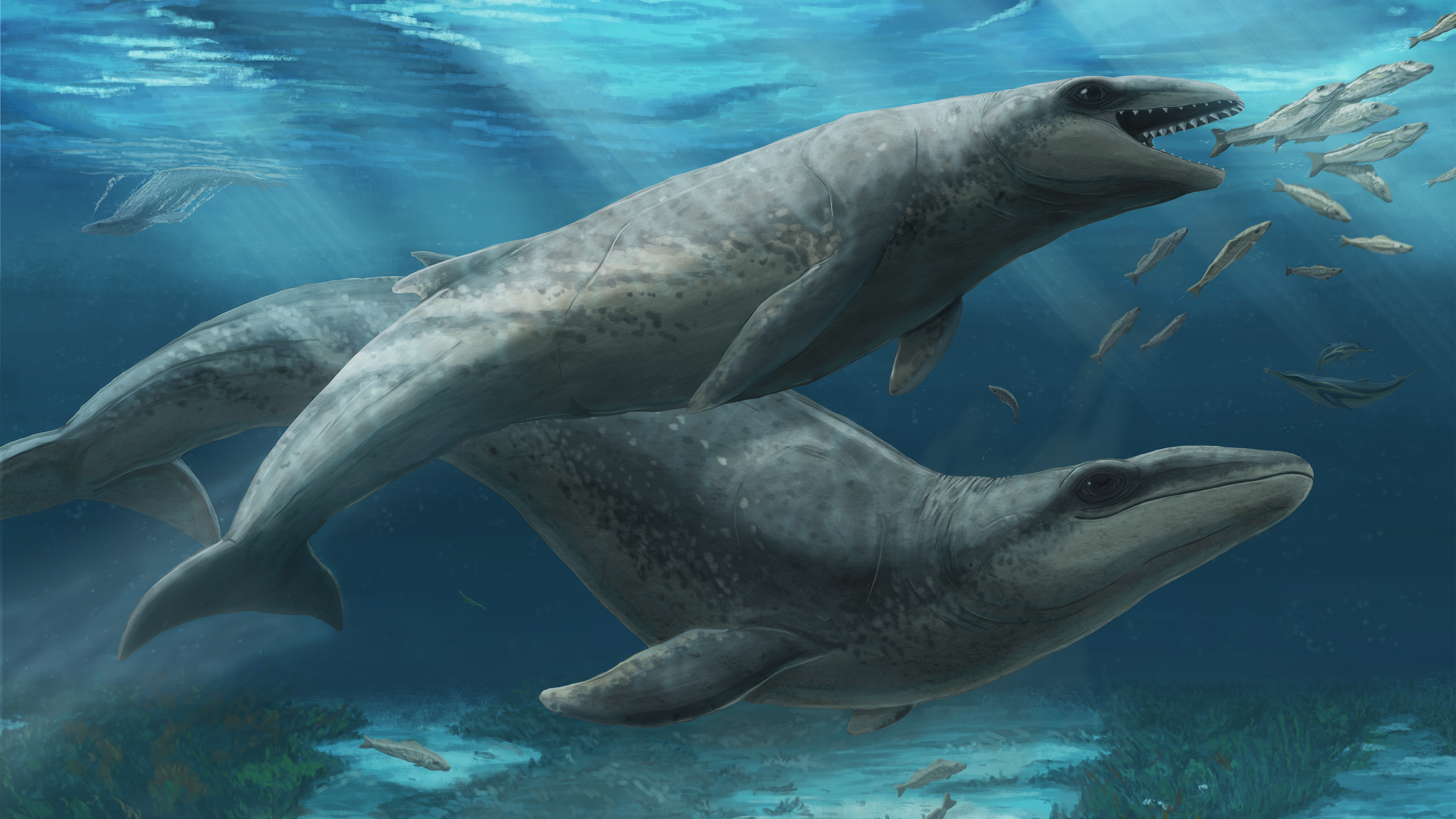
An illustration of a Janjucetus dullardi calf and mother in shallow waters off Australia 26 million years ago.

The newly described Janjucetus dullardi is known from juvenile remains. This illustration depicts a J. dullardi calf with its mother. (Image credit: Artwork by Ruairidh Duncan. Source: Museums Victoria)

Scientists have discovered a “deceptively cute” ancient whale with large eyes and razor-sharp teeth that devoured prey off Australia around 26 million years ago.

The newly discovered Janjucetus dullardi is one of the earliest known cousins of filter-feeding baleen whales, including the gigantic blue whale (Balaenoptera musculus). However, J. dullardi was much smaller than its living relatives, with a compact body built for speed.

Researchers identified this new species from pieces of skull found on the coast of southeastern Australia. The individual it belonged to was a juvenile or subadult, around 7 feet (2.1 meters) long, according to a study published Tuesday (Aug. 12) in the journal Zoological Journal of the Linnean Society.


You may like

“It’s essentially a little whale with big eyes and a mouth full of sharp, slicing teeth,” study lead author Ruairidh Duncan, a paleontology doctoral student at the Museums Victoria Research Institute and Monash University in Australia, said in a statement. “Imagine the shark-like version of a baleen whale — small and deceptively cute, but definitely not harmless.”

Related: Ancient whale ‘graveyard’ discovered under melting Russian glacier

J. dullardi belonged to a family of small whales called mammalodontids, which lived in warm, shallow waters off Australia and New Zealand during the Oligocene Epoch (33.9 million to 23 million years ago). This is not long, in evolutionary time, from when the ancient ancestors of today’s whales first returned to the ocean some 50 million years ago.

A school principal named Ross Dullard first spotted the J. dullardi fossils while walking along the beach of Half Moon Bay, near Melbourne, in 2019. The fossils were exposed at the base of a wave-eroded rock outcrop — part of a geological formation known as the Jan Juc Marl, which is between about 24 million and 28 million years old. After discovering the fossils, Dullard donated them to Museums Victoria.

Get the world’s most fascinating discoveries delivered straight to your inbox.

“This kind of public discovery and its reporting to the museum is vital,” senior study author Erich Fitzgerald, a senior curator of vertebrate paleontology at the Museums Victoria Research Institute, said in the statement. “Ross’ discovery has unlocked an entire chapter of whale evolution we’ve never seen before. It’s a reminder that world-changing fossils can be found in your own backyard.”

Illustrations of the three mammalodontid species discovered in Victoria, southeastern Australia.

Scientists have named three mammalodontid species from fossils discovered in Victoria, southeastern Australia. (Image credit: Artwork by Ruairidh Duncan. Source: Museums Victoria)

Researchers used photography, microCT scans and other techniques to perform a detailed analysis of the fossils, which included preserved teeth and inner ear structures. The team deduced that J. dullardi was a previously unknown species of mammalodontid and named it after Dullard. One of the reasons researchers could tell it was a young whale was because of a lack of wear on the teeth.

Southeastern Australia has become a hotspot for ancient whale fossils, with two other mammalodontid species recovered from the Jan Juc Marl formation. Researchers continue to find fossils in this region and expect more discoveries in the years ahead, according to the statement.

“This region was once a cradle for some of the most unusual whales in history, and we’re only just beginning to uncover their stories,” Fitzgerald said.

Source link

Share. Facebook Twitter Pinterest LinkedIn Tumblr Email
Previous ArticleArmenia, Azerbaijan defy Iran and Russia over U.S.-brokered peace deal
Next Article Teacher accused of killing parents on hike pleads not guilty to murder charges
Editor
  • Website

Related Posts

Lifestyle

Some fungi can influence the weather ‪—‬ and now we know how they do it

April 28, 2026
Lifestyle

Neanderthals’ brains weren’t to blame for their demise, new study suggests

April 28, 2026
Lifestyle

NASA Curiosity rover uncovers rock with 7 new organic molecules on Mars

April 27, 2026
Add A Comment

Comments are closed.

Categories
  • Entertainment
  • Lifestyle
  • News
  • Sports
  • Tech
  • Travel
Recent Posts
  • Some fungi can influence the weather ‪—‬ and now we know how they do it
  • Neanderthals’ brains weren’t to blame for their demise, new study suggests
  • NASA Curiosity rover uncovers rock with 7 new organic molecules on Mars
  • Mystery of golden orb found in depths of ocean off Alaska finally solved: ‘Everyone was like, What the heck? What is that?’
  • How everything you do is being monitored in an AI-fuelled ‘surveillance capitalism system’ that’s ramping up aggressively
calendar
April 2026
M T W T F S S
 12345
6789101112
13141516171819
20212223242526
27282930  
« Mar    
Recent Posts
  • Some fungi can influence the weather ‪—‬ and now we know how they do it
  • Neanderthals’ brains weren’t to blame for their demise, new study suggests
  • NASA Curiosity rover uncovers rock with 7 new organic molecules on Mars
About

Welcome to Baynard Media, your trusted source for a diverse range of news and insights. We are committed to delivering timely, reliable, and thought-provoking content that keeps you informed
and inspired

Categories
  • Entertainment
  • Lifestyle
  • News
  • Sports
  • Tech
  • Travel
Facebook X (Twitter) Pinterest WhatsApp
  • Contact Us
  • About Us
  • Privacy Policy
  • Disclaimer
  • UNSUBSCRIBE
© 2026 copyrights reserved

Type above and press Enter to search. Press Esc to cancel.