

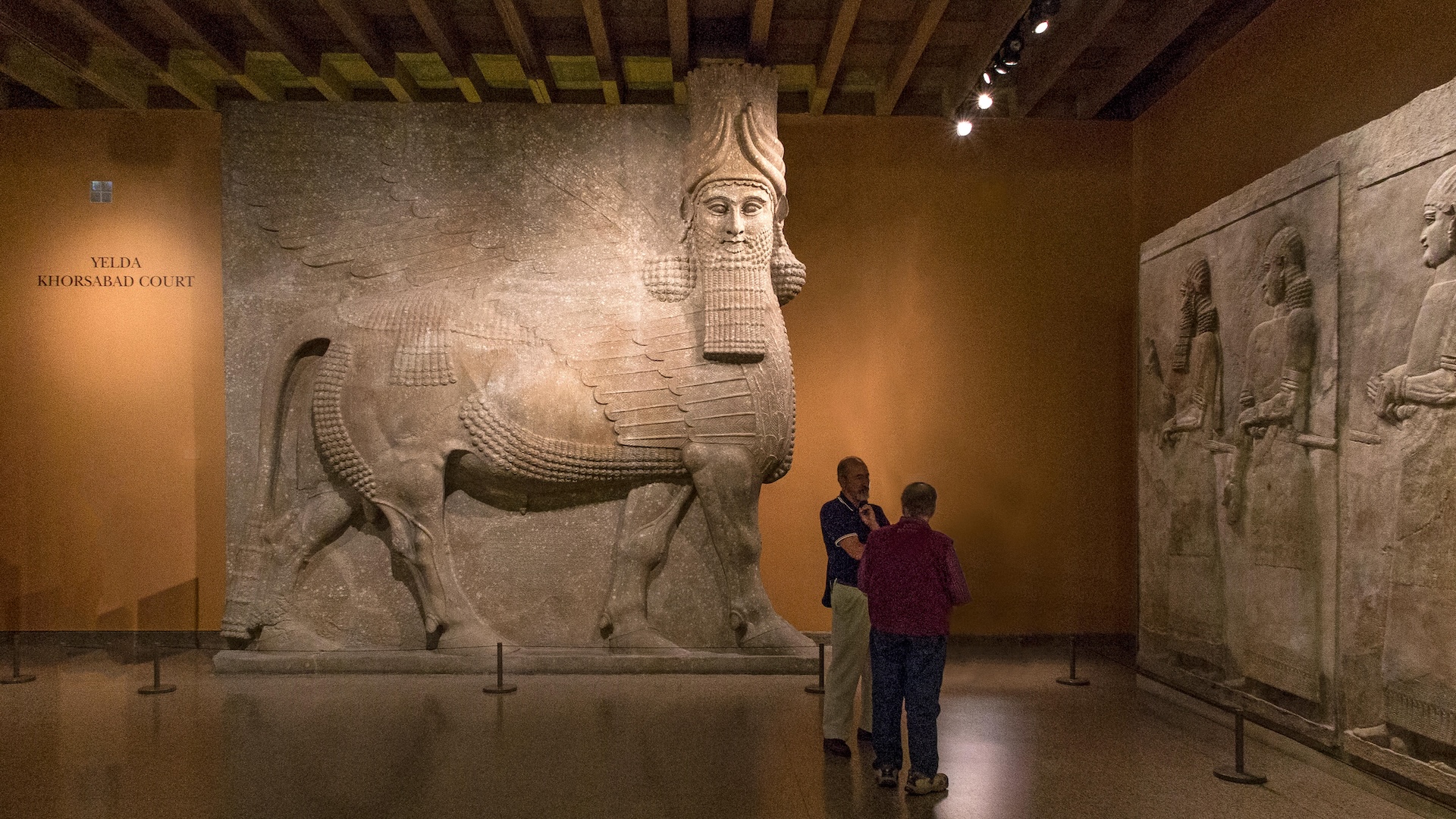
Archaeologists in northern Iraq have discovered the remains of a massive villa, royal gardens and other structures buried deep underground at what was once the ancient Assyrian capital of Khorsabad, a new magnetic survey reveals.
The international team of researchers used a magnetometer in unusually taxing conditions to detect the 2,700-year-old city’s water gate, possible palace gardens and five large buildings — including a villa with 127 rooms that is twice the size of the White House. The previously undiscovered structures challenge the notion that Khorsabad was never developed beyond a palace complex in the eighth century B.C., according to an American Geophysical Union (AGU) statement.
“All of this was found with no excavation,” Jörg Fassbinder, a geophysicist at Ludwig-Maximilians-University in Munich, first author of the research presented Dec. 9 at the AGU 2024 Annual Meeting, said in the AGU statement. The research has yet to be published in a peer-reviewed journal.
“The remote mapping work that Fassbinder and his team have done is extremely important. The magnetometer creates a more comprehensive reconstruction than traditional test trenches, and it does not cause any damage to the site,” Sarah Melville, a historian who specializes in the Neo-Assyrian Empire who was not involved in the Khorsabad survey, told Live Science in an email.
Neo-Assyrian emperor Sargon II started building his giant new capital — originally called Dur-Sharrukin, meaning “Fortress of Sargon” — in 713 B.C. But Sargon died in 705 B.C., possibly before the capital’s occupancy and completion. Sargon II’s son and successor, Sennacherib, then moved the capital to the city of Nineveh, and Khorsabad was abandoned and forgotten for over two millennia.
Related: Ancient carvings of Assyrian war scenes revealed on stone gate in Iraq damaged by Islamic State group
Over 25 centuries later, French and American archaeological missions in the 1800s and 1900s, respectively, unearthed Khorsabad’s palace, including iconic “Lamassu” statues of winged bulls with human heads that are now at the Louvre. Beyond the palace and the city’s 1.1-by-1.1 mile (1.7-by-1.7 kilometers) walls, however, the layout of the ancient capital remained a mystery, and archaeologists assumed it had been left unfinished. In 2015, Khorsabad was looted by the Islamic State, and archaeologists were able to resume work at the site only when the militant Islamist group largely withdrew from the region in 2017.
Fassbinder’s team conducted their remote sensing operation in 2022. Instead of mounting the magnetometer on a vehicle or drone, which might have attracted unwanted attention, Fassbinder and a fellow researcher hand-carried the 33-pound (15 kilogram) device back and forth over the buried capital. They worked for seven days, covering 2.79 million square feet (0.3 square kilometers) — which is still less than 10% of the site.
“Every day we discovered something new,” Fassbinder said in the statement.
“Surprisingly, the vast amount of data available on Assyrian capitals comes almost exclusively from the study of official monumental architecture — essentially, the spaces and creations associated with the king,” Daniele Morandi Bonacossi, an archaeologist from the University of Udine in Italy who specializes in the Ancient Near East and was not involved in the survey, told Live Science in an email. “Consequently, it is often impossible to gain insights into the lives of other inhabitants, or even to confirm the existence of additional residents in the Assyrian capitals.”
He noted that the new research “seeks to address this significant gap in our understanding,” by, among other things, investigating urban structures in addition to the palace complex.
Ultimately, the results of the new survey suggest that Khorsabad was a thriving capital developed far beyond what was previously hypothesized. It remains to be seen whether archaeologists will now bring the remotely detected structures to light.
