Close Menu
  • Home
  • UNSUBSCRIBE
  • News
  • Lifestyle
  • Tech
  • Entertainment
  • Sports
  • Travel
Facebook X (Twitter) WhatsApp
Trending
  • Can people catch infections from plants?
  • Andes virus spreads via ‘close contact’ — but what exactly does that mean?
  • 8-year-old African American boy from Colonial Maryland found buried with white Colonists, and it’s unclear if he was enslaved
  • Science news this week: PCOS has a new name, Neanderthals were the world’s oldest dentists, and the first nuclear bomb explosion spawned an ‘alien’ crystal
  • Newly discovered, blue-whale-size asteroid will fly super close to Earth Monday — and you can watch it live
  • Don Juan Pond: Antarctica’s salty, syrupy lake that never freezes, even when it’s minus 58 F
  • Withings ScanWatch 2 review: Style meets next-level health monitoring
  • AI Chatbots are turbo-charging violence against women and girls: We urgently need to regulate them | Yvonne McDermott Rees
Facebook X (Twitter) WhatsApp
Baynard Media
  • Home
  • UNSUBSCRIBE
  • News
  • Lifestyle
  • Tech
  • Entertainment
  • Sports
  • Travel
Baynard Media
Home»News»After several delays, NASA’s SPHEREx launches in mission to map 450 million galaxies
News

After several delays, NASA’s SPHEREx launches in mission to map 450 million galaxies

EditorBy EditorMarch 12, 2025No Comments2 Mins Read
Share Facebook Twitter Pinterest LinkedIn Tumblr Reddit Telegram Email
Share
Facebook Twitter LinkedIn Pinterest Email

A new NASA observatory launched into space Tuesday on a mission that could help scientists unravel what happened in the first fractions of a second after the Big Bang.

The SPHEREx mission (short for Spectro-Photometer for the History of the Universe, Epoch of Reionization and Ices Explorer) is designed to map the entire celestial sky, studying hundreds of millions of galaxies and piecing together how the universe formed and evolved.

The launch had been postponed several times since late February to give engineers more time to assess the rocket and its components, according to NASA, and most recently because of bad weather at the launch site.

The cone-shaped spacecraft finally lifted off Tuesday at roughly 8:10 p.m. PT atop a SpaceX Falcon 9 rocket from Vandenberg Space Force Base in California. Also along for the ride into orbit were four suitcase-sized satellites that NASA will deploy on a separate mission to study the sun.

The $488 million SPHEREx observatory will survey the whole sky four times over its two-year mission. The spacecraft’s instruments will observe the cosmos in 102 different colors, or wavelengths, which NASA has said is more than any previous mission.

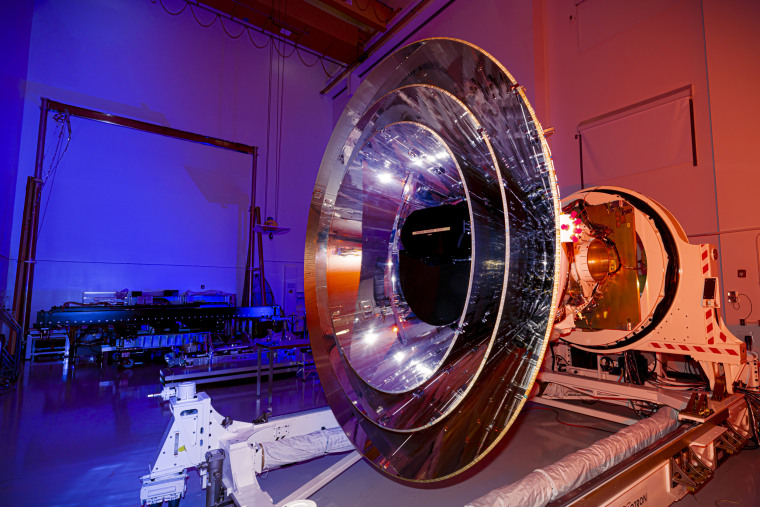
The SPHEREx.
The SPHEREx observatory in a horizontal position, allowing us to see all three layers of photon shields as well as the telescope.BAE Systems / NASA

Colors in the infrared range are essentially invisible to humans because infrared light has longer wavelengths than what the eye can see. In space, however, infrared light from stars, galaxies and other celestial objects carries key information about their composition, density, temperature and chemical makeup.

A technique known as spectroscopy allows scientists to analyze infrared light, splitting it into different colors much like how a prism can separate sunlight into a colorful rainbow. As such, data gathered by the SPHEREx observatory will give researchers insight into the chemistry and other characteristics of hundreds of millions of galaxies in the universe.

NASA said these observations could help scientists study how galaxies form, trace the origins of water in the Milky Way, and piece together what happened after the Big Bang that created the universe around 13.8 billion years ago.

Source link

Share. Facebook Twitter Pinterest LinkedIn Tumblr Email
Previous ArticleDemocrats win Minnesota state House special election, setting up shared control of the chamber
Next Article NASA’s SPHEREx, PUNCH missions launch on Falcon 9 rocket
Editor
  • Website

Related Posts

News

Omar files new financial form in response to Trump, GOP critics

April 21, 2026
News

Ex-CENTCOM commanderwarns against ‘risky’ US ground op to seize Iran uranium

April 21, 2026
News

Santa Ana’s Upcoming Report on Police Firing on ICE Protesters Lacks Details

April 21, 2026
Add A Comment

Comments are closed.

Categories
  • Entertainment
  • Lifestyle
  • News
  • Sports
  • Tech
  • Travel
Recent Posts
  • Can people catch infections from plants?
  • Andes virus spreads via ‘close contact’ — but what exactly does that mean?
  • 8-year-old African American boy from Colonial Maryland found buried with white Colonists, and it’s unclear if he was enslaved
  • Science news this week: PCOS has a new name, Neanderthals were the world’s oldest dentists, and the first nuclear bomb explosion spawned an ‘alien’ crystal
  • Newly discovered, blue-whale-size asteroid will fly super close to Earth Monday — and you can watch it live
calendar
May 2026
M T W T F S S
 123
45678910
11121314151617
18192021222324
25262728293031
« Apr    
Recent Posts
  • Can people catch infections from plants?
  • Andes virus spreads via ‘close contact’ — but what exactly does that mean?
  • 8-year-old African American boy from Colonial Maryland found buried with white Colonists, and it’s unclear if he was enslaved
About

Welcome to Baynard Media, your trusted source for a diverse range of news and insights. We are committed to delivering timely, reliable, and thought-provoking content that keeps you informed
and inspired

Categories
  • Entertainment
  • Lifestyle
  • News
  • Sports
  • Tech
  • Travel
Facebook X (Twitter) Pinterest WhatsApp
  • Contact Us
  • About Us
  • Privacy Policy
  • Disclaimer
  • UNSUBSCRIBE
© 2026 copyrights reserved

Type above and press Enter to search. Press Esc to cancel.