
At this point, the “Rethinking 94,” engagement plan for reconstructing a 10-mile urban core stretch of Interstate 94 has been going on for so long, it’s hard to remember when it began.
I heard about it early on, after the Minnesota Department of Transportation (MnDOT) opened up an office on University Avenue in St. Paul and commissioned a pair of documentaries about the highway from local public television.
It’s been a decade of surface-level public engagement since then. There were many meetings, tables set up to ask people what they thought of the freeway, where and when they drove. I recall large decals with QR codes placed on the sidewalks next to a pedestrian bridge that have since fallen apart, entropically disintegrating over the years to become adhesive abstract graffiti. During all this time, the procedural clockwork of MnDOT process ticked on, winnowing an initially wide range of options down to three almost-final choices, soon to be finalized by the agency.
One option (M-B) expands the roadway footprint, keeping the current four general purpose lanes while using the extra space to form a continuous shoulder. (The current shoulder disappears for large stretches). The second option (RF-A) reduces the freeway footprint back down to what it was pre-I35W bridge collapse, with two general lanes and one for MnPass/transit. The final option (RF-A2) is a four-lane footprint (three general plus one for MnPass/transit).
Related: MnDOT’s rethinking Interstate 94 traffic modeling and the status quo
Glancing at the agency’s website, it’s easy to see the fingers on the butcher’s scale: they prefer the third option, expansion that includes a MnPass lane. The renderings depicting congestion and framing of the facile “purpose and need” evaluation are transparent. The modeling is also misleading; I wrote two years back about how experts critique the agency’s traffic modeling process for failing to account for key chokepoints like the Lowry Hill tunnel.
Instead, this process predictably solidifies a freeway expansion while only marginally improving transit performance. I doubt it will meaningfully shift either mobility patterns or climate action in the Twin Cities, and it’s likely nobody would notice much change to their daily lives, for better or worse.
Lots of talk, little progress
This is disappointing given the grandiose ambitions of MnDOT’s 10-year effort, and the 2015 literal apology for destroying Rondo — the mostly Black community torn apart by the 1950s I-94 construction. Big ideas like “rethinking” our central freeway may result in an outcome out of the 1960s, aka an era when hockey goalies did not yet wear masks. Why bother with 10 years of ambitious drama when the results were straight out of the freeway expansion handbook?
One glaring omission from the analysis: the concept of induced demand, by now a fundamental scientific concept as proven as vaccines. Decades of research prove that automobile travel demand is quite elastic. Boosting the supply of freeway lanes does not “solve” congestion, but merely increases trips as drivers reconfigure their schedules or geography to take advantage of new capacity. In other words, expanded freeways very quickly create just as much traffic as smaller ones.
But this also means that removing capacity can reduce less necessary driving, an idea around which many engineers seem unable to wrap their heads. We should be trying to reduce single-occupancy trips through the central metro area, along the lines of policies like our ambitious VMT law. (See also: the surprising lack of traffic impact from the New York City congestion pricing policy.)
To me, the most surprising thing about MnDOT’s evaluation is instead the price tag: almost every alternative would cost around $2 billion, sometimes much more. That’s a huge sum of money to rebuild an existing urban freeway with little functional improvement, all while recommitting errors that have been scrutinized for generations. This is a literal sunk cost fallacy, and speaks to the evacuated state of American imagination. At a moment when we should be striving to decarbonize the economy, investing in electric, low-carbon mobility, we are remaking a future from the 1970s.
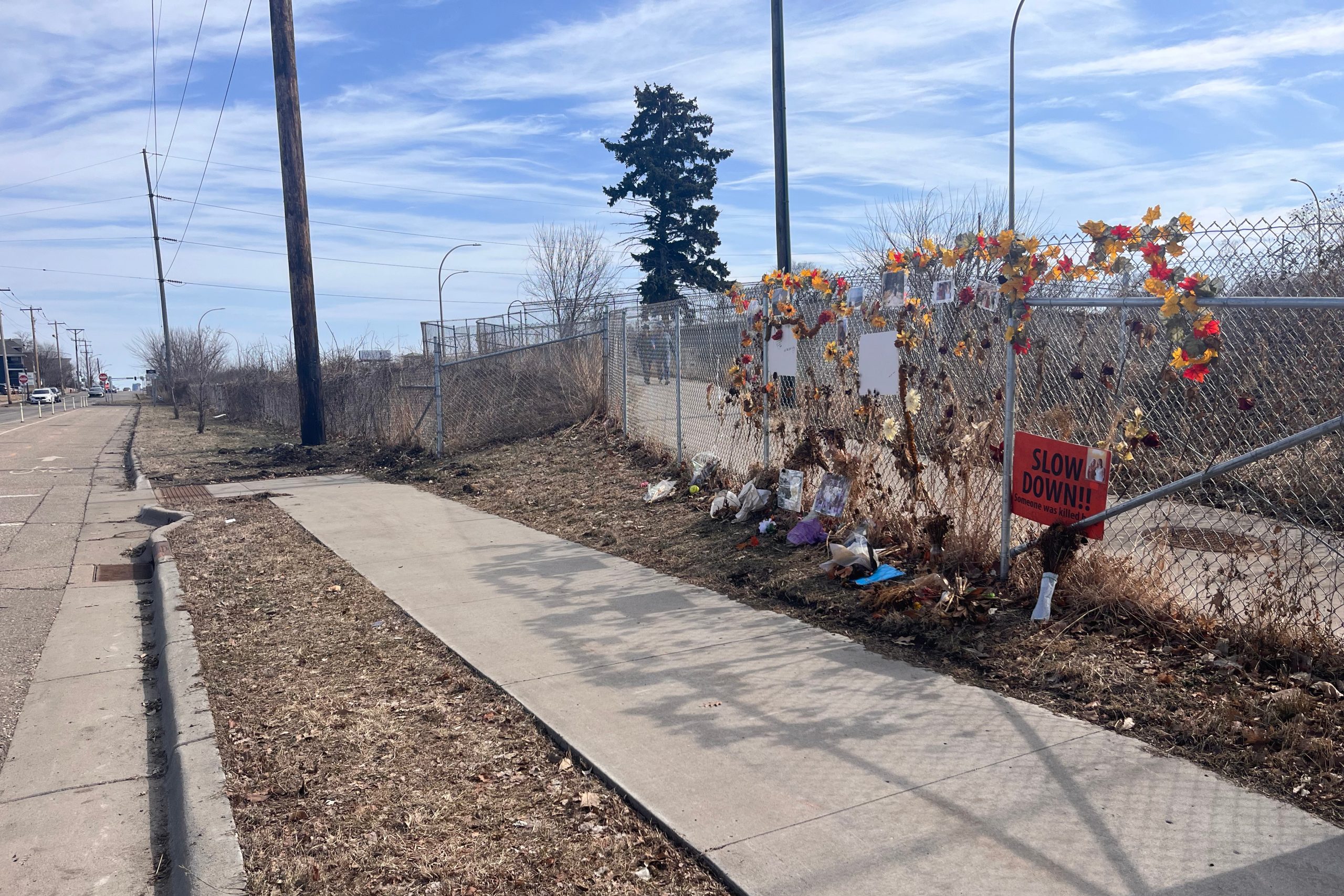
The other day I was bicycling across the freeway and happened across the memorial to Amber Deneen, a 30-year-old woman killed by a speeding Chevy Suburban driver while walking her dogs over one of the freeway’s remnant 60s-era pedestrian bridges. A large collection of artificial flowers, photographs, and handwritten messages were affixed to the bleak chain-link fence.
One of my only hopes throughout MnDOT’s whole “Rethinking 94” process was that it could be pushed to meaningfully improve, not the freeway itself, but its margins — the roads serving neighborhoods on both sides of the berms and sound walls. These are horrific streets like the one on which Deneen was killed, and reflect the parts of the city most impacted by the daily pollution and onslaught of speeding cars.
Related: Advocates push MnDOT to consider replacing I-94 with boulevard
These “frontage road” spaces are people’s front yards, vital connections for thousands. Rondo Avenue is literally one of these streets, and at the very least, any “Rethinking 94” outcome needs to dramatically improve these spaces. The state agency should ensure that these valuable parts of the city do not become subdued by the freeway and its speeding cars, and that fatal crashes next to inadequate bridges do not recur.
A predictable outcome for Interstate 94
Even though it remains a good idea, I never had hoped that MnDOT would take seriously the idea of the Twin Cities Boulevard. In the U.S., we live in an unfortunate thicket of engineering groupthink. That said, comparing “Rethinking 94” to freeway expansions in Oregon, Texas or Louisiana, it seems like a forward-thinking effort. At least it’s not proposing to demolish yet another working-class neighborhood or a BIPOC elementary school.
Look at other countries, and MnDOT is putting forward an embarrassingly backward project. The options on the table would largely perpetuate the status quo. Maybe there’s an alternate world in which meaningful change to the freeway could have taken place, say if Hillary Clinton had won the presidency, or Congress had passed Joe Biden’s Green New Deal, or his infrastructure bill did not turn out to be a fossil-fueled dud, providing very little for transit or climate action.
Of course, none of that happened, and our nation went in a different direction. Here in the Twin Cities, we will have a aging freeway to consider. Public comment on the final proposals is open until March 24, though Our Streets, a transportation advocacy group, is calling for a halt to the agency’s public process and timeline.
I’m sad to say that MnDOT did not “rethink” I-94. What we have before us, instead, is a recapitulation of the 20th century, a predictable political outcome in of a society that could use a change of habit.
