
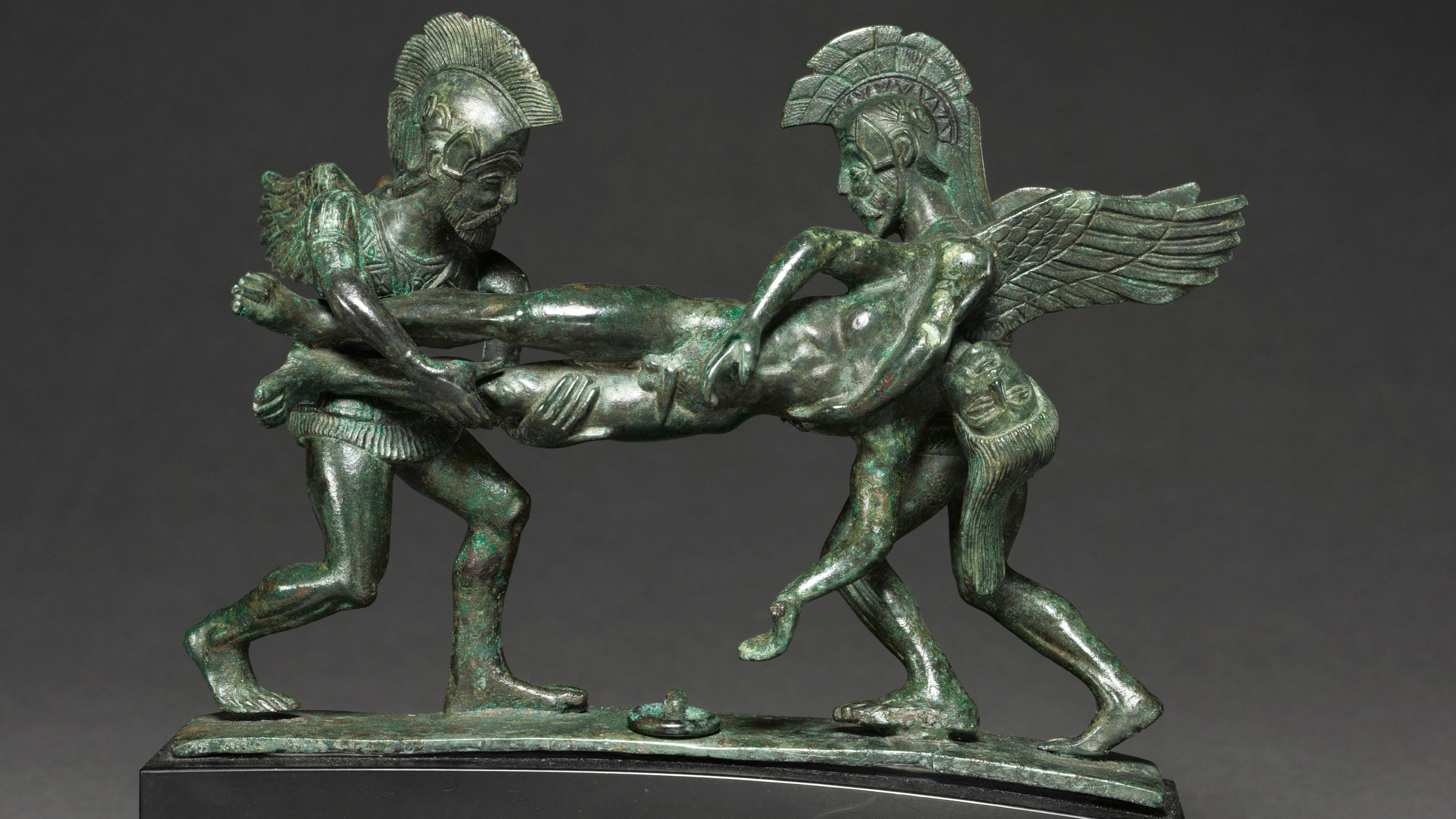
QUICK FACTS
Name: Sleep and Death cista handle
What it is: A bronze decoration on a lidded box
Where it is from: Italy
When it was made: 400 to 375 B.C.
Homer’s “Iliad” and “Odyssey” have inspired countless books, movies and works of art in the nearly three millennia since the epic tales were first written. This small, bronze sculpture, once attached to an ancient box, shows how the Greek epics influenced the aesthetics of the enigmatic Etruscans.
The Sleep and Death cista handle, which is in the collection of the Cleveland Museum of Art, features a set of bronze figurines welded to form a decorative handle for a cista — a small, cylindrical, lidded box used for a variety of purposes in ancient Egypt, Greece, Rome and Etruria, an ancient region in central Italy.
The handle is roughly 7.3 inches long and 7.2 inches tall (18.5 by 18.3 centimeters). The figurines represent Hypnos (the Greek god of sleep) and Thanatos (the Greek god of nonviolent death) bending to lift the body of Sarpedon, one of Zeus’ sons who fought in the legendary Trojan War.
Sarpedon fought on the side of Troy, leading his men into battle against the formidable Greeks, according to Book XVI of the “Iliad.” The Greek hero Patroclus entered the fray wearing Achilles’ armor to trick the Trojans into thinking the greatest Greek warrior had joined the fight and scare off the Trojans. Sarpedon met Patroclus on the battlefield, and even though Zeus wanted to save his son, Sarpedon was mortally wounded. The Greeks stripped Sarpedon’s body of his armor, but Zeus commanded Apollo to retrieve the corpse and deliver it to twin brothers Hypnos and Thanatos, “who bear men swiftly away” (translation by A. S. Kline).
The ancient sculptor of this piece “succeeded brilliantly in capturing the pathos and emotion in a scene from Homer’s ‘Iliad,'” Michael Bennett, former curator of Greek and Roman art at the Cleveland Museum of Art, said in a video. And on a technical level, the piece is much more detailed than a typical Etruscan handle; this one appears to be almost ergonomically designed, as Sarpedon’s limply falling hair can be used as a finger grip, according to Bennett.
But the reason the Etruscans adapted the visual aesthetic of Homeric epic to many of their artworks, such as sculptures and wall paintings, is still unclear.
Because the Etruscan language is only partly understood, most information about this civilization, which arose around 900 B.C., comes from outside sources, such as the Greek historian Herodotus, who was writing several centuries later. Herodotus believed the Etruscans came from Lydia in Asia Minor, not too far south of Troy. Coupled with the later legend that Aeneas, a Trojan hero, wandered to Italy after the war and helped found Rome, some experts, such as linguist Robert Beekes, believe the Etruscans may derive from the Trojans or groups that fought on the Trojan side. However, a 2021 genetic study found the Etruscans may have been local.
Get the world’s most fascinating discoveries delivered straight to your inbox.
The Etruscans may have used scenes from the Trojan War to decorate their vases and bronze boxes because they felt kinship with the antagonists in the “Iliad.” But they also might have adopted the aesthetics because the Trojan War was a popular theme in Greek art at the time, and vases and other works decorated in this style reached the Etruscans through extensive trade networks. The Etruscans then put their own spin on the stories of the Trojan War, focusing in particular on scenes of death and brutality, classical archaeologist Larissa Bonfante argued in “Etruscan Myths” (2006, British Museum Press).
For more stunning archaeological discoveries, check out our Astonishing Artifacts archives.


The Gessel gold hoard is among the largest treasures ever discovered in prehistoric Europe but has only three pieces of jewelry in it.
Can you put together last week’s Astonishing Artifact?
TOPICS
