
About 2,000 years ago in the far North of Scotland, a woman was buried after her brain was scooped out and her bones were whittled into tools, a new analysis reveals.
The highly unusual burial is giving archaeologists new insight into social networks and funeral traditions in prehistoric Britain.
Archaeologists excavated a low stone burial cairn near Loch Borralie, a lake in northern Scotland, in 2000 after locals reported discovering human bones that had been dislodged from the soil by rabbits. The rectangular cairn, or pile of stones, included the partial skeletons of an adult and a teenager, both of whom were buried between the first century B.C. and the first century A.D., during the Iron Age.
While the original report suggested the Loch Borralie corpses had been scratched and gnawed by rats or dogs, a new study, published Wednesday (June 10) in the journal Antiquity, reveals that some of the bones were purposefully modified by humans in a funeral ritual that may have involved the veneration of an important ancestor — and cannibalism.
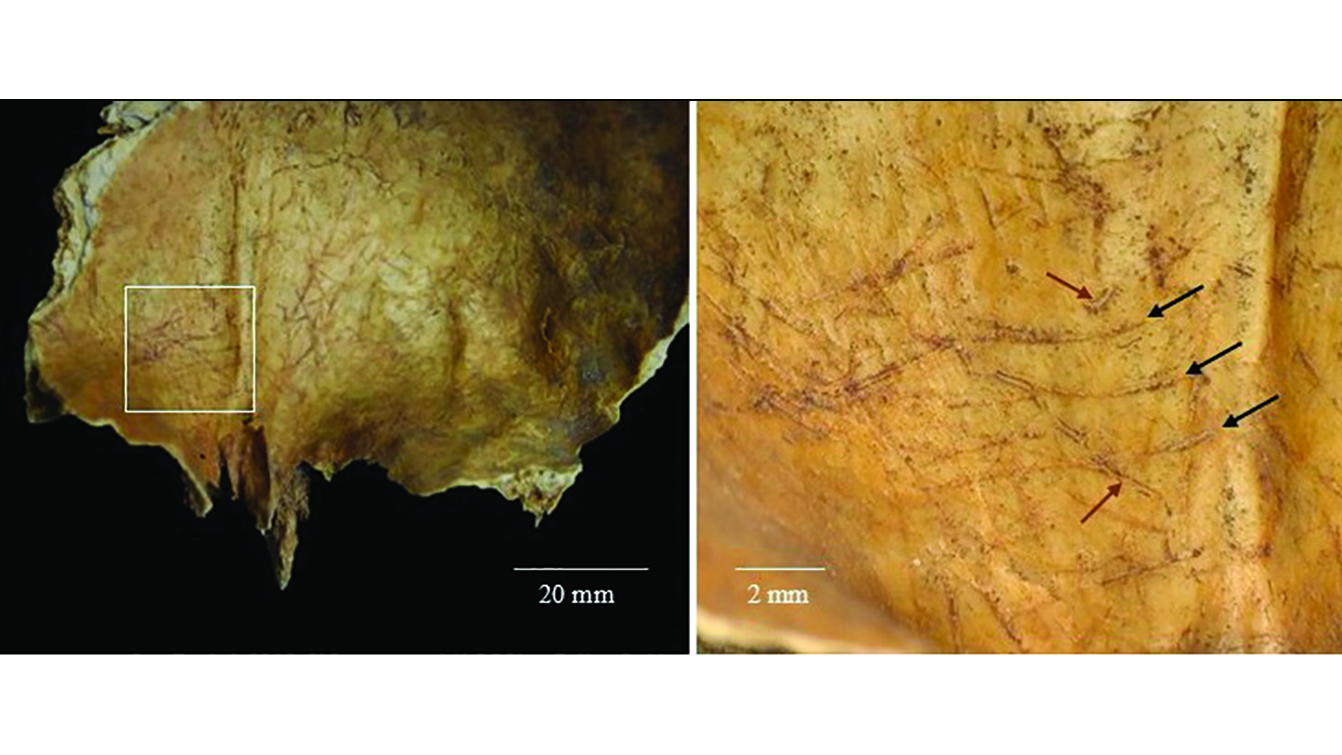
Researchers found that the adult skeleton, named “Individual 1,” was from a woman who was over 30 years old when she died. The base of her skull had an unusual fracture, and there were incisions made by a sharp tool on the inside of her skull.
“Taken together, breakage of the cranial base and internal cutmarks are suggestive of deliberate removal of the brain soon after the death of this individual,” the researchers wrote in the study. Removal of the brain could relate to cannibalism or could have resulted from an attempt to clean and preserve the skull for display, they noted.

Several arm and leg bones had been whittled into tools and then replaced in anatomical position in the grave.
(Image credit: Castells Navarro et al. / Antiquity Publications Ltd.)
The archaeologists also noticed that four of the woman’s bones — three arm bones and one leg bone — were damaged but had not been scavenged on by animals. The bones’ “internal layers have been whittled/worked to a sharp edge and a singular pointed end,” the researchers wrote.
Get the world’s most fascinating discoveries delivered straight to your inbox.
Although the bones had clearly been modified after the woman’s death, someone took care to put them back in her grave in their correct anatomical positions.
“The motivation behind the extensive manipulation of the skeletal remains of Individual 1 is very difficult to interpret,” study first author Laura Castells Navarro, an archaeologist at the University of York in the U.K., said in a statement. “However, the care with which she was reassembled and deposited in the cairn possibly suggests she commanded a level of reverence and respect by her community.”

A map of the original excavations at Loch Borralie, showing where the two skeletons were discovered.
(Image credit: Castells Navarro et al. / Antiquity Publications Ltd.)
The other skeleton in the burial cairn, Individual 2, was a boy who was about 15 years old when he died. His skull and bones were not manipulated in any way, but the analysis of ancient DNA from both skeletons showed that the individuals may have been second cousins (sharing a pair of great-grandparents).
The DNA analysis also revealed distant genetic connections between the two Loch Borralie skeletons and people buried at other prehistoric Scottish sites, including the remote Orkney Islands. Although this part of Britain is sparsely populated today, the abundance of prehistoric tombs in the area spanning nearly four millennia suggests people in ancient Scotland had complex social networks that they maintained over long distances.
“More broadly, our research shows that prehistoric maritime communities periodically moved around the north coast and Northern Isles of Scotland, possibly in small groups,” Castells Navarro said.
Castells Navarro, L., Metz, S., Bleasdale, M., Evans, J., Legge, M., Büster, L., Reich, D., Armit, I. (2026). Reconnecting the dead in Iron Age Britain: funerary processing and long-distance connectivity at Loch Borralie, Scotland. Antiquity 100(412). https://doi.org/10.15184/aqy.2026.10353
What do you know about the Empire’s conquest of the British Isles? Find out with our Roman Britain quiz!
