
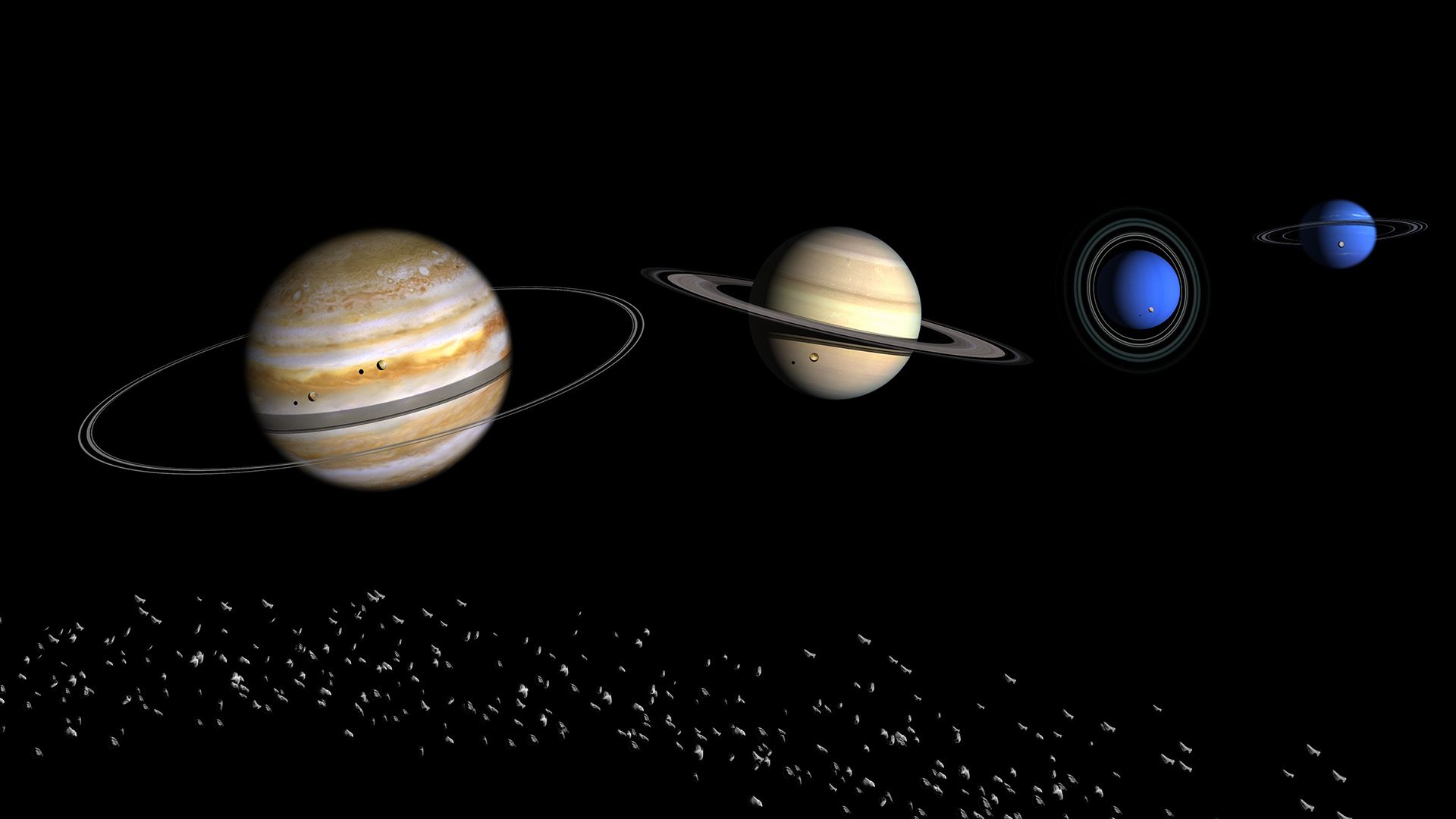
Something doesn’t quite add up about the orbits of our solar system’s eight planets and their hundreds of moons, a new study hints.
According to the research — which compared more than 100 simulations of our cosmic neighborhood’s early history — there may have once been two extra giant planets careening around the outer solar system, helping to reshape the orbits of the other planets before ultimately being kicked out into interstellar space.
This migration, first proposed in 2005 by astronomers in Nice, France, as a part of the “Nice Model,” likely started due to extra-close encounters between the planets and leftover planetary building blocks called planetesimals. Additionally, modifications proposed in 2011 suggested there may have been a fifth giant planet whose gravitational encounters with its neighbors ultimately tossed it out of our cosmic neighborhood.
However, astronomers don’t know much about this missing planet. To find out more, the new study “systematically tested the effects of giant-planet close encounters on the orbital stability of their satellites,” Matthew Clement, a research scientist at the Johns Hopkins University Applied Physics Laboratory and the study’s first author, told Live Science in an email.
Replaying cosmic history
For their analysis, the researchers turned to computer models of the early outer solar system. Each model tracked the trajectories of the giant planets and a thousand planetesimals over 20 million years.
From a previously constructed database of 100,000 of these models, the team identified a smaller subset of 122 simulations with final configurations broadly similar to those of the present-day giant planets. Roughly two-fifths of this subset’s simulations started with five giant planets, while the remaining began with six. Then, the team “‘re-played’ these encounter sequences with the giant planets satellites in place,” Clement said.
Get the world’s most fascinating discoveries delivered straight to your inbox.

A composite image of Jupiter and its four largest moons. From top to bottom: Io, Europa, Ganymede and Callisto.
(Image credit: NASA/JPL/DL)
The simulations showed that the extra giant planet (or planets) ping-ponged among their neighbors, before finally being kicked out of the system. But the simulations also revealed an unexpected result: Jupiter’s moons remained stable mostly in the simulations with two extra ice giants, while Uranus’ moons remained stable in those with just one extra giant planet. In other words, Jupiter’s and Uranus’ moons appear to have been preserved in separate events — an outcome the researchers found surprising.
The scientists noted that three of Jupiter’s big moons — Io, Europa and Ganymede — exist today in an intricate resonance of 1:2:4. In other words, Io completes four orbits of Jupiter for every two of Europa and one of Ganymede. Such a delicately balanced dance suggests that Jupiter’s moons have remained largely untouched since they formed and thus favors the existence of two extra ice giant planets, the researchers said.
Planet ping-pong
While ping-ponging between the gas giants and Uranus, these supplemental planets likely destabilized Uranus’ moons, causing them to collide. Such collisions would have at least partially fragmented the moons and vaporized volatile materials like ice, which later accumulated on the remnants, possibly explaining why Uranus’ moon Miranda has 50% more ice than the planet’s other moons, the researchers suggested.
But this isn’t the only possibility. Two simulations yielded a scenario resembling the present-day solar system, in which both Jupiter’s and Uranus’ satellites survived the same instability. In those cases, only one extra ice giant planet was involved. Therefore, further simulations will be needed to discern whether there was one extra ice giant or two, the researchers said in the study.
Little can be inferred about the now-missing planets, except for their masses. In the five-giant-planet scenarios, the one extra planet had a mass similar to that of Neptune, while in the six-planet cases, the two extra planets had masses between those of Earth and Neptune, making them “super-Earths.”
“Given that the masses are not too different from Uranus and Neptune, [the long-lost planets’] physical properties probably resembled those planets,” study co-author Nathan Kaib, a senior scientist at the Planetary Science Institute in Tucson, Arizona, told Live Science by email.
Although the researchers aren’t planning to actively research the fugitive planets, they will continue studying Uranus’ moons to identify signatures that show they were disrupted and to determine “the actual consequences of what happens if the satellites do go unstable,” Clement said.
The team’s research was published online March 25 in the journal Icarus.
See how well you know our planetary neighborhood with our solar system quiz!
