Close Menu
  • Home
  • UNSUBSCRIBE
  • News
  • Lifestyle
  • Tech
  • Entertainment
  • Sports
  • Travel
Facebook X (Twitter) WhatsApp
Trending
  • Eruption blows hole in sun’s atmosphere, unleashing solar flare and potentially triggering northern lights
  • ‘A combination of amazement and horror’: Hitchhiker fish hide in manta ray buttholes
  • Hantavirus-carrying rodents are expected to expand their range, climate models find
  • Physicists find evidence that the universe isn’t perfectly uniform, potentially unraveling 100-year-old model of cosmology
  • Once-in-a-century ‘super’ El Niño in the cards as ocean temperatures reach near record highs in April
  • Goodbye PCOS: Polycystic ovary syndrome is getting a new name that doctors say better reflects the underlying disease
  • Microplastics absorb heat in the atmosphere and contribute to global warming — as if they weren’t bad enough
  • ‘Insect apocalypse’ is already fueling malnutrition in some regions, first-of-its-kind study reveals
Facebook X (Twitter) WhatsApp
Baynard Media
  • Home
  • UNSUBSCRIBE
  • News
  • Lifestyle
  • Tech
  • Entertainment
  • Sports
  • Travel
Baynard Media
Home»Lifestyle»Eruption blows hole in sun’s atmosphere, unleashing solar flare and potentially triggering northern lights
Lifestyle

Eruption blows hole in sun’s atmosphere, unleashing solar flare and potentially triggering northern lights

EditorBy EditorMay 13, 2026No Comments3 Mins Read
Share Facebook Twitter Pinterest LinkedIn Tumblr Reddit Telegram Email
Share
Facebook Twitter LinkedIn Pinterest Email

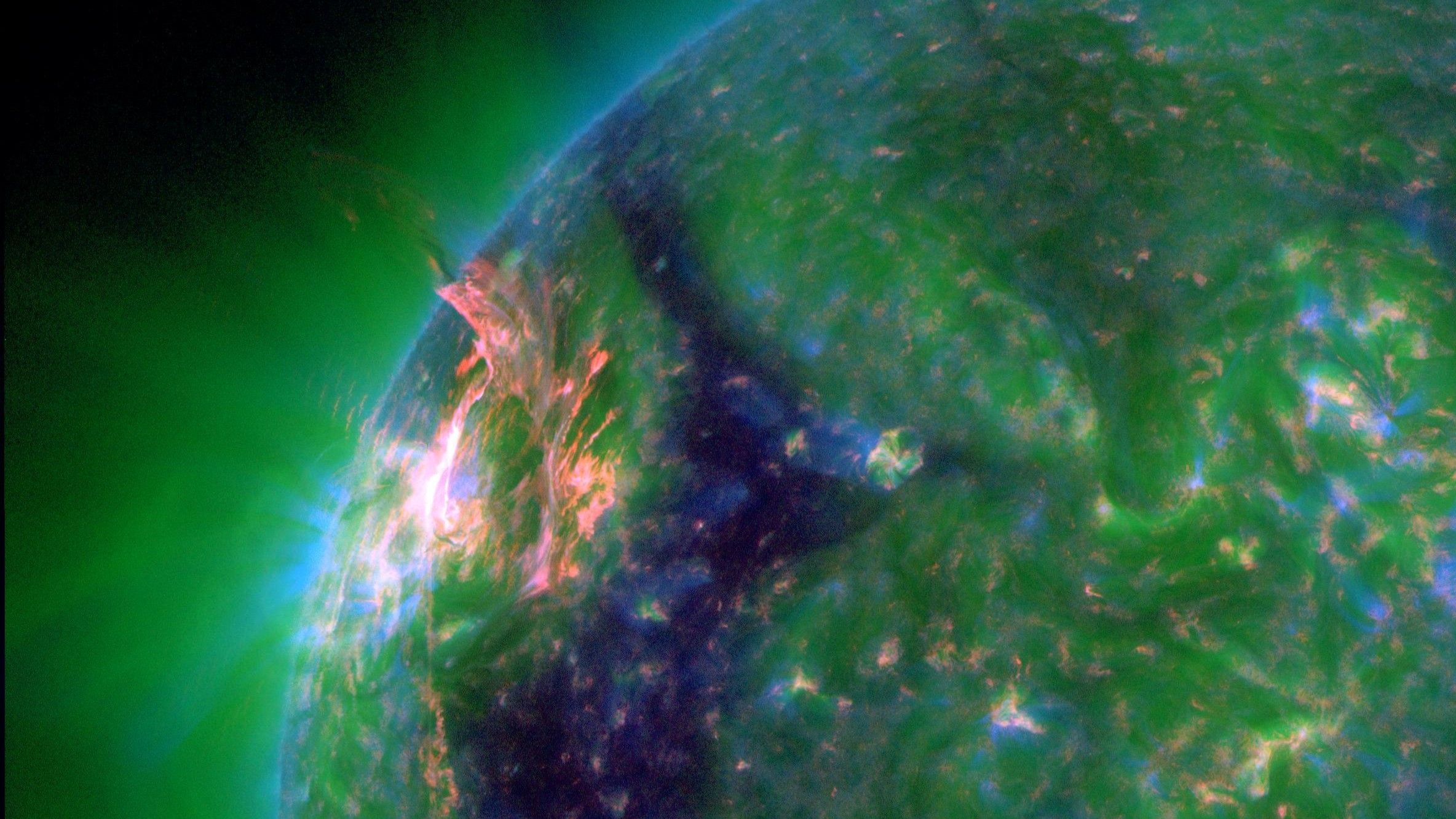
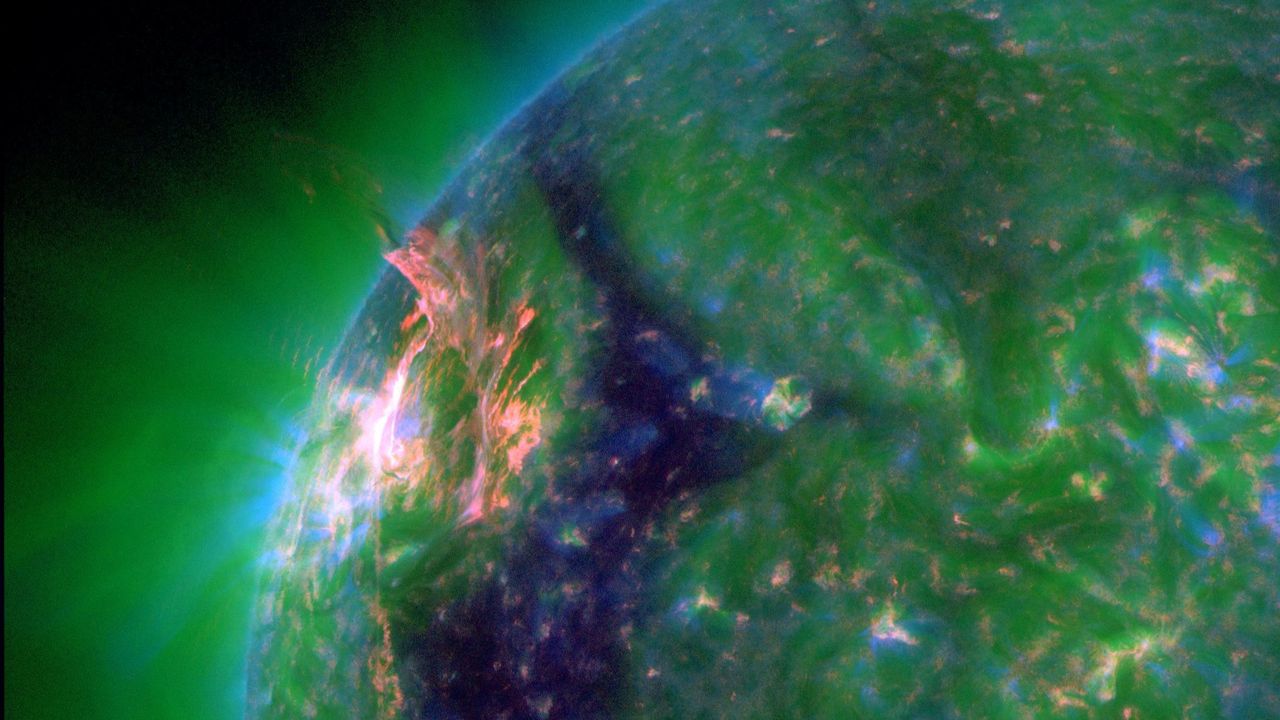
A solar eruption has blown a massive hole in the sun’s atmosphere, causing temporary radio blackouts and possibly triggering a northern lights display tomorrow.

Scientists recorded an M5.7-class solar flare on Sunday (May 10), which briefly disrupted high-frequency radio communications on the sunlit side of our planet, according to the National Oceanic and Atmospheric Administration’s (NOAA) Space Weather Prediction Center. M-class solar flares are the second strongest category of solar eruption, after X-class flares.

Solar flares are sudden bursts of electromagnetic radiation ejected from the sun. This energy travels at the speed of light, so by the time scientists observe them, they’re already here. Earth’s atmosphere and magnetic field protect us from the flares’ harmful radiation, but they can disrupt radio communications traveling through the upper atmosphere, as well as satellites and spacecraft, according to NASA.


You may like

The eruption also produced a coronal mass ejection (CME) — a slower-moving cloud of solar plasma and radiation — that can trigger geomagnetic storms and aurora displays. There’s no guarantee that the CME will hit Earth, but we could take a glancing blow, according to the Space Weather Prediction Center.

“Modeling of the resulting CME indicates that a bulk of the material should pass well behind Earth’s orbit,” a spokesperson for the Space Weather Prediction Center wrote in an update published Monday (May 11). “That being said, a glancing blow and or shock arrival by late on 12 May into the early portions of the 13th … can not be ruled out.”

Will there be auroras?

A glancing blow could produce a minor G1 geomagnetic storm, according to the U.K.’s Met Office. The geomagnetic storm scale ranges from G1 to G5, with G5 being the most severe. However, G1 storms can still result in visible auroras in places like northern Michigan and Maine, weak power grid fluctuations and minor impacts on satellite operations and migratory animals, according to the Space Weather Prediction Center.

Our sun has been very active in recent years after reaching solar maximum — the peak of the sun’s roughly 11-year activity cycle. The solar maximum likely ended sometime in early 2025, so solar activity is, in theory, declining. Solar flares of a 5.7 magnitude aren’t uncommon in and around a solar maximum, when there are more sunspots to unleash solar flares and CMEs.

Get the world’s most fascinating discoveries delivered straight to your inbox.

The sunspot that produced the solar flare, designated sunspot 4436, has been very active in recent days. Last week, the same sunspot ejected at least 5 CMEs while it was on the far side of the sun, Spaceweather.com reported. More explosions in the coming days could result in other CMEs striking Earth and more intense geomagnetic storms.

Auroras appear in the sky when charged particles from the sun hit Earth’s upper atmosphere, colliding with oxygen and nitrogen particles. These particles then glow different colors as they shed energy from the collision, according to NASA’s Jet Propulsion Laboratory. Oxygen gives off the greens and reds in the auroras, while nitrogen gives off the blue and purple colored light, according to NASA.

Source link

Share. Facebook Twitter Pinterest LinkedIn Tumblr Email
Previous Article‘A combination of amazement and horror’: Hitchhiker fish hide in manta ray buttholes
Editor
  • Website

Related Posts

Lifestyle

‘A combination of amazement and horror’: Hitchhiker fish hide in manta ray buttholes

May 12, 2026
Lifestyle

Hantavirus-carrying rodents are expected to expand their range, climate models find

May 12, 2026
Lifestyle

Physicists find evidence that the universe isn’t perfectly uniform, potentially unraveling 100-year-old model of cosmology

May 12, 2026
Add A Comment

Comments are closed.

Categories
  • Entertainment
  • Lifestyle
  • News
  • Sports
  • Tech
  • Travel
Recent Posts
  • Eruption blows hole in sun’s atmosphere, unleashing solar flare and potentially triggering northern lights
  • ‘A combination of amazement and horror’: Hitchhiker fish hide in manta ray buttholes
  • Hantavirus-carrying rodents are expected to expand their range, climate models find
  • Physicists find evidence that the universe isn’t perfectly uniform, potentially unraveling 100-year-old model of cosmology
  • Once-in-a-century ‘super’ El Niño in the cards as ocean temperatures reach near record highs in April
calendar
May 2026
M T W T F S S
 123
45678910
11121314151617
18192021222324
25262728293031
« Apr    
Recent Posts
  • Eruption blows hole in sun’s atmosphere, unleashing solar flare and potentially triggering northern lights
  • ‘A combination of amazement and horror’: Hitchhiker fish hide in manta ray buttholes
  • Hantavirus-carrying rodents are expected to expand their range, climate models find
About

Welcome to Baynard Media, your trusted source for a diverse range of news and insights. We are committed to delivering timely, reliable, and thought-provoking content that keeps you informed
and inspired

Categories
  • Entertainment
  • Lifestyle
  • News
  • Sports
  • Tech
  • Travel
Facebook X (Twitter) Pinterest WhatsApp
  • Contact Us
  • About Us
  • Privacy Policy
  • Disclaimer
  • UNSUBSCRIBE
© 2026 copyrights reserved

Type above and press Enter to search. Press Esc to cancel.