
WASHINGTON – The U.S. Senate was ensnared this week by President Donald Trump’s insistence that it approve a controversial voting bill above all other legislation.
While Republicans hold a majority in the Senate, they do not have the 50 votes needed to overcome Democratic opposition to the “Safeguard American Voter Eligibility (SAVE) Act.” The legislation would require everyone registering to vote to provide a document verifying their citizenship and implement strict photo ID requirements to vote.
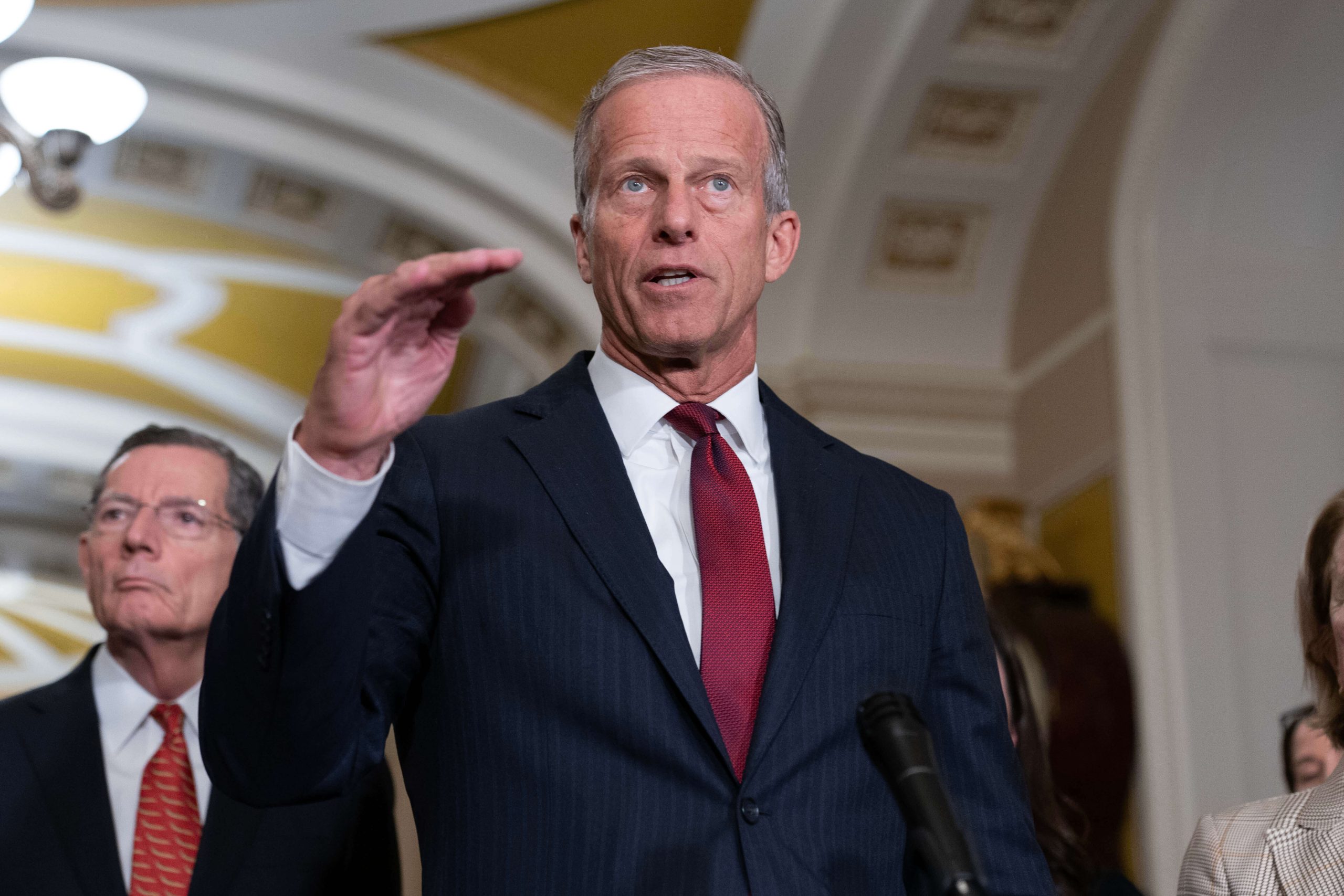
Senate Majority Leader John Thune, R-S.D., told Trump this week there isn’t enough support to pass the SAVE Act. No matter.
Trump vowed to withhold his signature from any bills that reach his desk until Congress passes the legislation.
And the president and many of his high-profile supporters, including Elon Musk, have pressured Thune to get it done.
Related: The citizenship requirement in SAVE Act has no basis in the Constitution
There was talk this week of forcing Democrats to hold a “talking filibuster,” which would force Democrats to speak continuously on the Senate floor to delay the bill. Once the Democrats ceded the floor, Republicans could pass the measure with 51 votes. Thune threw cold water on the plan.
But Republicans plan to hold marathon sessions on the bill when it comes up for consideration next week.
Trump, and his MAGA supporters, have rallied around the bill because the GOP appears to be in real trouble heading into this year’s midterms.
Not only is the U.S. House, now held by Republicans by the slimmest of margins, ripe for a Democratic takeover, but some political analysts also consider the U.S. Senate in play.
Democrats would have to flip four Senate seats to take that chamber. Polls show the GOP facing competitive Senate races not just in traditional battlegrounds such as Michigan, Maine and North Carolina, but also in conservative states like Alaska, Iowa, Ohio and even Texas.
Saying without evidence that Democratic wins in the midterms would be based on cheating and the illegal votes of undocumented immigrants, Trump told House Republicans at their retreat in Florida this week that passing the SAVE Act is critical to keeping GOP control of Congress in November.
“It will guarantee the midterms. If you don’t get it, big trouble,” he said.
According to the National Conference of State Legislatures (NCSL), Minnesota is one of about a dozen states – including Maryland, California, New Mexico, New York and Maine – that does not require proof of identification to vote.
And while the NCSL says 36 states currently have voter ID requirements to vote, state approaches vary. Just 10 states fall into the strict photo ID category, the NCSL said.
There’s evidence the voting requirements in the SAVE Act would impact Democratic voters more than Republicans, a University of Maryland study says.
The study said people of color (11%) were more likely than White voters to lack documented proof of citizenship, which is limited largely by the SAVE Act to birth certificates, U.S. passports, naturalization papers and military and certain government IDs.
The study said more males (11%) than females (8%) cannot easily access the required proof of citizenship. But there is another problem for women voters: they are more likely to change their names upon marriage or divorce and would require additional documents to show proof of that name change.
The study also said nearly 9.7 million Democrats (10%) and 7.1 million Republicans (7%) don’t have easy access to proof of citizenship as neither do about 4.6 million (14%) of people who are unaffiliated with either major party.
The Save Act cleared the U.S. House in February on a 218-213 vote. All of Minnesota’s Democratic members of Congress opposed the bill, and all of the state’s GOP lawmakers supported it. Rep. Tom Emmer, R-6th District, said the legislation is vital to stop “illegals” from voting.
“Dems are playing the same old broken record on voter suppression with the SAVE America Act, but why aren’t they screaming about photo ID’s at airports, libraries or even their own (Democratic National Convention) Emmer said in a post on X.
Dems are playing the same old broken record on voter suppression with the SAVE America Act, but why aren’t they screaming about photo IDs at airports, libraries, or even their own DNC? We passed this bill to ensure proof of citizenship & photo ID for federal elections because…
— Tom Emmer (@tomemmer) February 17, 2026
While the House has approved the SAVE Act, Trump wants them to revisit the issue, including additional provisions to the legislation the chamber has already approved, including a ban on mail-in ballots for those who aren’t disabled or in the military and a ban on transgender athletes in women’s sports.
There’s also pressure on the Senate to amend the legislation to include those new restrictions.
Meanwhile, the Department of Homeland Security continues to lack funding because Democrats in the Senate, including Sens. Amy Klobuchar and Tina Smith of Minnesota, refuse to support a budget for the agency that does not include reforms to federal immigration agencies.
Klobuchar moves on prediction markets
When the United States struck targets in Iran on Feb. 28, a trader with the name of “Magamyman” made more than $553,000 on the predictive market Polymarket, betting on the air strikes and the fate of Supreme Leader Ayatollah Ali Khamenei just before an Israeli strike killed him.
Just on Polymarket alone, half-a-billion dollars was traded over when exactly U.S. forces would drop bombs on Iran.
The nation’s leading predictive markets allow individuals to place bets on almost anything – from Oscar winners (“One Battle after Another” with Leonardo Dicaprio is favored) and the outcome of professional and college sporting events to the winner of the 2028 presidential election (Vice President JD Vance has a slight edge over California Gov. Gavin Newsom) and the date of a U.S.-Iran cease fire.
The specter of insider trading by lawmakers and government officials and the potential for corruption has prompted Sens. Amy Klobuchar, D-Minn., and Jeff Merkley, D-Ore., to introduce a bill this week called the End Prediction Market Corruption Act to prevent public officials from trading on prediction markets like Polymarket.
Klobuchar’s bill would ban members of Congress and any president and vice president from using prediction markets to bet on the outcome of events, and prohibits other senior government officials from betting on events related to their official duties.
“At the same time that prediction markets have seen huge growth, we have seen increasing reports of misconduct,” Klobuchar said in a statement. “This legislation strengthens the Commodity Futures Trading Commission’s ability to prevent those with confidential government or policy information from exploiting their access for financial gain.”
The bill instructs the Commodities Futures Trading Commission to issue new regulations on insider trading in the predictions market, but the Justice Department would enforce the new law.
The fate of the legislation is unclear. Congress has struggled for years – and failed – to pass bills that would prevent lawmakers from trading in stocks because of concerns of insider trading.
A rare bipartisan win on housing
Another bill whose future is uncertain – even as it was decisively approved by the U.S. Senate on Thursday on a bipartisan 89-10 vote – is legislation aimed at curbing housing costs.
The bill, which is supported by President Donald Trump and fellow Republicans as a centerpiece of the GOP’s “affordability” campaign, would restrict large investors from the housing market.
The bill would also provide new incentives to build new homes, launch a program to allow abandoned buildings to become housing, offer development fund grants to overhaul homes and ease regulations on mobile homes and cut other home-construction red tape.
Sen. Tina Smith, D-Minn., lauded that a bill she co-sponsored with Sen. Mike Rounds, R-S.D., called the Rural Housing Service Reform Act was included in the housing package.
The bill would expand housing opportunities in rural areas by offering new loans, grants and rental assistance and by reforming a U.S. Department of Agriculture housing program to preserve 400,000 homes in small towns and rural communities across the nation – 9,000 of them in Minnesota.
“Without a safe, affordable place to live, nothing else in your life works,” Smith said in a statement. “For the first time in decades, the Senate is taking bipartisan action to cut red tape so we can build more housing and lower costs for Americans.”
Related: Report: Substandard housing facilities for rural residents reflected in health outcomes
The legislation also includes a bill sponsored by Sen. Amy Klobuchar, D-Minn., that would establish a new grant program to fund the development by local governments of comprehensive housing policy plans.
While the housing package had strong support in the Senate, it is expected to run into trouble in the U.S. House – even though it has Trump’s backing. The House approved a housing bill last month that lacked some of the provisions in the Senate legislation.
Conservative House Republicans oppose the Senate’s inclusion of language that prevents major investors who own at least 350 single-family homes from buying more.
As a sweetener to some lawmakers, the Senate bill would also prohibit the Federal Reserve from issuing digital currency until the end of 2030. But the conservative House Freedom Caucus wants that ban to be permanent.
The housing package is also stymied by Trump’s determination that voting legislation is his top priority and reports he has said that “nobody gives a (bleep)” about housing (see item above).
ICYMI:
▪️ Matthew Blake had a story this week about Gov. Tim Walz’s ambitious plan to overhaul the state’s Medicaid program, which has been a victim of fraud, by eliminating the privatized plans run by insurance companies.
▪️ Because the Supreme Court ruled that many of President Trump’s tariffs are unconstitutional, Minnesota companies that had sued over those tariffs at the Court of International Trade are likely to receive refunds. But others may not as the Trump administration resists reimbursing companies that have not sued.
▪️ Reporter Shadi Bushra wrote that Minnesota’s winter tourism has been a victim of Operation Metro Surge as a survey shows cancellations, fewer visitors and lingering fear and uncertainty tied to the unprecedented immigration crackdown in the state.
▪️ Greater Minnesota reporter Brian Arola determined that water projects are big in the state this year, as communities seek $1 billion in water infrastructure funding.
This and that:
A reader commented on a story about the failure of congressional Democrats to approve a resolution that would limit President Donald Trump’s ability to prosecute the Iran war and GOP opposition to the resolution.
“So Minnesota Republicans want this war?,” the reader said. “Be sure to attend all the funerals of those who are killed in action and visit military hospitals to thank the wounded. Israel, a country of 10 million people, wants to defeat a country 9 times as large, so Netanyahu sweet talked Trump into this war. Trump once again lied about how he would act once elected. This is not America First.”
Please keep your comments, and any questions, coming. I’ll try my best to respond. Please contact me at aradelat@minnpost.com.
