
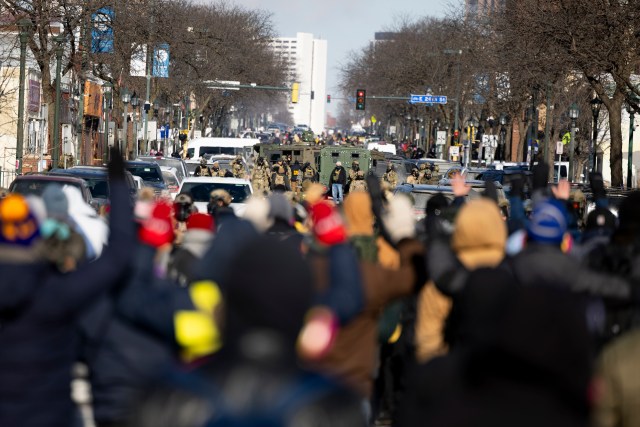

Minnesota spent the first weeks of 2026 as an American crucible. What America stands for, how it should work, and who it is for were tested in ways that drew the nation’s and the world’s attention.
As the United States marks its 250th anniversary, Minnesota has a rare opportunity. Many here have witnessed firsthand what are often abstract constitutional debates. We have seen what fights over citizenship, states’ rights, federal authority, and the First, Second, Fourth and 10th Amendments mean in lived experience. That perspective carries both insight and responsibility as the nation enters its semiquincentennial year.
Minnesotans should lean into the civic mantle this moment has thrust upon us. We can help lead conversations across our state and beyond, about America’s core promises and enduring tensions. We can share the stories that animate our love and concern for America and encourage others to do the same. As a closely divided state with a rich diversity of views and backgrounds, Minnesota is uniquely positioned to model what it looks like to engage honestly across difference.
Related: Why the ‘Streets of Minneapolis’ have echoed with public support – unlike the campus of Kent State in 1970
That engagement must reflect the full participation of our communities, including voices that have too often been left out of civic life. Democracy is strongest when more people see themselves in it.
Many of us are apprehensive about opening up a conversation on hot-button issues. That’s even more true if we expect that the person we’re talking to has a different perspective or politics than we do. Yet democracy has never depended on uniform agreement. As Hubert H. Humphrey reminded us, freedom is “hammered out on the anvil of dialogue, dissent and debate.” Dialogue is not a sign of weakness or compromise; it is the essential infrastructure of a healthy republic. Debate does not necessitate sacrificing one’s own views, but can often help us forge stronger understanding of what we believe and why.
This moment demands that we lean into questions about what we most value in the American experiment. The 250th anniversary of the Declaration of Independence is more than a symbolic milestone. The Founders understood that democracy must be a living, breathing practice. It requires habits of listening, reasoning and respectful disagreement. We do not need to reach consensus on every issue. But we do need to recommit to the norms and processes that allow a diverse people to govern ourselves.
Our state’s institutions and leaders should take this opportunity to create forums that invite people of all backgrounds and political persuasions to engage with these core democratic questions. Public universities, private colleges, libraries, faith communities, civic groups and media organizations can serve as trusted nonpartisan conveners. These are places where difficult conversations can be facilitated with care, where facts are valued, and where disagreement is handled with dignity. We should put a spotlight on Minnesota as the main stage for the most thoughtful engagement about what America is all about going forward.
But we shouldn’t simply wait for leaders, institutions or the media to create these conversations. Every person has the power within their own circles to foster this kind of dialogue. We can each share our own stories, experiences, values and perspectives. We can listen and better understand how people with different politics or life experiences view core American issues. Through that practice, we may discover shared commitments that transcend our current divides.
As we reflect on 250 years of American democracy, we must also look ahead to the next 250. The civic habits we model today will shape the inheritance we leave to the next generation. We owe young people more than celebration; we owe them examples of how to engage constructively across difference, how to think critically, and how to participate fully in civic life.
Related: Minnesota back to normal after ICE? Not exactly
The stories of what happened in Minnesota this year, and what we chose to do in response, will be told for decades to come. The question is not whether those stories will be told, but whether they will tell of a state that turned tension into learning, disagreement into dialogue, and uncertainty into renewed civic commitment.
Minnesota should be at the forefront of sharing those stories, not to claim moral authority, but to model how a diverse state can wrestle openly and responsibly with its constitutional principles. If we meet this moment with courage and humility, Minnesota can help demonstrate that democracy is not self-executing. Democracy is sustained by citizens willing to practice it. And that example may be one of the most meaningful contributions we make to America’s next chapter.
Tane Danger is co-founder of Danger Boat Productions. Nisha D. Botchwey is professor and dean of the Humphrey School of Public Affairs at the University of Minnesota.
