Close Menu
  • Home
  • UNSUBSCRIBE
  • News
  • Lifestyle
  • Tech
  • Entertainment
  • Sports
  • Travel
Facebook X (Twitter) WhatsApp
Trending
  • Are we more closely related to cats or dogs?
  • Declassified Apollo 12 images show UFOs on the moon — Space photo of the week
  • ‘More than 100 million years of evolution’: How snakes evolved and lost their legs
  • More polar bears are approaching human sites as the climate warms, and it’s not just the skinny ones
  • James Webb telescope zooms in on a black hole that could reveal the truth about ‘little red dots’
  • If humans are getting smarter, why are our brains shrinking?
  • ‘Feuding tech bros’ go head to head in legal showdown. But what does it mean for the future of AI?
  • Pregnancy quiz: Can you deliver on the science of growing babies?
Facebook X (Twitter) WhatsApp
Baynard Media
  • Home
  • UNSUBSCRIBE
  • News
  • Lifestyle
  • Tech
  • Entertainment
  • Sports
  • Travel
Baynard Media
Home»Lifestyle»Stone Age woman was buried like a man, revealing flexible gender roles 7,000 years ago in Hungary
Lifestyle

Stone Age woman was buried like a man, revealing flexible gender roles 7,000 years ago in Hungary

EditorBy EditorMarch 4, 2026No Comments3 Mins Read
Share Facebook Twitter Pinterest LinkedIn Tumblr Reddit Telegram Email
Share
Facebook Twitter LinkedIn Pinterest Email

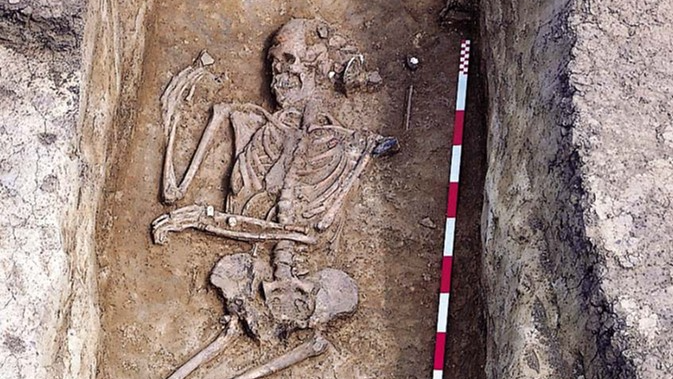
a skeleton lying partly on its right side in an excavated grave with archaeological sign and meter stick in view

A typical male burial from the Stone Age cemetery of Csőszhalom in Hungary. He is buried on his right side, with a polished stone tool near his left shoulder. (Image credit: Alexandra Anders)

A Stone Age woman buried with male-associated artifacts in what is now Hungary is revealing that her society embraced complex identities and flexible gender roles 7,000 years ago, a new study finds.

In the study, published Feb. 16 in the American Journal of Biological Anthropology, researchers analyzed 125 skeletons from two cemeteries in eastern Hungary that were in use from 5300 to 4650 B.C. Their goal was to compare traces of repeated activities found on the bones, and examine burial positions and grave goods, which together could shed light on gender roles in this Neolithic society.

The analysis focused on activity-related skeletal changes to gain insight into past people’s overall physical workload, upper-limb overuse, and toe hyperextension (which can result from a kneeling posture). While all of the Stone Age men and women had high overall physical workloads and engaged in activities involving kneeling, the researchers discovered that the male skeletons had evidence of right-sided upper-limb overuse — possibly related to throwing movements — that indicated differences in men’s and women’s use of their arms.


You may like

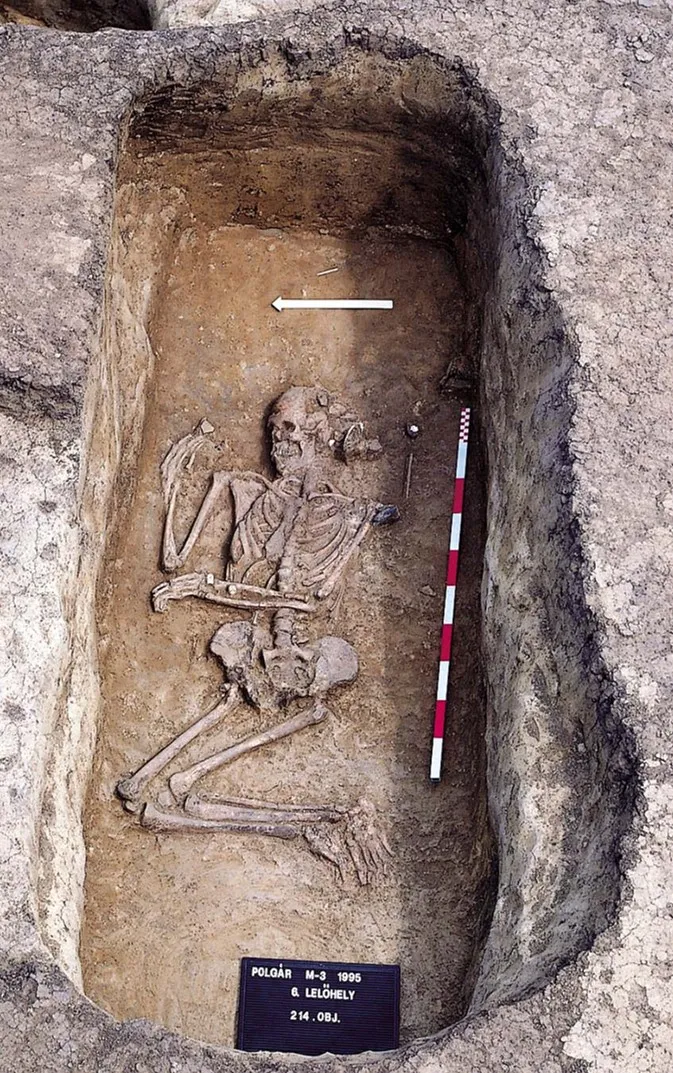
Men and women were also buried differently. In one cemetery, most female skeletons were placed on their left side and were buried with shell bead belts, while most male skeletons were found on their right side and were interred with polished stone tools. But according to the study, two male skeletons and five female skeletons were buried in ways that didn’t align with expectations, revealing that the association between biological sex and body position in death was not absolute.

One older adult female burial was particularly unusual. Hers was the only female skeleton the researchers found buried with polished stone tools, and her toes revealed a kneeling activity pattern more like that of the males in the cemetery. According to the researchers, this burial suggests that “females may have assumed roles traditionally associated with males” in the society and that gender roles “were fluid and shaped by multiple intersecting factors.”

Study first author Sébastien Villotte, a researcher at the French National Center for Scientific Research, told Live Science in an email that there is no clear evidence this woman had a unique social role, such as shaman. The other people who were buried in ways that did not align with their biological sex may have had “individual trajectories that do not fit in with an ‘ideal’ pattern,” Villotte said. “This is the period in Central Europe when people began to express previously existing gender roles in a new arena.”

Villotte, S., Szeniczey, T., Kacki, S., & Anders, A. (2026). Fixed and fluid: The two faces of gender roles—A combined study of activity patterns and burial practices in the European Neolithic. American Journal of Biological Anthropology, 189(2), e70217. https://doi.org/10.1002/ajpa.70217


Stone Age quiz: What do you know about the Paleolithic, Mesolithic and Neolithic?

Get the world’s most fascinating discoveries delivered straight to your inbox.

Source link

Share. Facebook Twitter Pinterest LinkedIn Tumblr Email
Previous ArticleBest power station deal: Save 51% on the Anker Solix F3800, the BP3800 expansion battery, and a 400W solar panel.
Next Article At the Guthrie and the Children’s Theatre, ‘play’ is onstage
Editor
  • Website

Related Posts

Lifestyle

Are we more closely related to cats or dogs?

May 11, 2026
Lifestyle

Declassified Apollo 12 images show UFOs on the moon — Space photo of the week

May 10, 2026
Lifestyle

‘More than 100 million years of evolution’: How snakes evolved and lost their legs

May 10, 2026
Add A Comment

Comments are closed.

Categories
  • Entertainment
  • Lifestyle
  • News
  • Sports
  • Tech
  • Travel
Recent Posts
  • Are we more closely related to cats or dogs?
  • Declassified Apollo 12 images show UFOs on the moon — Space photo of the week
  • ‘More than 100 million years of evolution’: How snakes evolved and lost their legs
  • More polar bears are approaching human sites as the climate warms, and it’s not just the skinny ones
  • James Webb telescope zooms in on a black hole that could reveal the truth about ‘little red dots’
calendar
May 2026
M T W T F S S
 123
45678910
11121314151617
18192021222324
25262728293031
« Apr    
Recent Posts
  • Are we more closely related to cats or dogs?
  • Declassified Apollo 12 images show UFOs on the moon — Space photo of the week
  • ‘More than 100 million years of evolution’: How snakes evolved and lost their legs
About

Welcome to Baynard Media, your trusted source for a diverse range of news and insights. We are committed to delivering timely, reliable, and thought-provoking content that keeps you informed
and inspired

Categories
  • Entertainment
  • Lifestyle
  • News
  • Sports
  • Tech
  • Travel
Facebook X (Twitter) Pinterest WhatsApp
  • Contact Us
  • About Us
  • Privacy Policy
  • Disclaimer
  • UNSUBSCRIBE
© 2026 copyrights reserved

Type above and press Enter to search. Press Esc to cancel.