
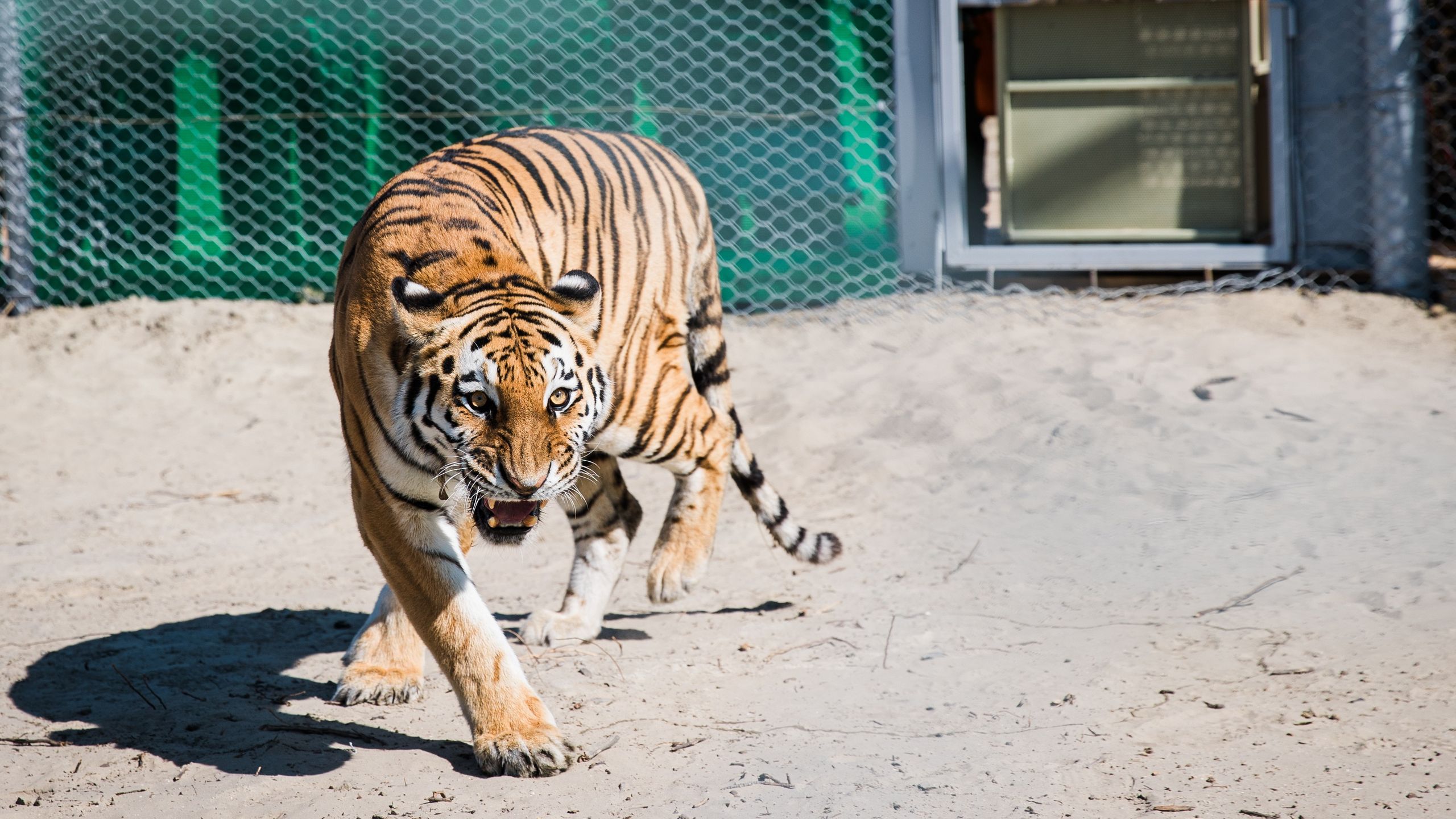
Tigers will soon roam Kazakhstan for the first time in over 70 years as conservationists undertake a gargantuan effort to restore part of their lost habitat.
The last of Kazakhstan’s Caspian tigers disappeared in the late 1940s, after years of hunting, habitat loss and declines in prey numbers. Now, the Central Asian country has an ambitious plan to reintroduce the world’s largest cats to their historic lands.
Last year, the Kazakhstan tiger reintroduction program — led by the government of Kazakhstan with support from the World Wildlife Fund (WWF) and the United Nations Development Programme — planted 37,000 seedlings and cuttings near a giant lake in southeast Kazakhstan’s South Balkhash region, where tigers used to live, according to WWF Central Asia. This adds to the 50,000 seedlings planted between 2021 to 2024.
Tree planting is a key part of Kazakhstan’s massive ongoing greening initiative. The country has planted around 1.4 billion trees since 2021, and officials say they are on track to reach 2 billion trees by 2027.
In South Balkhash, newly planted trees serve as a foundation for recovering ecosystems that sit alongside already-forested lands. The trees provide shelter and water access, as well as food for the tiger’s prey: hooved mammals (ungulates) like boar and Bukhara deer (Cervus elaphus bactrianus, also called Bactrian deer).
“Already, wild ungulates have been seen foraging on the restored sites, indicating that the ecosystem is beginning to function,” a spokesperson for WWF Central Asia told Live Science in an email. “Each planted seedling is therefore a direct contribution to the future of the tiger in Kazakhstan.”
The planting zone encompasses around 2.5 miles (4 kilometers) of shoreline along Lake Balkhash, which covers roughly 6,500 square miles (17,000 square km) and is the largest lake in Central Asia and the 15th-largest lake in the world. The new vegetation — which includes 30,000 narrow-leaf oleaster seedlings, 5,000 willow cuttings and 2,000 turanga poplar seedlings — creates growing “islands” of forest that regulate the flow of water to stabilize floods and overflows.

WWF Central Asia attributes the increase in planting in 2025 to the accumulated experience of the staff, as well as to factors like improved planting techniques and expanded partnerships. However, the pace of the ecosystem’s recovery and its suitability for tigers will depend on a variety of factors, including the climate, stability of water resources, and growth of vegetation.
Bringing back tigers
The tigers that used to live in Kazakhstan were part of a now-extinct Central Asian population known as Caspian tigers. However, the living Amur tigers found in the Russian Far East and China (and potentially North Korea) can serve as suitable replacements. A 2009 study published in the journal PLOS One found that Caspian and Amur tigers were likely part of the same population until human activity forced them apart in the 19th century, meaning they’re essentially the same animal.
The reintroduction program welcomed two captive Amur tigers in 2024, and they appear to have adapted well to life in Kazakhstan. These tigers, a female named Bodhana and a male named Kuma, came from an animal sanctuary in the Netherlands in 2024 and are currently living in an enclosure within the Ile-Balkhash Nature Reserve. Bodhana and Kuma are used to life in captivity, so they’ll never be released, but the hope is that their offspring will form part of a new founder population of Kazakhstan tigers.
However, as there’s no guarantee that Bodhana and Kuma will breed or produce suitable offspring, so the bulk of the new population will be made up of wild tigers imported from Russia.
Kazakhstan officials are expecting to receive the first tigers from Russia in the coming months. WWF Central Asia told Live Science that it hasn’t been confirmed where the Russian tigers are coming from, but “based on publicly available information and recent media reports, it is understood that the Amur tigers expected in the first half of 2026 are from the wild.”
Reintroducing large predators is a delicate and risky process, particularly when those predators are capable of harming humans and livestock. But it can be done; a 2024 study published in The Journal of Wildlife Management found that a tiger reintroduction attempt in Russia was largely a success. Researchers cared for six orphaned wild cubs and prepared them for re-release into their natural habitat. The tigers caught their own prey and survived.
However, the study noted that one rehabilitated tiger killed multiple domestic animals, including more than 13 goats in a single event, and failed to demonstrate adequate fear of humans. That tiger was subsequently recaptured and placed in a zoo.
WWF Central Asia said Kazakhstan’s program is prepared to resolve any incidents that involve human conflict with its released tigers. Measures include creating a special team that will continuously track released individuals and respond to any potential human-wildlife conflicts.
“The group’s main tasks include regular patrols, monitoring tiger movements via satellite collars, early detection of potential approaches to settlements, and rapid response measures,” the WWF Central Asia spokesperson said.
The program is also working with local communities to raise awareness about tigers and how to behave in their presence, as well as promoting sustainable development in those communities by offering grants for agriculture and ecotourism, according to WWF Central Asia.
“All of this forms part of a long-term strategy for peaceful coexistence between people and predators,” the spokesperson said. “A compensation scheme for local residents is also planned in cases where tigers cause livestock losses.”
