Close Menu
  • Home
  • UNSUBSCRIBE
  • News
  • Lifestyle
  • Tech
  • Entertainment
  • Sports
  • Travel
Facebook X (Twitter) WhatsApp
Trending
  • Weapons of the world quiz: Can you identify these historical objects of war?
  • ‘The detectors never stopped beeping!’ Nearly 3,000 coins discovered in field are Norway’s largest Viking hoard on record
  • ‘We can no longer ignore diseases in the deep human past’: Malaria influenced early humans’ migrations across Africa, study suggests
  • Used SpaceX rocket stage could hit the moon’s Einstein crater this summer, report finds
  • Does Wegovy carry a risk of ‘eye stroke’ and vision loss? Here’s what the data says.
  • Heartbeats physically stop cardiac cancer from growing — hinting that ‘squeezing’ tumors could be a good way to thwart them
  • Gone in 9 seconds: Claude AI deletes an entire company’s database, then confesses
  • ‘It cuts both ways’: Positive tipping points can restore wreaked ecosystems — we just need to trigger them, Earth system scientist Tim Lenton says
Facebook X (Twitter) WhatsApp
Baynard Media
  • Home
  • UNSUBSCRIBE
  • News
  • Lifestyle
  • Tech
  • Entertainment
  • Sports
  • Travel
Baynard Media
Home»Lifestyle»Closest baby nebula to Earth ‘hatches’ in strange new Hubble image – Space photo of the week
Lifestyle

Closest baby nebula to Earth ‘hatches’ in strange new Hubble image – Space photo of the week

EditorBy EditorFebruary 25, 2026No Comments3 Mins Read
Share Facebook Twitter Pinterest LinkedIn Tumblr Reddit Telegram Email
Share
Facebook Twitter LinkedIn Pinterest Email

QUICK FACTS

What it is: The Egg Nebula (CRL 2688), a planetary nebula

Where it is: 1,000 light-years away, in the constellation Cygnus

When it was shared: Feb. 10, 2026

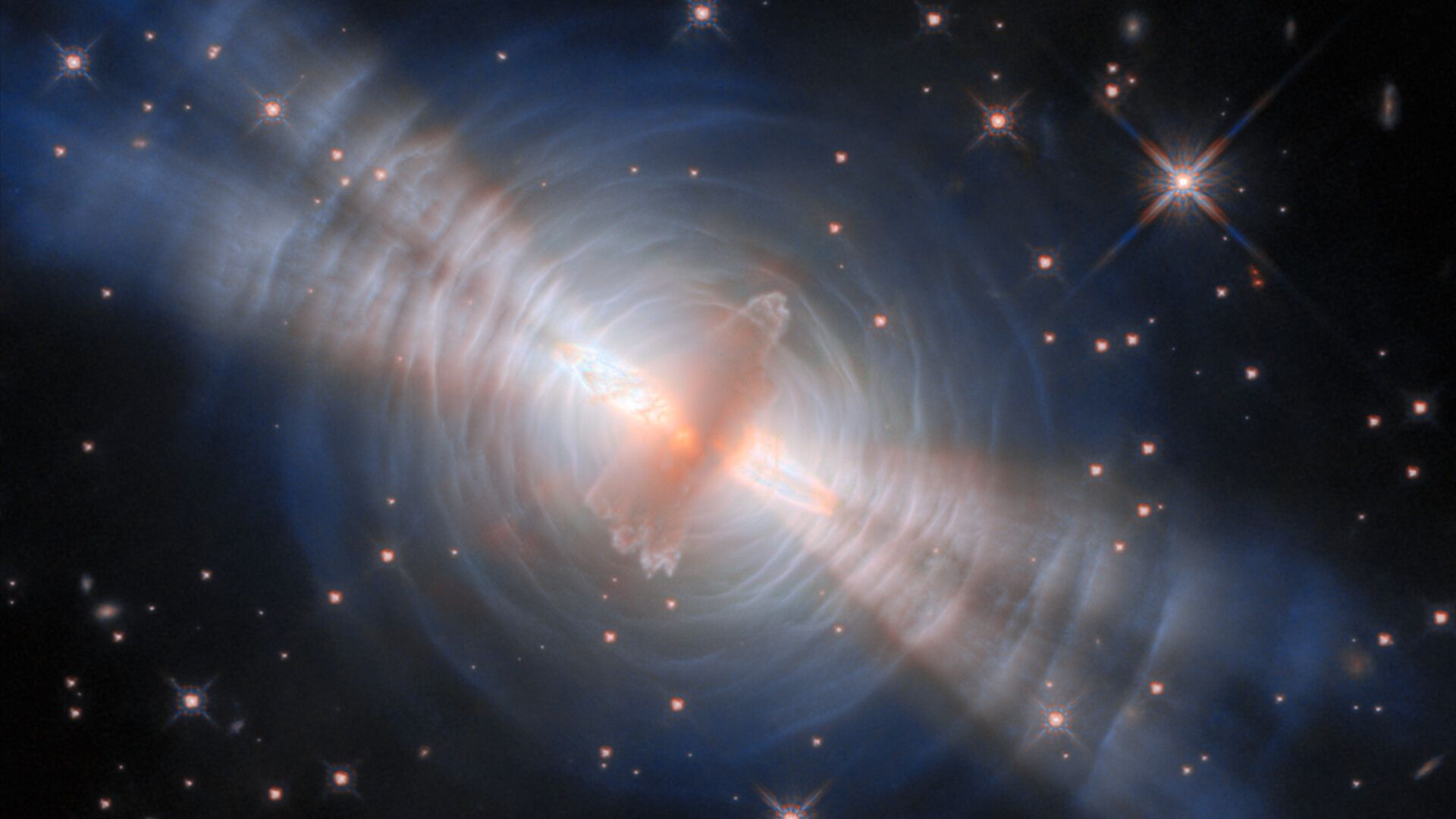
A searchlight shines through concentric circles of fresh stardust ejected by a dying star in this beautiful new image of the Egg Nebula. The dramatic scene, captured by the Hubble Space Telescope, also provides tantalizing evidence of exactly what happens to sunlike stars as they reach the end of their lives.

The Egg Nebula is famous among astronomers as the first, youngest and closest pre-planetary nebula ever discovered. Despite the name, a planetary nebula has nothing to do with planets. Instead, 18th-century astronomers gave planetary nebulas their name because they superficially looked like planets in telescopes.

However, they are actually expanding shells of ionized gas and dust expelled by stars during the final stages of their evolution, leaving behind dense stellar remnants called white dwarfs at their centers.


You may like

The Egg Nebula is one of the only known planetary nebulas in a very early stage — a pre-planetary nebula. It gives scientists a detailed view of a fleeting transitional phase that lasts only a few thousand years, before the gas and dust are dispersed to form a fully developed planetary nebula.

There are many examples of those, including the Helix Nebula, the Stingray Nebula and the Butterfly Nebula. But the Egg Nebula is one of the only places where astronomers can see what happens as a star exhausts its hydrogen and helium fuel and begins to shed its outer layers into space. The short lifespan of pre-planetary nebulas means that very few exist at any given time in cosmic history, and they’re extremely dim.

Hubble has peered at the Egg Nebula before — in 1997, 2003 and 2012 — and it was the latter data, combined with new data, that created this new image. In this early stage of becoming a planetary nebula, the light in the Egg Nebula comes from its star, which expelled a dense disk of dust just a few hundred years ago.

Now blocked by dust, light from the star escapes through polar openings, forming twin beams. The concentric arcs and symmetry are evidence that the star regularly “burps” out mass, and they rule out the possibility of a chaotic supernova explosion.

Get the world’s most fascinating discoveries delivered straight to your inbox.


A bright blue streak of light is seen covering a series of bright stars in this dark deep space image. A white box surrounds the blue shape
Webb and Chandra’s deepest views

The James Webb telescope and Chandra X-ray Observatory captured a galaxy cluster in the making when the universe was only one billion years old.

Source link

Share. Facebook Twitter Pinterest LinkedIn Tumblr Email
Previous ArticleYouTube Premium Lite now gets background play and downloadable content
Next Article Trump blasts ‘fraud’ in Minnesota in SOTU address
Editor
  • Website

Related Posts

Lifestyle

Weapons of the world quiz: Can you identify these historical objects of war?

April 30, 2026
Lifestyle

‘The detectors never stopped beeping!’ Nearly 3,000 coins discovered in field are Norway’s largest Viking hoard on record

April 30, 2026
Lifestyle

‘We can no longer ignore diseases in the deep human past’: Malaria influenced early humans’ migrations across Africa, study suggests

April 30, 2026
Add A Comment

Comments are closed.

Categories
  • Entertainment
  • Lifestyle
  • News
  • Sports
  • Tech
  • Travel
Recent Posts
  • Weapons of the world quiz: Can you identify these historical objects of war?
  • ‘The detectors never stopped beeping!’ Nearly 3,000 coins discovered in field are Norway’s largest Viking hoard on record
  • ‘We can no longer ignore diseases in the deep human past’: Malaria influenced early humans’ migrations across Africa, study suggests
  • Used SpaceX rocket stage could hit the moon’s Einstein crater this summer, report finds
  • Does Wegovy carry a risk of ‘eye stroke’ and vision loss? Here’s what the data says.
calendar
April 2026
M T W T F S S
 12345
6789101112
13141516171819
20212223242526
27282930  
« Mar    
Recent Posts
  • Weapons of the world quiz: Can you identify these historical objects of war?
  • ‘The detectors never stopped beeping!’ Nearly 3,000 coins discovered in field are Norway’s largest Viking hoard on record
  • ‘We can no longer ignore diseases in the deep human past’: Malaria influenced early humans’ migrations across Africa, study suggests
About

Welcome to Baynard Media, your trusted source for a diverse range of news and insights. We are committed to delivering timely, reliable, and thought-provoking content that keeps you informed
and inspired

Categories
  • Entertainment
  • Lifestyle
  • News
  • Sports
  • Tech
  • Travel
Facebook X (Twitter) Pinterest WhatsApp
  • Contact Us
  • About Us
  • Privacy Policy
  • Disclaimer
  • UNSUBSCRIBE
© 2026 copyrights reserved

Type above and press Enter to search. Press Esc to cancel.