Close Menu
  • Home
  • UNSUBSCRIBE
  • News
  • Lifestyle
  • Tech
  • Entertainment
  • Sports
  • Travel
Facebook X (Twitter) WhatsApp
Trending
  • Once-in-a-century ‘super’ El Niño in the cards as ocean temperatures reach near record highs in April
  • Goodbye PCOS: Polycystic ovary syndrome is getting a new name that doctors say better reflects the underlying disease
  • Microplastics absorb heat in the atmosphere and contribute to global warming — as if they weren’t bad enough
  • ‘Insect apocalypse’ is already fueling malnutrition in some regions, first-of-its-kind study reveals
  • Hantavirus LIVE: American passengers from cruise head to specialized facilities in Nebraska
  • New ‘trick’ fixes major flaw in neutral-atom quantum computers — inching us closer to a superpowerful system
  • A 2025 Alaskan tsunami was one of the largest on record, new research finds
  • Lion’s head pendant: An ancient Egyptian board game piece that was later repurposed into a magical religious object with baboons
Facebook X (Twitter) WhatsApp
Baynard Media
  • Home
  • UNSUBSCRIBE
  • News
  • Lifestyle
  • Tech
  • Entertainment
  • Sports
  • Travel
Baynard Media
Home»Lifestyle»Hidden ‘doomed’ star revealed by James Webb Space Telescope could solve decades-old mystery
Lifestyle

Hidden ‘doomed’ star revealed by James Webb Space Telescope could solve decades-old mystery

EditorBy EditorOctober 13, 2025No Comments3 Mins Read
Share Facebook Twitter Pinterest LinkedIn Tumblr Reddit Telegram Email
Share
Facebook Twitter LinkedIn Pinterest Email

The James Webb Space Telescope (JWST) has revealed a hidden “doomed” star that could help solve a giant astrophysical mystery.

The star is a massive red supergiant, which JWST snapped just before the star exploded in a fiery supernova. Massive red supergiants should, in theory, cause most supernovas, but they’re rarely observed. The latest JWST observation, described in a new study published Wednesday (Oct. 8) in The Astrophysical Journal Letters, adds weight to the idea that these giants are often obscured by clouds of dust.

“For multiple decades, we have been trying to determine exactly what the explosions of red supergiant stars look like,” study lead author Charlie Kilpatrick, a research assistant professor studying massive stars at Northwestern University in Illinois, said in a statement. “Only now, with JWST, do we finally have the quality of data and infrared observations that allow us to say precisely the exact type of red supergiant that exploded and what its immediate environment looked like.”


You may like

Stars around the size of our sun swell up near the end of their lifecycles to become red giants before going supernova. Red supergiants are massive stars on the verge of detonating, typically measuring hundreds or thousands of times larger than our sun.

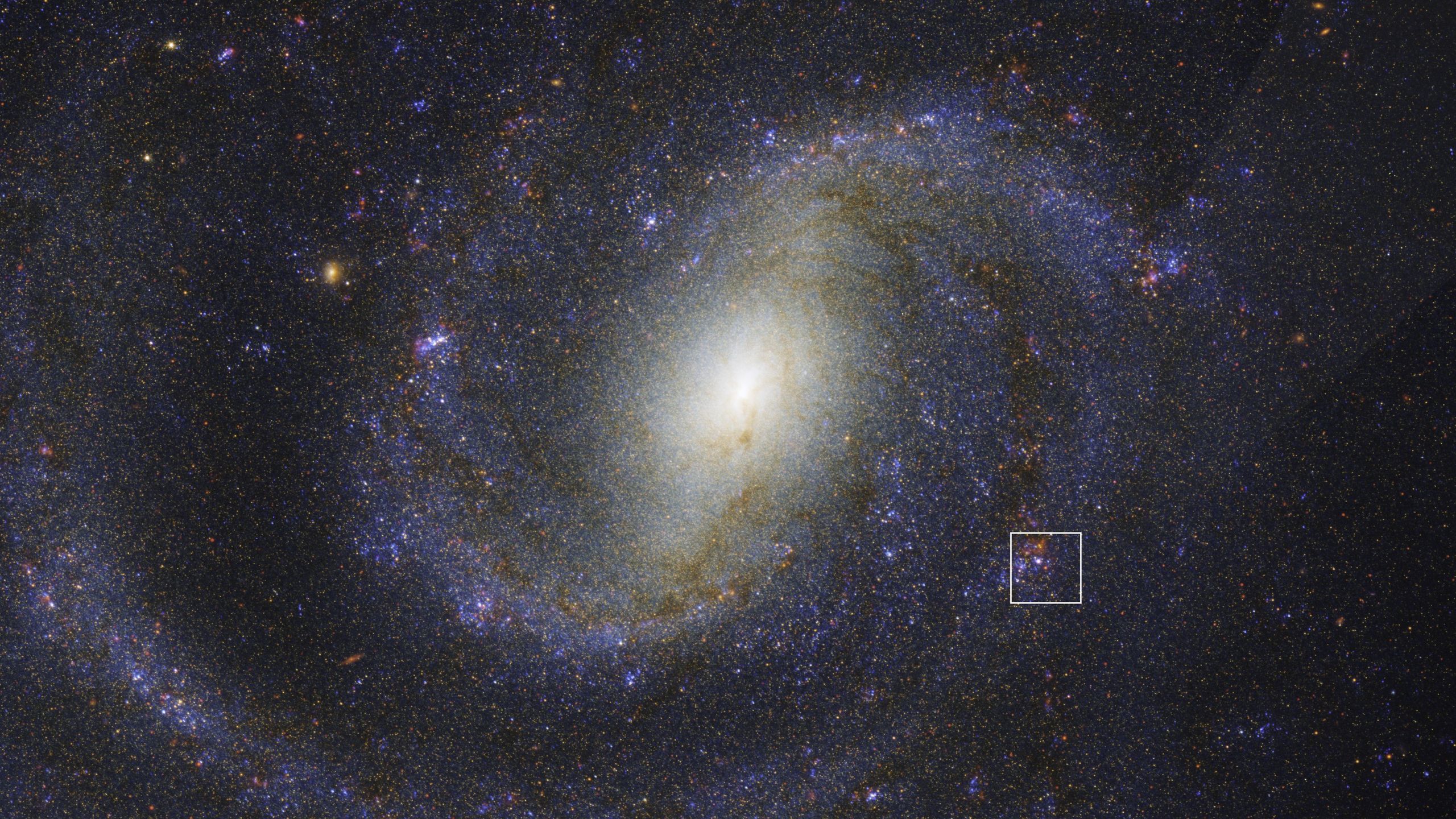
The All-Sky Automated Survey for Supernovae first detected the supernova from the newly imaged supergiant in June. The supernova, officially named SN 2025pht, came from a galaxy called NGC 1637, which is located 38 million light-years from Earth — pretty close for something in space. The authors of the new study identified the supergiant’s source star (its progenitor) by comparing historical Hubble Space Telescope data to new JWST images of NGC 1637 taken before and after the explosion.

An image of the spiral galaxy NGC 1637 with additional detailed images of the red supergiant before and after it went supernova, combining JWST and Hubble observations.

Researchers combined observations from JWST and Hubble to make this image of spiral galaxy NGC 1637, with additional images of the massive red supergiant before and after it went supernova. (Image credit: NASA, ESA, CSA, STScI, Charles Kilpatrick (Northwestern), Aswin Suresh (Northwestern))

Researchers like Kilpatrick have suggested that the most massive aging stars might also be the dustiest, so their light is blocked. This possible explanation tracks with the new JWST observation. The star shone about 100,000 times brighter than our sun, but the team estimated that its dust was so thick that this light was made more than 100 times dimmer, according to the statement.

The dust was also particularly effective at blocking shorter, blue wavelengths of light. Fortunately, JWST’s powerful infrared detection could see the longer red wavelengths, providing an unprecedented detailed look at a supergiant on the brink of going supernova.

Get the world’s most fascinating discoveries delivered straight to your inbox.

“SN2025pht is surprising because it appeared much redder than almost any other red supergiant we’ve seen explode as a supernova,” Kilpatrick said. “That tells us that previous explosions might have been much more luminous than we thought because we didn’t have the same quality of infrared data that JWST can now provide.”

Source link

Share. Facebook Twitter Pinterest LinkedIn Tumblr Email
Previous ArticleLions’ Brian Branch faces criticism for postgame punch
Next Article Hostage Bar Kupershtein speaks to family on phone
Editor
  • Website

Related Posts

Lifestyle

Once-in-a-century ‘super’ El Niño in the cards as ocean temperatures reach near record highs in April

May 12, 2026
Lifestyle

Goodbye PCOS: Polycystic ovary syndrome is getting a new name that doctors say better reflects the underlying disease

May 12, 2026
Lifestyle

Microplastics absorb heat in the atmosphere and contribute to global warming — as if they weren’t bad enough

May 12, 2026
Add A Comment

Comments are closed.

Categories
  • Entertainment
  • Lifestyle
  • News
  • Sports
  • Tech
  • Travel
Recent Posts
  • Once-in-a-century ‘super’ El Niño in the cards as ocean temperatures reach near record highs in April
  • Goodbye PCOS: Polycystic ovary syndrome is getting a new name that doctors say better reflects the underlying disease
  • Microplastics absorb heat in the atmosphere and contribute to global warming — as if they weren’t bad enough
  • ‘Insect apocalypse’ is already fueling malnutrition in some regions, first-of-its-kind study reveals
  • Hantavirus LIVE: American passengers from cruise head to specialized facilities in Nebraska
calendar
May 2026
M T W T F S S
 123
45678910
11121314151617
18192021222324
25262728293031
« Apr    
Recent Posts
  • Once-in-a-century ‘super’ El Niño in the cards as ocean temperatures reach near record highs in April
  • Goodbye PCOS: Polycystic ovary syndrome is getting a new name that doctors say better reflects the underlying disease
  • Microplastics absorb heat in the atmosphere and contribute to global warming — as if they weren’t bad enough
About

Welcome to Baynard Media, your trusted source for a diverse range of news and insights. We are committed to delivering timely, reliable, and thought-provoking content that keeps you informed
and inspired

Categories
  • Entertainment
  • Lifestyle
  • News
  • Sports
  • Tech
  • Travel
Facebook X (Twitter) Pinterest WhatsApp
  • Contact Us
  • About Us
  • Privacy Policy
  • Disclaimer
  • UNSUBSCRIBE
© 2026 copyrights reserved

Type above and press Enter to search. Press Esc to cancel.