Close Menu
  • Home
  • UNSUBSCRIBE
  • News
  • Lifestyle
  • Tech
  • Entertainment
  • Sports
  • Travel
Facebook X (Twitter) WhatsApp
Trending
  • Lemur used in ‘lemur yoga’ session dies of human herpesvirus, study finds
  • ‘A fine line between reducing stigma and trivialising conditions’: Social media, self-diagnosis and the glamorization of ADHD
  • New 2D memory device stores data on just a single electron
  • Before we ban kids from social media completely, here’s what we should try first | Jonathan Bellack and Mariana Olaizola Rosenblat
  • Scientists uncover a better way to beat ‘the bends’ — using deep-diving pigs
  • Mars may have been losing its water more than 4 billion years ago, oldest-known Martian meteorite suggests
  • ‘The lance head was still inside the pelvis’: Mass grave found in Austria may hold casualties of unknown ancient Roman battle
  • ‘Full-on berserker mode’: Archaeologists solve mystery of medieval soldiers with gruesome square holes in their skull
Facebook X (Twitter) WhatsApp
Baynard Media
  • Home
  • UNSUBSCRIBE
  • News
  • Lifestyle
  • Tech
  • Entertainment
  • Sports
  • Travel
Baynard Media
Home»Lifestyle»Leopards ate our ancient human ancestors’ faces, AI analysis reveals
Lifestyle

Leopards ate our ancient human ancestors’ faces, AI analysis reveals

EditorBy EditorOctober 7, 2025No Comments3 Mins Read
Share Facebook Twitter Pinterest LinkedIn Tumblr Reddit Telegram Email
Share
Facebook Twitter LinkedIn Pinterest Email

Almost 2 million years ago, leopards likely hunted and feasted on our human ancestors in East Africa, a new study finds.

The research, which used artificial intelligence (AI) analysis tools, provides insight into the demise of two prehistoric individuals from the archaic human species Homo habilis — one of the earliest members of the Homo genus.

Previous studies have suggested that H. habilis was likely sometimes preyed on by large carnivores, like big cats and crocodiles, as indicated by evidence like tooth marks found on some specimens. But it’s often been challenging to attribute predation events to specific species using traditional methods such as physical examination, so many studies tended to stop short of firmly identifying the predator species involved.


You may like

With the help of AI, however, a study published Sept. 16 in the journal Annals of the New York Academy of Sciences documents with “unprecedented reliability” the carnivore responsible for preying on the unfortunate H. habilis individuals.

“AI has opened new doors of understanding,” study co-author Manuel Domínguez-Rodrigo, a professor of prehistory at the University of Alcalá in Spain and a visiting professor of anthropology at Rice University in Texas, said in a statement.

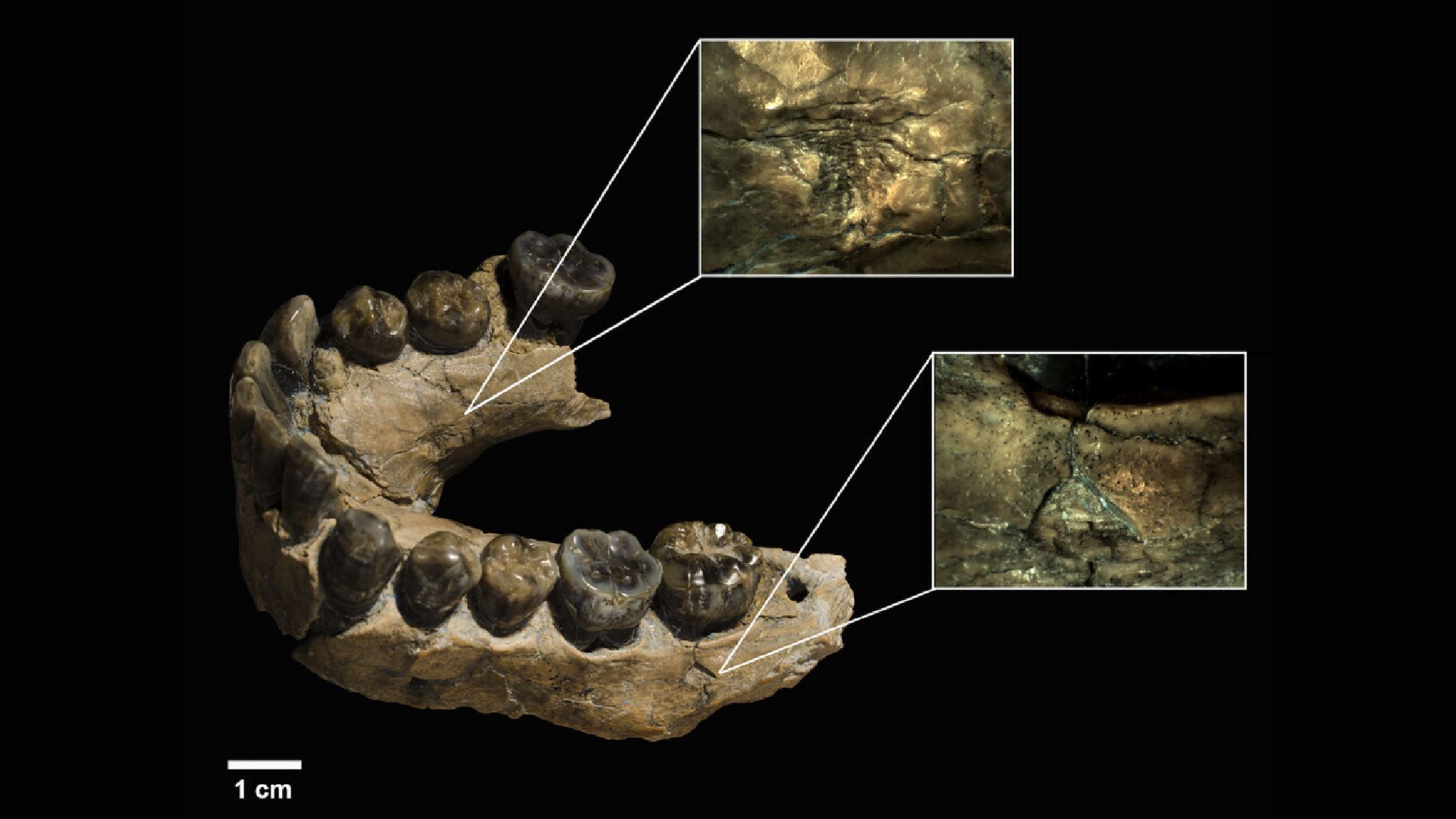
a close-up of details on a human jaw bone

Further views of the juvenile jawbone, which has yielded evidence that the Homo habilis individual was preyed on by a leopard. (Image credit: Vegara-Riquelme et al., 2025; CC BY-NC-ND 4.0)

In the new study, Domínguez-Rodrigo and colleagues analyzed two H. habilis specimens: a juvenile (known as OH 7) and an adult (known as OH 65), dated to around 1.85 million years ago and 1.8 million years ago, respectively. Both specimens were found decades ago in the Olduvai Gorge site in Tanzania.

“We chose those two fossils because they are most unambiguously identified as H. habilis and because they are probably the best preserved specimens,” Domínguez-Rodrigo told Live Science in an email.

The team conducted a preliminary examination of the OH 7 and OH 65 specimens, identifying carnivore tooth marks on the upper jaw of the adult and the lower jaw of the juvenile, that had not been documented before. The team then applied AI tools to analyze these tooth marks.

Using computer vision — an AI technique for identifying items through images — the researchers trained deep learning models on hundreds of examples of bone markings produced by modern carnivores such as hyenas, crocodiles and leopards. In blind tests, the best of these models was more than 90% accurate in correctly identifying which animal produced the marks, according to Domínguez-Rodrigo.

Applying this system to analyze the OH 7 and OH 65 remains revealed, with a high degree of confidence, that the bite marks had been made by leopards, the study reported.

The conclusion that these H. habilis individuals were most likely preyed on and consumed by the leopards — rather than simply being attacked or bitten by them — is supported by several pieces of evidence.

“The fact that very few pieces of the skeleton survived indicates a high degree of ravaging,” Domínguez-Rodrigo said. “If a different carnivore had had access to habilis before the leopards, the latter would have been uninterested since they are only flesh-eaters,” he said, adding that in such a scenario, not much flesh would have survived in carcasses of this size after the first predator finished with its meal.

“We know that to reach the inside of the mandible [lower jaw] of OH7 (as the leopard did) and break the mandibular corpus, a substantial amount of flesh and tongue had to be removed first,” Domínguez-Rodrigo said. “This indicates consumption and not just a bite to kill.”

Source link

Share. Facebook Twitter Pinterest LinkedIn Tumblr Email
Previous ArticleTrump blames Dems for government shutdown amid ‘one of the most successful economies’
Next Article Rainbow brick crosswalk removed in Miami Beach
Editor
  • Website

Related Posts

Lifestyle

Lemur used in ‘lemur yoga’ session dies of human herpesvirus, study finds

August 15, 2026
Lifestyle

‘A fine line between reducing stigma and trivialising conditions’: Social media, self-diagnosis and the glamorization of ADHD

August 15, 2026
Lifestyle

New 2D memory device stores data on just a single electron

August 15, 2026
Add A Comment

Comments are closed.

Categories
  • Entertainment
  • Lifestyle
  • News
  • Sports
  • Tech
  • Travel
Recent Posts
  • Lemur used in ‘lemur yoga’ session dies of human herpesvirus, study finds
  • ‘A fine line between reducing stigma and trivialising conditions’: Social media, self-diagnosis and the glamorization of ADHD
  • New 2D memory device stores data on just a single electron
  • Before we ban kids from social media completely, here’s what we should try first | Jonathan Bellack and Mariana Olaizola Rosenblat
  • Scientists uncover a better way to beat ‘the bends’ — using deep-diving pigs
calendar
September 2026
M T W T F S S
 123456
78910111213
14151617181920
21222324252627
282930  
« Aug    
Recent Posts
  • Lemur used in ‘lemur yoga’ session dies of human herpesvirus, study finds
  • ‘A fine line between reducing stigma and trivialising conditions’: Social media, self-diagnosis and the glamorization of ADHD
  • New 2D memory device stores data on just a single electron
About

Welcome to Baynard Media, your trusted source for a diverse range of news and insights. We are committed to delivering timely, reliable, and thought-provoking content that keeps you informed
and inspired

Categories
  • Entertainment
  • Lifestyle
  • News
  • Sports
  • Tech
  • Travel
Facebook X (Twitter) Pinterest WhatsApp
  • Contact Us
  • About Us
  • Privacy Policy
  • Disclaimer
  • UNSUBSCRIBE
© 2026 copyrights reserved

Type above and press Enter to search. Press Esc to cancel.