Close Menu
  • Home
  • UNSUBSCRIBE
  • News
  • Lifestyle
  • Tech
  • Entertainment
  • Sports
  • Travel
Facebook X (Twitter) WhatsApp
Trending
  • Withings ScanWatch 2 review: Style meets next-level health monitoring
  • AI Chatbots are turbo-charging violence against women and girls: We urgently need to regulate them | Yvonne McDermott Rees
  • ‘The biggest El Niño event since the 1870s’: ‘Super’ El Niño is now the most likely scenario by the end of this year ‪—‬ and the humanitarian cost could be huge
  • Antarctica’s sudden sea ice loss is one of the most extreme and confusing events in the modern climate record. Scientists now know why it’s happening.
  • ‘I heard gasps’: Artemis II astronauts reveal inside story of their mind-bending solar eclipse
  • A pill can stop people from developing COVID after being exposed to the virus, trial finds
  • ‘There are 4 people in those pixels’: Earth-based telescope snapped Artemis II crew orbiting the moon
  • High-status Roman woman was buried in a lead coffin with jet hairpins and exotic resins, archaeologists find
Facebook X (Twitter) WhatsApp
Baynard Media
  • Home
  • UNSUBSCRIBE
  • News
  • Lifestyle
  • Tech
  • Entertainment
  • Sports
  • Travel
Baynard Media
Home»Lifestyle»Scientists have digitally removed the ‘death masks’ from four Colombian mummies, revealing their faces for the first time
Lifestyle

Scientists have digitally removed the ‘death masks’ from four Colombian mummies, revealing their faces for the first time

EditorBy EditorSeptember 30, 2025No Comments4 Mins Read
Share Facebook Twitter Pinterest LinkedIn Tumblr Reddit Telegram Email
Share
Facebook Twitter LinkedIn Pinterest Email

Centuries-old mummies from the Andes of Colombia have been digitally unmasked and virtually reconstructed, revealing how they may have looked during their lifetimes.

These individuals, who lived sometime between the 13th and 18th centuries, were buried with death masks covering their faces and jaws. They’re the only Colombian examples of a cultural practice otherwise common for communities in other parts of pre-Columbian South America. However, as their graves were looted, little was known about these four individuals and their archaeological context.

Now, researchers have digitally “unmasked” their skulls to reconstruct their faces, which they presented for the first time Aug. 14 during the 11th World Congress on Mummy Studies in Peru.


You may like

These reconstructions highlight “the fascinating cultural practices” of the Indigenous peoples who lived in South America, Jessica Liu, the project manager for Face Lab at Liverpool John Moores University in the U.K, said in a statement about the project.

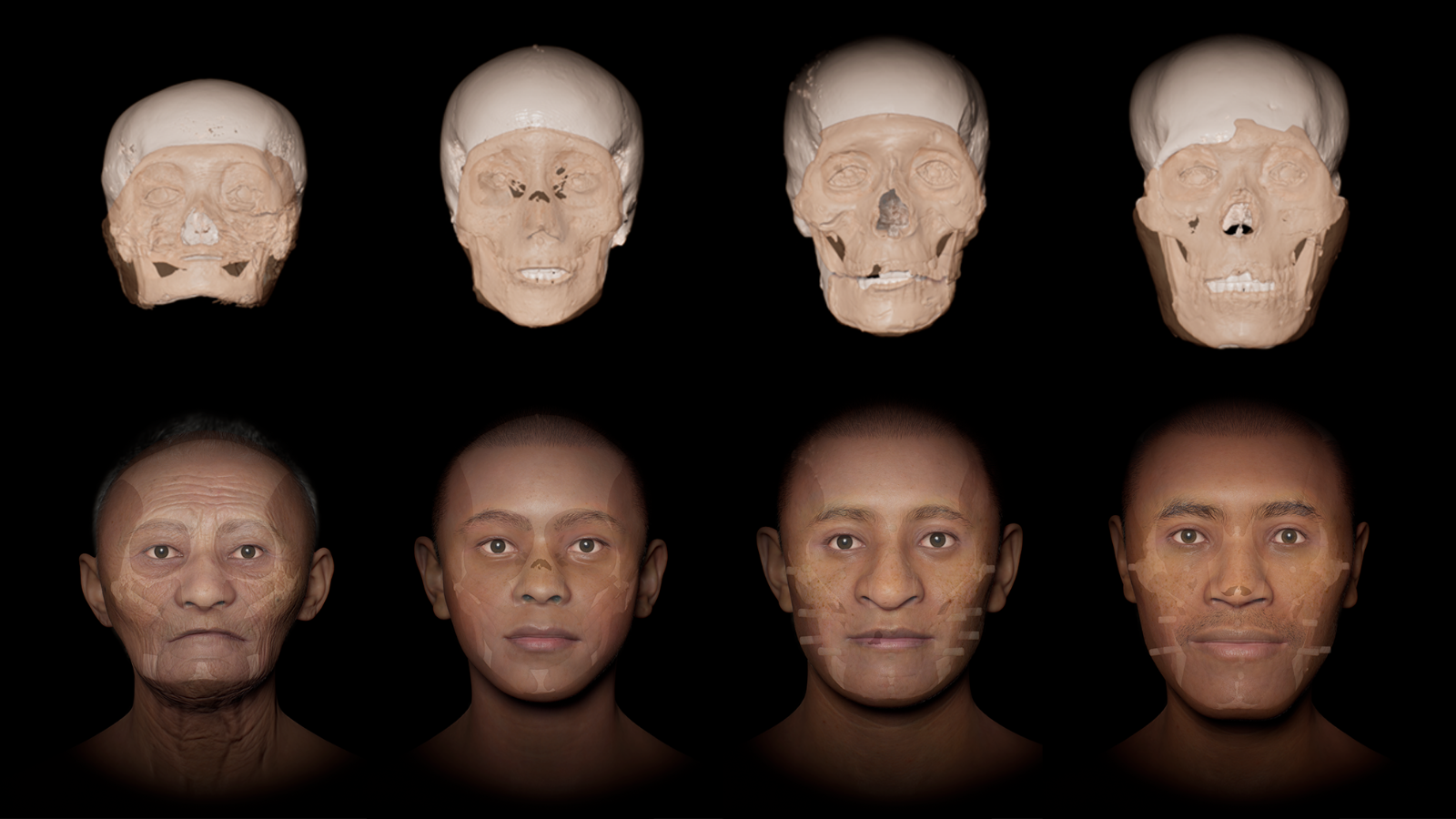
The mummies are of a 6- to 7-year-old child, a female in her 60s and two young adult males, all with stylized masks made of resin, clay, wax and maize attached to their faces. All the masks are damaged, with missing noses and chunks along the base, but some ornamental beads outlining the eyes remain. The individuals were from pre-Hispanic populations in the Eastern Cordillera, a region in the Colombian Andes, with radiocarbon dating indicating they lived between 1216 and 1797.

CT scans were performed on the masked skulls. CT scans use X-rays to generate virtual 3D images by taking lots of images of 2D slices of a sample and putting them together. Because of this, the team could “effectively unmask the skull digitally” by removing the layers containing the mask, Liu told Live Science.

Next, the researchers used specialized software and a haptic touch stylus pen to superimpose muscles, soft tissue and fat onto the digitally unmasked skulls. Liu said this is like virtual sculpting, where you use the scaffolding of the skull to get the tissue to perfectly fit the individual.

Get the world’s most fascinating discoveries delivered straight to your inbox.

Reconstructions of four faces

The reconstructions have neutral expressions to avoid interpretations about personalities (Image credit: Facial depictions by Face Lab, Liverpool John Moores University)

The team used average facial tissue depth data from modern-day adult male Colombians to add the soft tissue to the two young adult male skulls. The team did not use such data to add soft tissue onto the other two skulls as no contemporary tissue data currently exists for Colombian children and females. However, they still reconstructed these faces, adding the muscles and tweaking them to fit each particular skull, and bulking out the child’s face with some fat. The nose size and shape was determined by measuring the bony tissues of the skull and then selecting the best-fitting nose out of an array of options.

The team gave the individuals the skin, eye and hair color typical of individuals from the region, and gave them a neutral facial expression. Next came the hard part, Liu said, because they then had to add the facial “texture”: wrinkles, eyelashes, freckles and pores. This is a long process of making constant changes until they find the best fit.

“Texture is always the biggest challenge, just because we simply don’t know how they would present themselves, whether or not they have any facial scarring or tattoos, or if that actually is the skin tone,” Liu said. “What we present in terms of texture is an average representation, based on what we know of these individuals.”

This is an important point, Liu said, because they are creating faces based on group averages, “but nobody is ever an average.” This means that these freshly unmasked faces are not accurate portraits of these individuals; they show “what they could have looked like rather than ‘this is what they looked like’,” she said.


Mummy quiz: Can you unwrap these ancient Egyptian mysteries?

Source link

Share. Facebook Twitter Pinterest LinkedIn Tumblr Email
Previous ArticleDietitians weigh in on Starbucks’ protein coffee drinks and offer nutrition tips
Next Article AOL discontinues dial-up service for internet users
Editor
  • Website

Related Posts

Lifestyle

Withings ScanWatch 2 review: Style meets next-level health monitoring

May 15, 2026
Lifestyle

AI Chatbots are turbo-charging violence against women and girls: We urgently need to regulate them | Yvonne McDermott Rees

May 15, 2026
Lifestyle

‘The biggest El Niño event since the 1870s’: ‘Super’ El Niño is now the most likely scenario by the end of this year ‪—‬ and the humanitarian cost could be huge

May 15, 2026
Add A Comment

Comments are closed.

Categories
  • Entertainment
  • Lifestyle
  • News
  • Sports
  • Tech
  • Travel
Recent Posts
  • Withings ScanWatch 2 review: Style meets next-level health monitoring
  • AI Chatbots are turbo-charging violence against women and girls: We urgently need to regulate them | Yvonne McDermott Rees
  • ‘The biggest El Niño event since the 1870s’: ‘Super’ El Niño is now the most likely scenario by the end of this year ‪—‬ and the humanitarian cost could be huge
  • Antarctica’s sudden sea ice loss is one of the most extreme and confusing events in the modern climate record. Scientists now know why it’s happening.
  • ‘I heard gasps’: Artemis II astronauts reveal inside story of their mind-bending solar eclipse
calendar
May 2026
M T W T F S S
 123
45678910
11121314151617
18192021222324
25262728293031
« Apr    
Recent Posts
  • Withings ScanWatch 2 review: Style meets next-level health monitoring
  • AI Chatbots are turbo-charging violence against women and girls: We urgently need to regulate them | Yvonne McDermott Rees
  • ‘The biggest El Niño event since the 1870s’: ‘Super’ El Niño is now the most likely scenario by the end of this year ‪—‬ and the humanitarian cost could be huge
About

Welcome to Baynard Media, your trusted source for a diverse range of news and insights. We are committed to delivering timely, reliable, and thought-provoking content that keeps you informed
and inspired

Categories
  • Entertainment
  • Lifestyle
  • News
  • Sports
  • Tech
  • Travel
Facebook X (Twitter) Pinterest WhatsApp
  • Contact Us
  • About Us
  • Privacy Policy
  • Disclaimer
  • UNSUBSCRIBE
© 2026 copyrights reserved

Type above and press Enter to search. Press Esc to cancel.