Close Menu
  • Home
  • UNSUBSCRIBE
  • News
  • Lifestyle
  • Tech
  • Entertainment
  • Sports
  • Travel
Facebook X (Twitter) WhatsApp
Trending
  • Wolves 2 – 1 Liverpool
  • Lisa Rinna on Harry Hamlin Sex Life, Sexuality
  • Anaheim Considers Self-Checkout Regulations
  • Prehistoric water-dwelling weirdo with sideways teeth and a twisted jaw was already a ‘living fossil’ 275 million years ago
  • Best iPhone 17e deal: Get the new iPhone and iPad Air for free at T-Mobile
  • Bruno Fernandes’ Man Utd future will depend on Champions League qualification and Michael Carrick – Paper Talk and transfer gossip | Football News
  • Honey Boo Boo’s Mama June on Medical Issues, Health Scare
  • Eileen Gu defends decision to compete for China over Team USA in statement
Facebook X (Twitter) WhatsApp
Baynard Media
  • Home
  • UNSUBSCRIBE
  • News
  • Lifestyle
  • Tech
  • Entertainment
  • Sports
  • Travel
Baynard Media
Home»Lifestyle»American submarine, lost for over a century, discovered ‘remarkably intact’ off the coast of San Diego
Lifestyle

American submarine, lost for over a century, discovered ‘remarkably intact’ off the coast of San Diego

EditorBy EditorMay 23, 2025No Comments4 Mins Read
Share Facebook Twitter Pinterest LinkedIn Tumblr Reddit Telegram Email
Share
Facebook Twitter LinkedIn Pinterest Email

Researchers have located the wrecks of two long-lost military vehicles on the seafloor a few miles from San Diego: an American submarine that sank during a training accident in 1917, and a U.S. Navy training aircraft that crashed nearby in 1950.

The USS F-1 submarine sank in seconds after it was badly damaged in a collision with another U.S. Navy submarine. Nineteen of its crew drowned in the accident, and three were rescued by the other sub.

The discovery, made by an expedition to the site earlier this year by researchers from the Woods Hole Oceanographic Institution (WHOI) and the U.S. Navy, was the first time the sub wreck had been located and surveyed since the sinking.


You may like

It now lies on the seafloor at a depth of more than 1,300 feet (400 meters). That’s too deep for human divers, so the wreck was surveyed by operators in the human-occupied underwater vehicle (HOV) Alvin and the autonomous underwater vehicle (AUV) Sentry, which were based on the WHOI research ship Atlantis.

“These two important oceanographic tools work extremely well together,” Bruce Strickrott, manager of the Alvin group at WHOI, told Live Science in an email. “The combined strength of the two capabilities has transformed deep sea oceanographic research and exploration, and is becoming a routine part of Alvin scientific missions.”

Related: 30 incredible sunken wrecks from WWI and WWII

Sunken submarine

Bradley Krueger, an underwater archaeologist for the U.S. Navy’s Naval History and Heritage Command (NHHC), was on board Alvin during some of the dives and outlined the fatal 1917 sinking.

Get the world’s most fascinating discoveries delivered straight to your inbox.

“USS F-1 was conducting a 48-hour engineering run and performance test traveling from San Pedro and San Diego, CA, when the accident occurred,” Krueger told Live Science in an email. “[Navy submarines] USS F-2 and USS F-3 were alongside performing similar testing when all three vessels entered a fog bank. USS F-3 collided with USS F-1, and following the collision USS F-3 remained on scene to help rescue survivors from the water.”

Image 1 of 3
a close-up of a submarine underwater
(Image credit: Image by Zoe Daheron, © Woods Hole Oceanographic Institution)

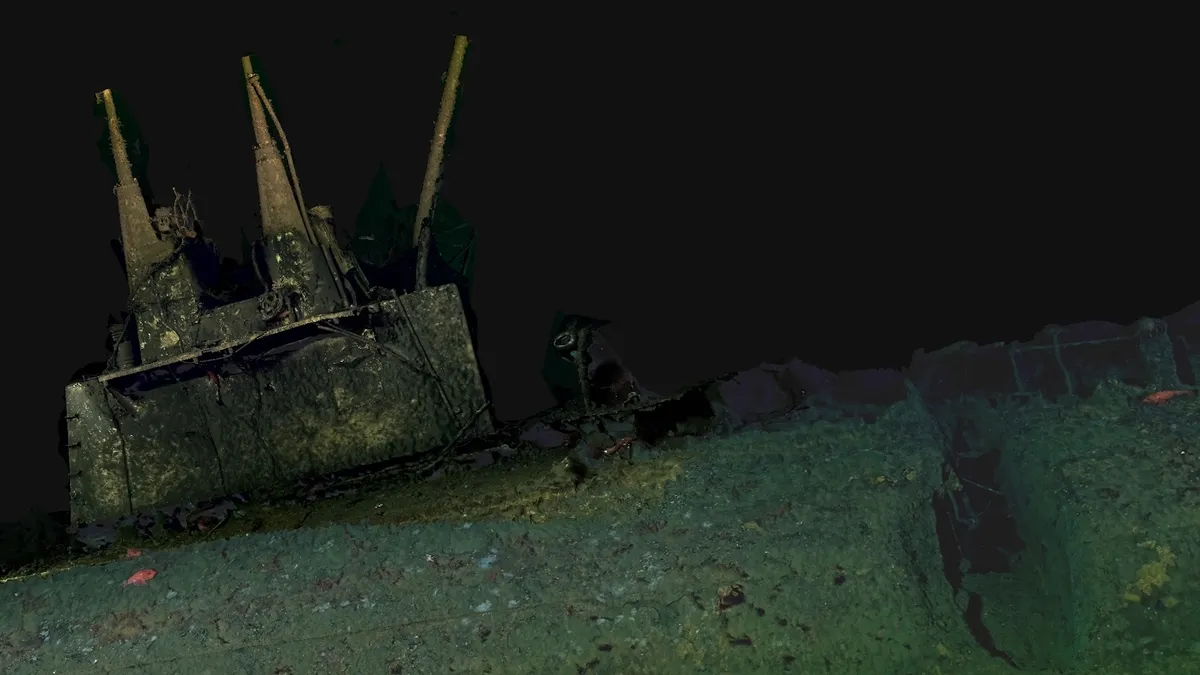
The reconstruction shows the submarine’s “conning” tower and the damage on the submarine’s hull that caused it to sink.

a wrecked torpedo bomber
(Image credit: Image courtesy of Anna Michel, Woods Hole Oceanographic Institution; NSF GEO; © Woods Hole Oceanographic Institution)

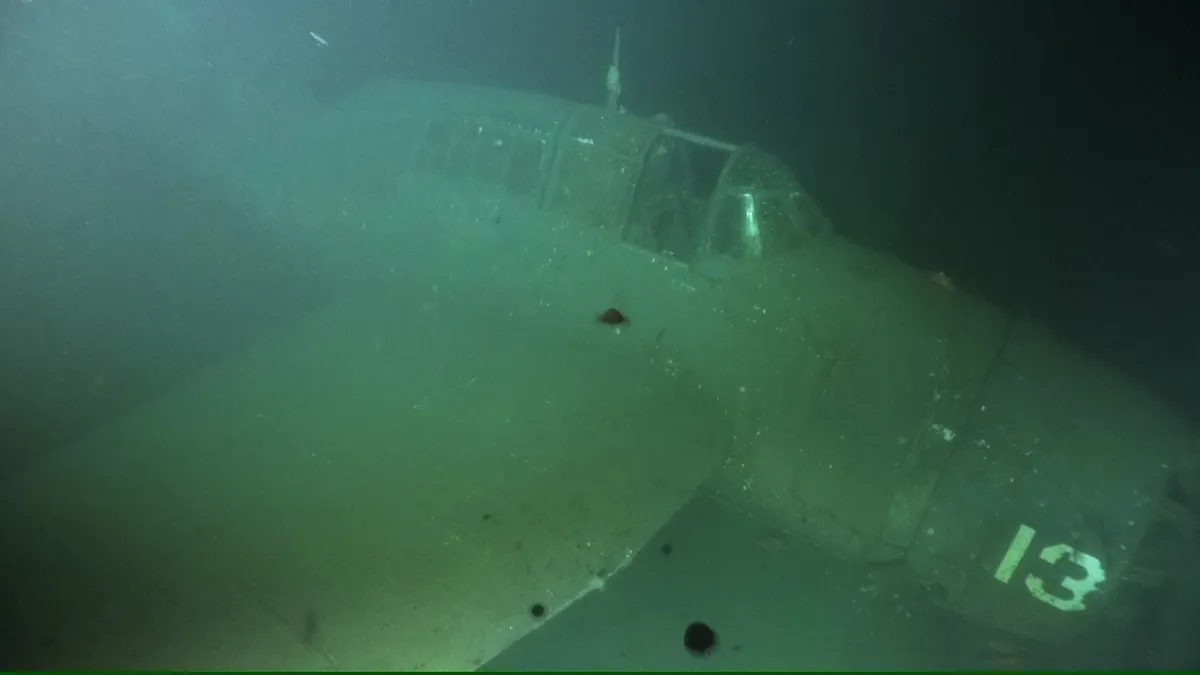
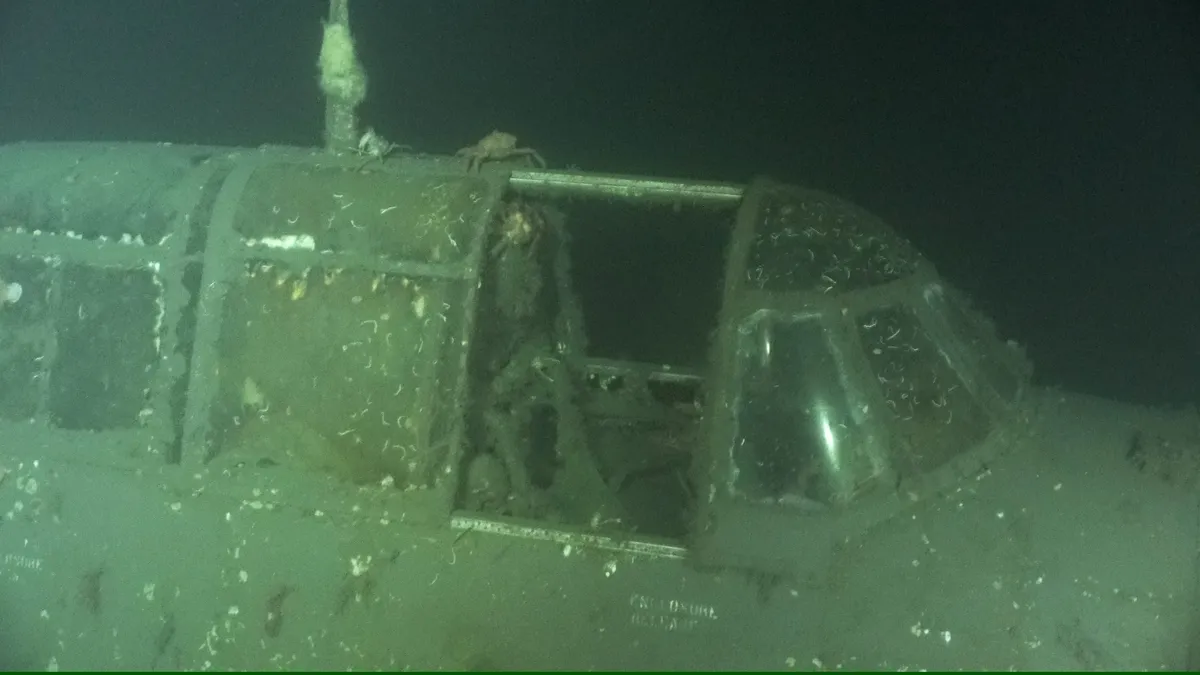
The expedition also surveyed the wreck of a U.S. Navy Grumman TBF Avenger torpedo bomber, which was being used for training in 1950 when it crashed nearby.

a close-up of a wrecked plane underwater
(Image credit: Image courtesy of Anna Michel, Woods Hole Oceanographic Institution; NSF GEO; © Woods Hole Oceanographic Institution)

The latest dives enabled the U.S. Navy to identify the aircraft and to confirm that no lives were lost in the accident.


Stickrott said he had worked out the submarine wreck’s rough location from Navy records and that the AUV Sentry was sent out to survey the area. It located the wreck on the first afternoon of searching.

The F-1 submarine now lies on its starboard (right) side with its bow (front) to the northwest, and subsequent explorations with the HOV Alvin showed the sub was “remarkably intact” after being underwater for more than 100 years, Stickrott said.

The wreck is now a war grave for the 19 crew who died in the 1917 accident. WHOI and the Navy agreed not to make contact with the wreck, “to preserve its condition and be respectful of its legacy,” he said.

Training bomber

The expedition also surveyed the nearby wreck of a U.S. Navy Grumman TBF Avenger torpedo bomber, which crashed in the same area when it was being used as a training aircraft in 1950.

Stickrott explained that the bomber wreck had been known to WHOI for several years and had sometimes been the target for engineering and training dives on Alvin. But the wreck’s location had been unknown to the U.S. Navy, so the site was surveyed to add information to the Navy’s records, he said.

The dives enabled the NHHC to establish an official identification of the aircraft and to confirm that the crew on board had escaped alive from the crash, Stickrott said.

He added that he had always been curious about the number “13” stenciled on the engine nacelle of the sunken aircraft — an “obvious superstitious element.” The number turned out to refer to the training squadron that the aircraft belonged to at the time of the crash, “but I often wonder what the pilot and squadron personnel thought,” he said.

Source link

Share. Facebook Twitter Pinterest LinkedIn Tumblr Email
Previous ArticleJupiter is shrinking and used to be twice as big, mind-boggling study reveals
Next Article Ozempic and Wegovy users report a desire to drink less. Could these weight loss drugs help treat alcohol use disorder?
Editor
  • Website

Related Posts

Lifestyle

Prehistoric water-dwelling weirdo with sideways teeth and a twisted jaw was already a ‘living fossil’ 275 million years ago

March 4, 2026
Lifestyle

JWST’s ‘little red dots’ could be the ‘parents’ of the universe’s first supermassive black holes

March 4, 2026
Lifestyle

‘An entirely new tool for cosmology’: The gravitational wave background could mend our broken understanding of the universe

March 3, 2026
Add A Comment

Comments are closed.

Categories
  • Entertainment
  • Lifestyle
  • News
  • Sports
  • Tech
  • Travel
Recent Posts
  • Wolves 2 – 1 Liverpool
  • Lisa Rinna on Harry Hamlin Sex Life, Sexuality
  • Anaheim Considers Self-Checkout Regulations
  • Prehistoric water-dwelling weirdo with sideways teeth and a twisted jaw was already a ‘living fossil’ 275 million years ago
  • Best iPhone 17e deal: Get the new iPhone and iPad Air for free at T-Mobile
calendar
March 2026
M T W T F S S
 1
2345678
9101112131415
16171819202122
23242526272829
3031  
« Feb    
Recent Posts
  • Wolves 2 – 1 Liverpool
  • Lisa Rinna on Harry Hamlin Sex Life, Sexuality
  • Anaheim Considers Self-Checkout Regulations
About

Welcome to Baynard Media, your trusted source for a diverse range of news and insights. We are committed to delivering timely, reliable, and thought-provoking content that keeps you informed
and inspired

Categories
  • Entertainment
  • Lifestyle
  • News
  • Sports
  • Tech
  • Travel
Facebook X (Twitter) Pinterest WhatsApp
  • Contact Us
  • About Us
  • Privacy Policy
  • Disclaimer
  • UNSUBSCRIBE
© 2026 copyrights reserved

Type above and press Enter to search. Press Esc to cancel.