
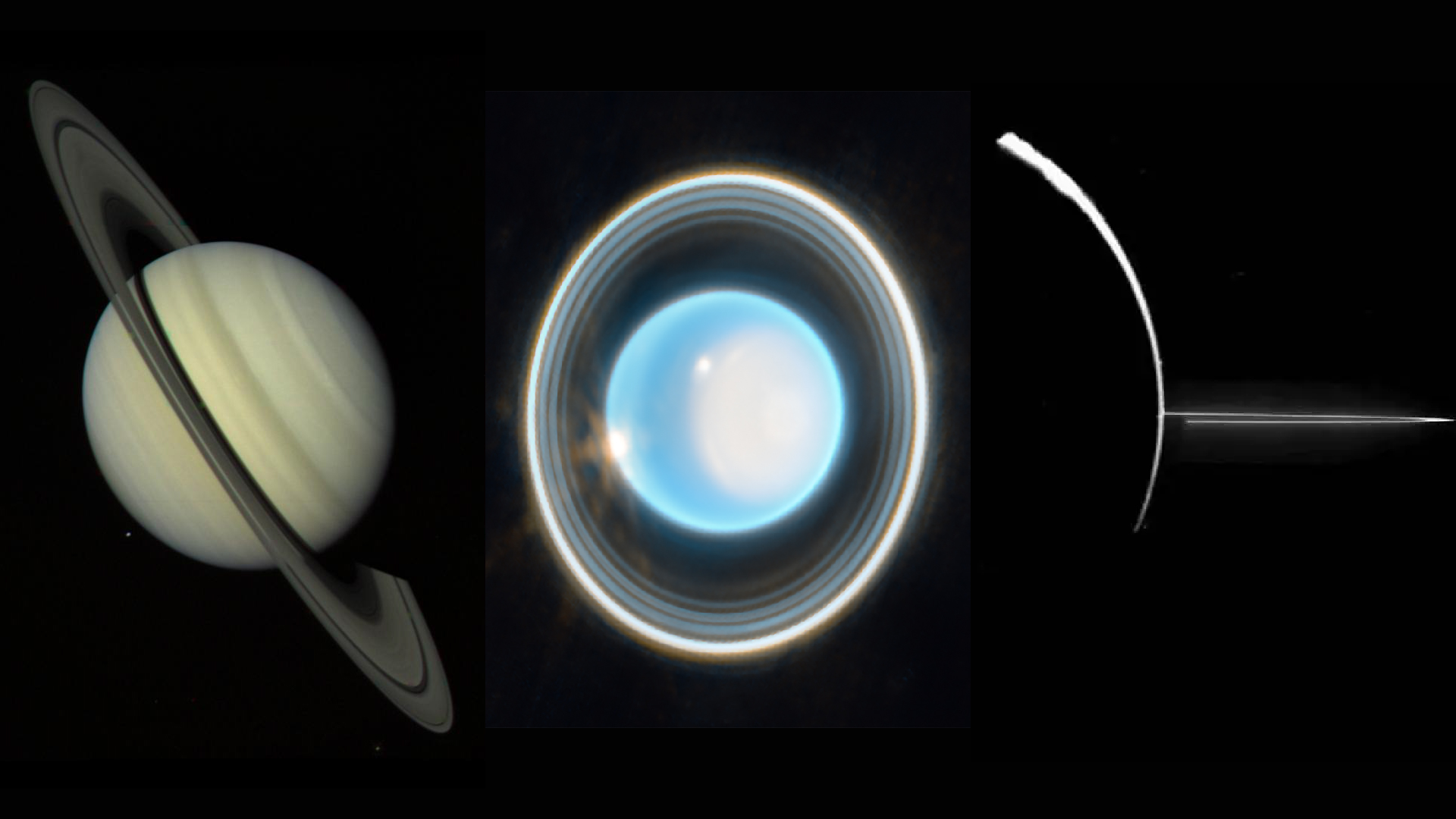
When you think of a planet with rings, majestic Saturn almost definitely comes to mind. But it’s not the only planet in the solar system with these breathtaking bands. So which planets in our solar system have rings?
All four giant planets — Jupiter, Saturn, Uranus and Neptune — sport these spectacular structures. Plus, many other objects in the solar system, including the dwarf planet Haumea and asteroid Chariklo, have rings. Whether or not we can see these rings easily from Earth depends on what they’re made of.
What are planetary rings made of?
Planetary rings might look sturdy and solid from afar, but they’re made of tiny bits of ice and rock orbiting the planet.
“Rings are mostly made of ice and small rocks,” said William Saunders, a planetary scientist at NASA’s Langley Research Center. “Saturn’s are mostly ice, Jupiter’s are mostly dust, and Uranus’ and Neptune’s are made of both.” Dust rings appear much fainter than ice rings, making them harder for us to see.
Related: How many planets are in the universe?
What a planet’s ring is made of also partly depends on where it is. In the outer solar system, it’s cold enough for ice to form. But “if Earth had a ring, it wouldn’t be made of ice because Earth is too close to the sun for ice to stay frozen in space,” Saunders said.
A planet’s moons can also influence its ring system. For example, Jupiter has rings just like the other gas giants, but its rings are smaller and fainter than Saturn’s. Jupiter’s multiple large moons (namely, the Galilean satellites: Io, Europa, Ganymede, and Callisto) make it hard for a large ring to exist, as they’d disturb and destabilize it with their gravity.

How do planets get rings?
There are a few ways a planet can get rings. If a large object hits a planet, it can break off bits of the planet and blast the impacting object to smithereens. Because of gravity, most of that debris doesn’t just float away into space. Instead, it is gathered into an orbit around the planet, making a ring.
Alternatively, a planet can devour its moon to create a ring. If a moon gets too close to its planet, the planet’s gravity can rip the moon apart, leaving a trail of debris that becomes a ring. (Don’t worry, we’re not at risk of this anytime soon!) Rings can also grow as a planet scoops up objects that pass nearby, like an asteroid that crosses into the planet’s gravitational sphere of influence.
Astronomers still have questions about planetary rings. We don’t know exactly where Saturn’s rings came from, nor why each planet’s rings are so incredibly different. Uranus’ rings hold a particularly intriguing mystery.
“We think that Uranus’ rings would be unstable without little, shepherding moons, but we haven’t discovered those moons yet,” Saunders said. “That’s one of the many reasons we need to send an orbiter to Uranus!”
Unlike a diamond ring, planets’ rings don’t last forever — not even the most iconic ones in the solar system. Scientists think Saturn’s rings will vanish as the debris that makes up the rings falls into Saturn’s atmosphere, but that won’t happen for a long time.
“We still have hundreds of millions of years to enjoy them,” Saunders said. “But it makes me think about how lucky we are to live at a time when Saturn has beautiful, icy, visible rings.”
