Close Menu
  • Home
  • UNSUBSCRIBE
  • News
  • Lifestyle
  • Tech
  • Entertainment
  • Sports
  • Travel
Facebook X (Twitter) WhatsApp
Trending
  • Withings ScanWatch 2 review: Style meets next-level health monitoring
  • AI Chatbots are turbo-charging violence against women and girls: We urgently need to regulate them | Yvonne McDermott Rees
  • ‘The biggest El Niño event since the 1870s’: ‘Super’ El Niño is now the most likely scenario by the end of this year ‪—‬ and the humanitarian cost could be huge
  • Antarctica’s sudden sea ice loss is one of the most extreme and confusing events in the modern climate record. Scientists now know why it’s happening.
  • ‘I heard gasps’: Artemis II astronauts reveal inside story of their mind-bending solar eclipse
  • A pill can stop people from developing COVID after being exposed to the virus, trial finds
  • ‘There are 4 people in those pixels’: Earth-based telescope snapped Artemis II crew orbiting the moon
  • High-status Roman woman was buried in a lead coffin with jet hairpins and exotic resins, archaeologists find
Facebook X (Twitter) WhatsApp
Baynard Media
  • Home
  • UNSUBSCRIBE
  • News
  • Lifestyle
  • Tech
  • Entertainment
  • Sports
  • Travel
Baynard Media
Home»Lifestyle»‘Dramatic revision of a basic chapter in algebra’: Mathematicians devise new way to solve devilishly difficult equations
Lifestyle

‘Dramatic revision of a basic chapter in algebra’: Mathematicians devise new way to solve devilishly difficult equations

EditorBy EditorMay 2, 2025No Comments3 Mins Read
Share Facebook Twitter Pinterest LinkedIn Tumblr Reddit Telegram Email
Share
Facebook Twitter LinkedIn Pinterest Email

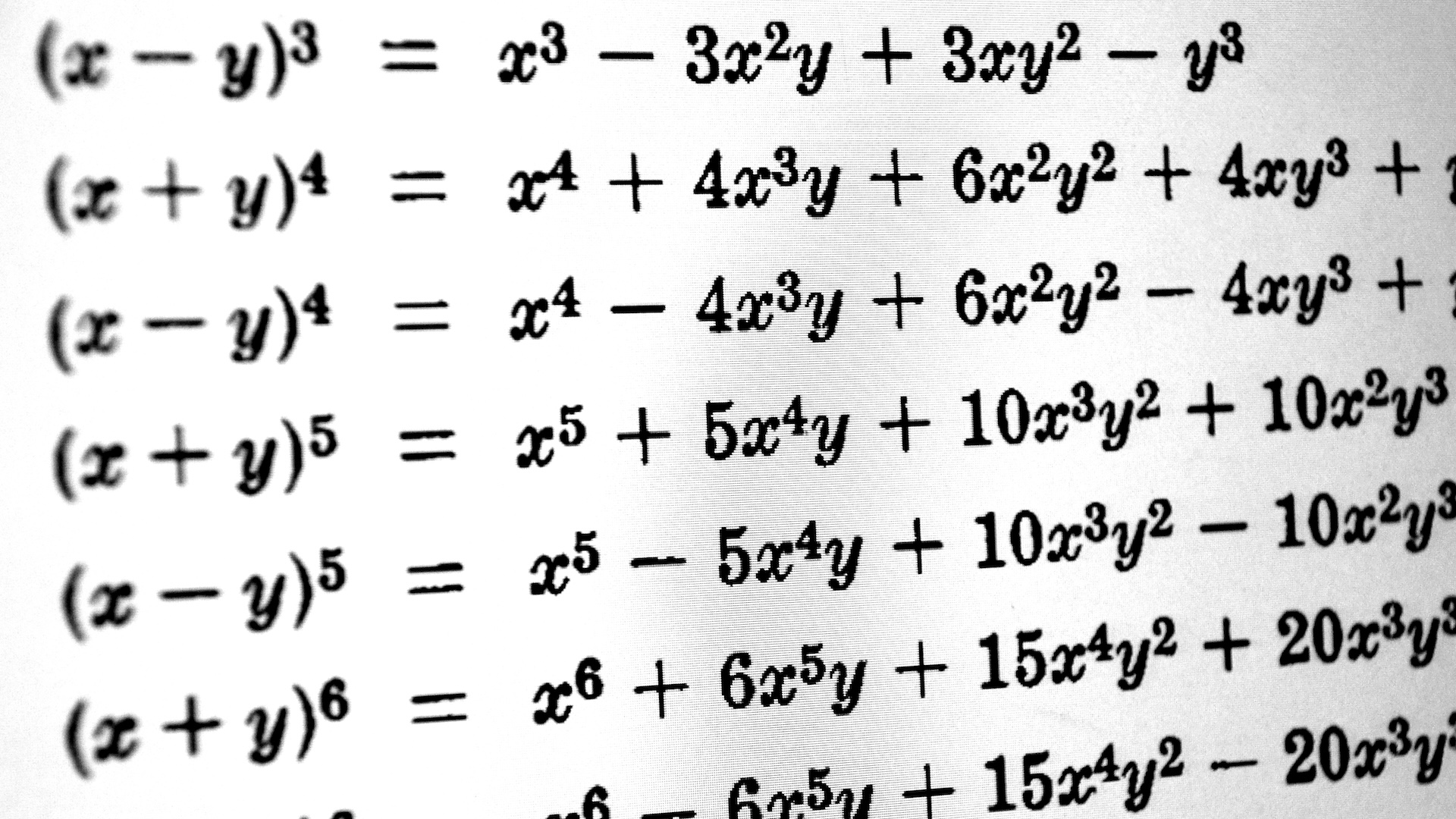
Polynomial equations are a cornerstone of modern science, providing a mathematical basis for celestial mechanics, computer graphics, market growth predictions and much more. But although most high schoolers know how to solve simple polynomial equations, the solutions to higher-order polynomials have eluded even seasoned mathematicians.

Now, University of New South Wales mathematician Norman Wildberger and independent computer scientist Dean Rubine have found the first general method for solving these devilishly difficult equations. They detailed their approach April 8 in the journal The American Mathematical Monthly.

A polynomial is a type of algebraic equation that involves variables raised to a non-negative power — for example, x² + 5x + 6 = 0. It is among the oldest mathematical concepts, tracing its roots back to ancient Egypt and Babylon.

Mathematicians have long known how to solve simple polynomials. However, higher-order polynomials, where x is raised to a power greater than four, have proved trickier. The approach most often used to solve two-, three- and four-degree polynomials relies on using the roots of exponential numbers, called radicals. The problem is that radicals often represent irrational numbers — decimals that keep going to infinity, like pi.

Related: Mathematicians just solved a 125-year-old problem, uniting 3 theories in physics

Although mathematicians can use radicals to find approximate solutions to individual higher-order polynomials, they have struggled to find a general formula that works for all of them. That’s because irrational numbers can never fully resolve. “You would need an infinite amount of work and a hard drive larger than the universe,” Wildberger said in a statement.

In their new method, Wildberger and his colleagues avoided radicals and irrational numbers entirely. Instead, they employed polynomial extensions known as power series. These are hypothetically infinite strings of terms with the powers of x, commonly used to solve geometric problems. They belong to a sub branch of mathematics known as combinatorics.

Get the world’s most fascinating discoveries delivered straight to your inbox.

The mathematicians based their approach on the Catalan numbers, a sequence that can be used to describe the number of ways to break down a polygon into triangles. This sequence was first delineated by Mongolian mathematician Mingantu around 1730 and was independently discovered by Leonhard Euler in 1751. Wildberger and Rubine realized that they could look to higher analogues of the Catalan numbers to solve higher-order polynomial equations. They called this extension “the Geode.”

The Geode has numerous potential applications for future research, especially in computer science and graphics. “This is a dramatic revision of a basic chapter in algebra,” Wildberger said.

Source link

Share. Facebook Twitter Pinterest LinkedIn Tumblr Email
Previous ArticlePlanet Nine? Astronomers spot potential ninth planet far beyond Neptune — but not everyone is convinced
Next Article Ancient Egyptians drew the Milky Way on coffins and tombs, linking them to sky goddess, study finds
Editor
  • Website

Related Posts

Lifestyle

Withings ScanWatch 2 review: Style meets next-level health monitoring

May 15, 2026
Lifestyle

AI Chatbots are turbo-charging violence against women and girls: We urgently need to regulate them | Yvonne McDermott Rees

May 15, 2026
Lifestyle

‘The biggest El Niño event since the 1870s’: ‘Super’ El Niño is now the most likely scenario by the end of this year ‪—‬ and the humanitarian cost could be huge

May 15, 2026
Add A Comment

Comments are closed.

Categories
  • Entertainment
  • Lifestyle
  • News
  • Sports
  • Tech
  • Travel
Recent Posts
  • Withings ScanWatch 2 review: Style meets next-level health monitoring
  • AI Chatbots are turbo-charging violence against women and girls: We urgently need to regulate them | Yvonne McDermott Rees
  • ‘The biggest El Niño event since the 1870s’: ‘Super’ El Niño is now the most likely scenario by the end of this year ‪—‬ and the humanitarian cost could be huge
  • Antarctica’s sudden sea ice loss is one of the most extreme and confusing events in the modern climate record. Scientists now know why it’s happening.
  • ‘I heard gasps’: Artemis II astronauts reveal inside story of their mind-bending solar eclipse
calendar
May 2026
M T W T F S S
 123
45678910
11121314151617
18192021222324
25262728293031
« Apr    
Recent Posts
  • Withings ScanWatch 2 review: Style meets next-level health monitoring
  • AI Chatbots are turbo-charging violence against women and girls: We urgently need to regulate them | Yvonne McDermott Rees
  • ‘The biggest El Niño event since the 1870s’: ‘Super’ El Niño is now the most likely scenario by the end of this year ‪—‬ and the humanitarian cost could be huge
About

Welcome to Baynard Media, your trusted source for a diverse range of news and insights. We are committed to delivering timely, reliable, and thought-provoking content that keeps you informed
and inspired

Categories
  • Entertainment
  • Lifestyle
  • News
  • Sports
  • Tech
  • Travel
Facebook X (Twitter) Pinterest WhatsApp
  • Contact Us
  • About Us
  • Privacy Policy
  • Disclaimer
  • UNSUBSCRIBE
© 2026 copyrights reserved

Type above and press Enter to search. Press Esc to cancel.