

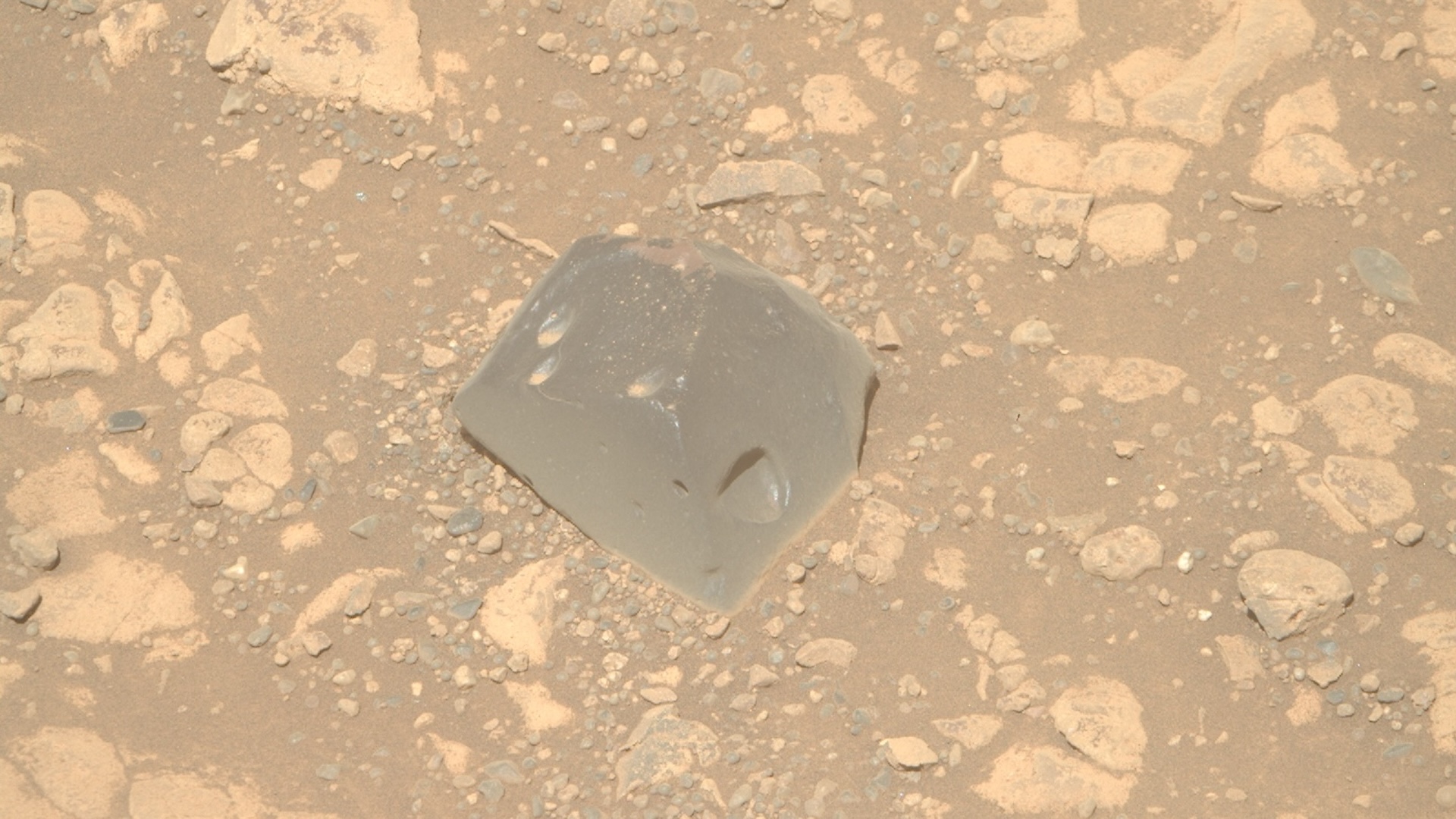
NASA’s Perseverance Mars rover has come across several unusual rocks that don’t seem to be in their original place.
Perseverance is currently searching for signs of ancient life in the hills and rocky outcrops along the rim of the Jezero Crater — a barren, bowl-shaped depression north of the Martian equator that scientists suspect held a huge lake billions of years ago. Since December 2024, the rover has been trekking down a tall slope called Witch Hazel Hill, which scientists hope will provide clues about Mars‘ past climate.
On April 11, Perseverance paused at a visually distinct geological boundary where light and dark rock outcrops meet. Here, one particular rock, which scientists nicknamed “Skull Hill,” stood out against the surrounding light-toned, rock-riddled surface due to its dark color, angular shape and pitted texture, according to a NASA blog post.
Related: Perseverance rover spots peculiar ‘spider egg’ rock on Mars — and scientists have no idea how it got there
The region, called Port Anson, contains several such rocks that may have been transported from elsewhere, scientists said. Known as “floats,” these loose rocks likely traveled vast distances billions of years ago when Mars possessed a warmer, wetter environment with rivers, lakes and potentially even oceans. As the water receded and softer surrounding material eroded over eons, the more resilient rocks remained perched on the Martian soil.
“We’ve found a few of these dark-toned floats in the Port Anson region,” the post noted. “The team is working to better understand where these rocks came from and how they got here.”
The mystery of Skull Hill
According to the post, the pits on Skull Hill may have formed in a couple of ways. Small pieces within Skull Hill itself might have become loose and eroded away, leaving the holes. Another possibility is that Martian winds, carrying tiny dust and rock particles, could have acted like sandpaper, slowly wearing away the rock’s surface and creating the pits.
The dark tone of Skull Hill and similar rocks could suggest they are meteorites, but recent analysis of their chemical data from Perseverance’s SuperCam instrument indicates their composition doesn’t match that of a typical meteorite.
Alternatively, these dark rocks could have a volcanic origin. On both Earth and Mars, minerals like olivine, pyroxene and biotite are known to give igneous rocks their dark color. If these rocks are indeed igneous, they might have come from nearby volcanic rock formations that have eroded away, or they could have been blasted out of the ground by an impact crater that excavated deeper volcanic layers.
“Luckily for us, the rover has instruments that can measure the chemical composition of rocks on Mars,” according to the post. “Understanding the composition of these darker-toned floats will help the team to interpret the origin of this unique rock.”
In the past few months, Perseverance has collected samples of five rocks, analyzed seven others in detail and zapped 83 more with its laser for remote study — the robotic explorer’s fastest pace of scientific data collection since landing on Mars four years ago, representatives of NASA’s Jet Propulsion Laboratory (JPL) said in another statement.
Mission scientists noted that it often takes months of searching the crater to find a scientifically unique rock worth sampling. On the crater rim, however, Perseverance is encountering new and intriguing rocks at every turn, according to the statement.
“Crater rims — you gotta love ’em,” Katie Morgan, Perseverance’s project scientist at JPL, said in the statement. “The last four months have been a whirlwind for the science team, and we still feel that Witch Hazel Hill has more to tell us — it has been all we had hoped for and more.”
Scientists are keen to get the samples Perseverance has collected back to Earth to determine if life ever existed on Mars. However, NASA’s Mars Sample Return mission is facing significant challenges with budget, timelines and technical complexities, leaving its future uncertain.
