
In 2020, astronomers observed for the first time what appeared to be a star engulfing one of its orbiting planets. But now, new evidence shows something else actually happened.
A planet certainly met its demise at the behest of its star, but now the way it happened looks much different. Rather than this star expanding, it drew the planet closer and closer until it was consumed, new evidence from NASA’s James Webb Space Telescope (JWST) reveals. This novel event serves as an equally fascinating first — even if it’s not what astronomers initially believed it to be. The researchers published their findings April 10 in The Astrophysical Journal.
“It’s not every day that we find these kinds of events,” the study’s first author, Ryan Lau, an assistant astronomer at the National Science Foundation National Optical-Infrared Astronomy Research Laboratory in Tucson, Arizona, told Live Science. This is “likely the first planetary engulfment event that was caught in the act.”
The celestial event, dubbed ZTF SLRN-2020, involves a star and its Jupiter-size planet, located in the Milky Way approximately 12,000 light-years from Earth. While watching the star, researchers noticed a bright flash of optical light, indicating that something — most likely a large planet — had been engulfed by the star, leaving only a cloud of dust behind.
‘A very different scenario’
Initially, researchers thought the star was similar to the sun and was following the natural life cycle of sunlike stars. A 2023 paper published in the journal Nature described the star as entering its final stage of life as a red giant, in which it balloons significantly as it exhausts its supply of hydrogen fuel. The sun will meet this fate in about 5 billion years, ultimately swallowing Mercury, Venus and, likely, Earth in the process.
But the data from JWST “paints a very different scenario,” Lau said. As JWST’s Mid-Infrared Instrument and Near-Infrared Spectrograph gathered information from the scene of the crime, a new picture appeared. The observations revealed that the star had not been emitting light in the form of infrared wavelengths expected from the transition into a red giant. In other words, it wasn’t as bright as expected, indicating that the red giant process likely wasn’t afoot.
Related: After 2 years in space, the James Webb telescope has broken cosmology. Can it be fixed?
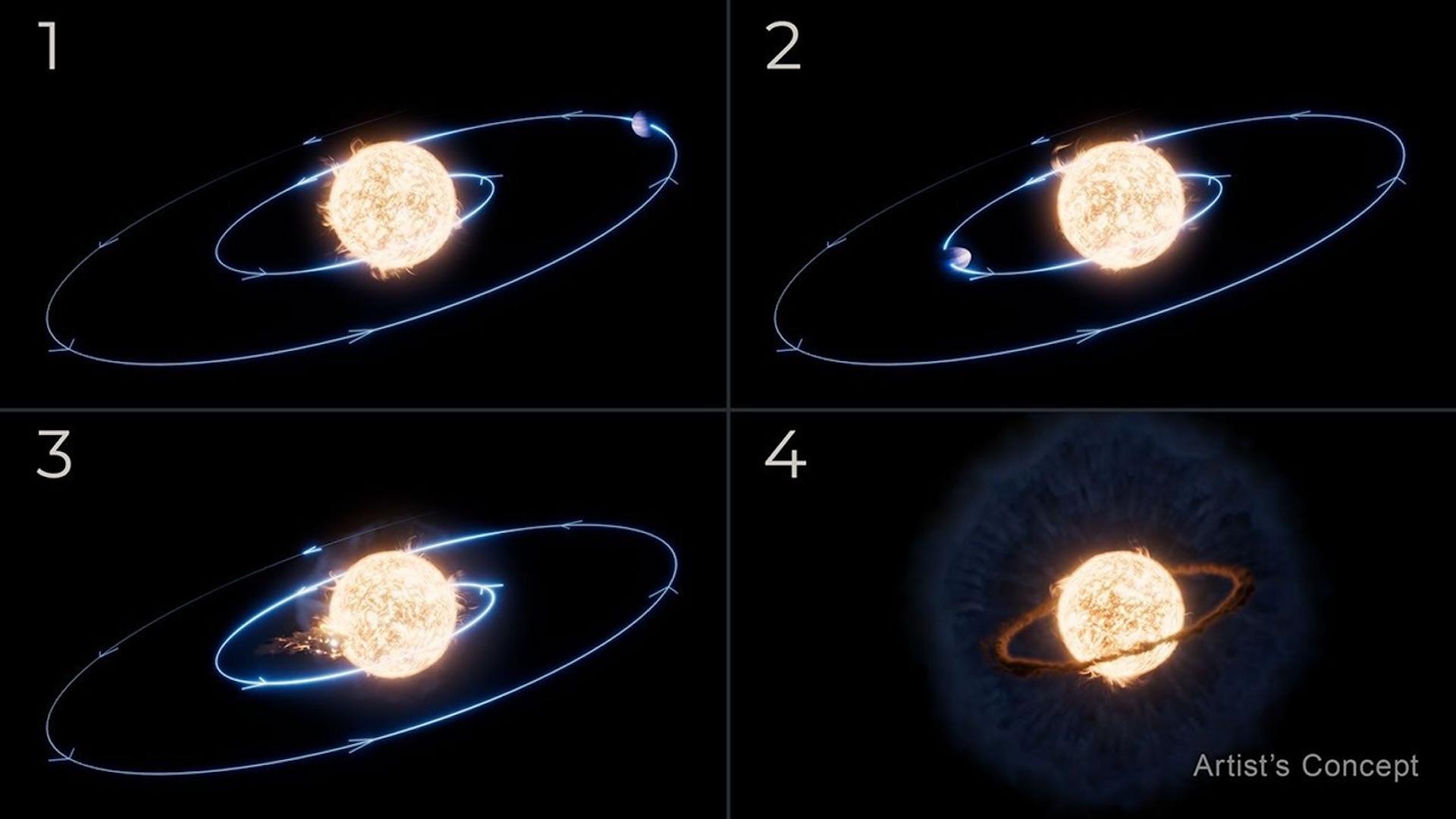
As for the devoured planet, the team proposes that it orbited unusually close to its host star — even closer than Mercury orbits the sun. Ultimately, the Jupiter-size planet started moving closer and closer to its star in a process called orbital decay. Lau and his team attribute this orbital decay to tidal interactions, a phenomenon in which strong gravitational forces between two celestial bodies can change the dynamics between those bodies.
The whole process probably took just a few months, Lau said. After the planet spiraled in toward the star, it made contact with the star’s surface. From there, drag forces sucked it into the star’s core, where it was fully engulfed. The star then ejected the planetary material, which created the brightening event first detected in 2020. This ejection also included longer-lasting infrared wavelengths and dust, which led astronomers to believe that the star had expanded, when, in fact, it did not.
Events like these can be hard to spot because the light signatures they produce are often quite faint. With the opening of the Vera C. Rubin Observatory, Lau said, these observational signatures — and their associated events — could become much easier to detect.
“We should be finding way more of these,” Lau said. “That’s one thing I’m very excited about.”
