Close Menu
  • Home
  • UNSUBSCRIBE
  • News
  • Lifestyle
  • Tech
  • Entertainment
  • Sports
  • Travel
Facebook X (Twitter) WhatsApp
Trending
  • 'This is the next jump in technology': World's first sub-1nm chip keeps Moore's Law alive a little longer
  • Scientists find thousands of earthquakes in a perfectly straight line in Alaska, revealing a hidden ‘microplate’
  • ‘You can’t patch your way out of it’: Cheap AI worm can spread between devices without human guidance — but how did scientists create it?
  • Diagnostic dilemma: After taking a medicine for years, a man suddenly had weird changes in his taste that made food disgusting
  • ‘A weird result from an already weird hominin’: Archaeologists discover all Homo naledi skeletons found in South African cave are female
  • China’s Einstein Probe detected a mysterious cosmic explosion — and scientists have no idea what caused it
  • Satellites reveal Earth has a surprising symmetry in the way it reflects light — and it might be tied to the El Niño cycle
  • Water might secretly be a mix of 2 different liquids, scientists say
Facebook X (Twitter) WhatsApp
Baynard Media
  • Home
  • UNSUBSCRIBE
  • News
  • Lifestyle
  • Tech
  • Entertainment
  • Sports
  • Travel
Baynard Media
Home»Lifestyle»‘If it weren’t for that asteroid, they might still share this planet’: Dinosaurs weren’t doomed before the asteroid hit, new study suggests
Lifestyle

‘If it weren’t for that asteroid, they might still share this planet’: Dinosaurs weren’t doomed before the asteroid hit, new study suggests

EditorBy EditorApril 8, 2025No Comments4 Mins Read
Share Facebook Twitter Pinterest LinkedIn Tumblr Reddit Telegram Email
Share
Facebook Twitter LinkedIn Pinterest Email

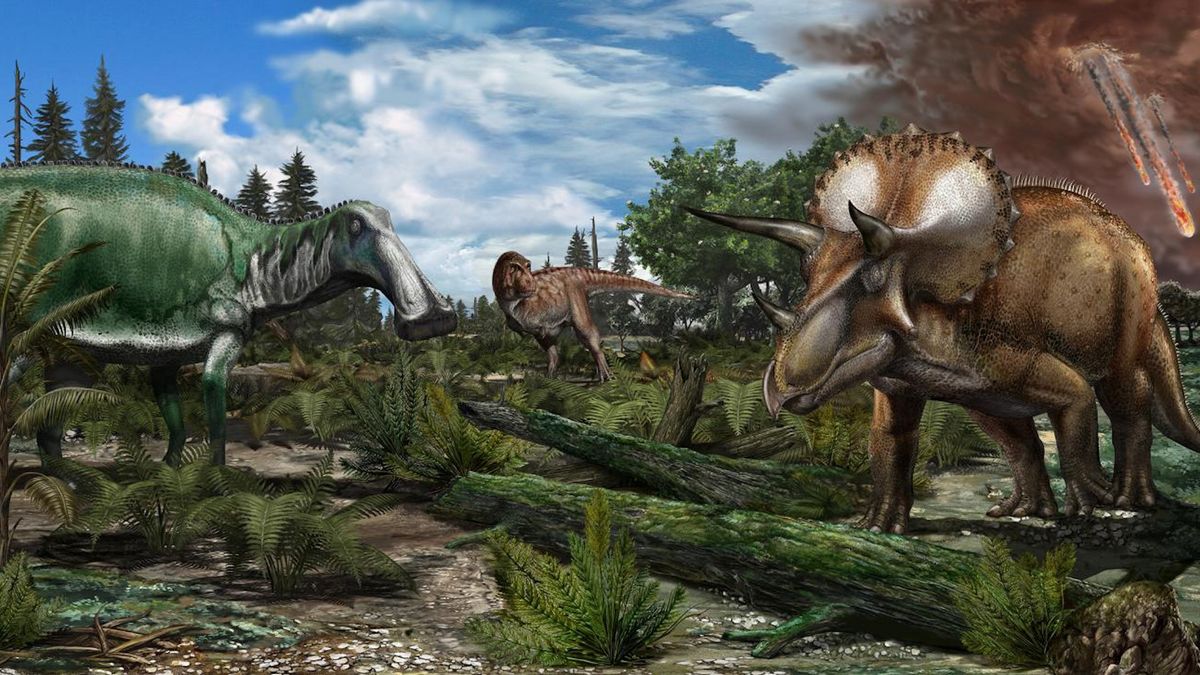
Dinosaurs weren’t in decline when an asteroid smashed into Earth and wiped them out, scientists say. Instead, the idea that dinosaur diversity was declining before the asteroid struck 66 million years ago is likely based on faulty fossil data, according to a study that looked at nearly 18 million years of fossil evidence.

Fossil discoveries have long indicated that dinosaurs were shrinking in numbers and diversity prior to the asteroid impact at the end of the Cretaceous period. Previously, some researchers believed this was a sign that dinosaurs were already on the road toward extinction even before the cataclysmic encounter with a space rock. However, this idea has long been controversial, with other researchers arguing that dinosaur diversity was doing just fine at the time of their demise.

“It’s been a subject of debate for more than 30 years — were dinosaurs doomed and already on their way out before the asteroid hit?” study lead author Chris Dean, a paleontologist at University College London, said in a statement.

Now, new research published Tuesday (April 8) in the journal Current Biology suggests that the apparent rarity of dinosaurs before their extinction may simply be due to a poor fossil record.

The scientists studied records of around 8,000 fossils from North America dating to the Campanian age (83.6 million to 72.1 million years ago) and Maastrichtian age (72.1 million to 66 million years ago), focusing on four families: the Ankylosauridae, Ceratopsidae, Hadrosauridae and Tyrannosauridae.

At face value, their analysis showed that dinosaur diversity peaked around 76 million years ago, then shrank until the asteroid strike wiped out the nonavian dinosaurs. This trend was even more pronounced in the 6 million years before the mass extinction, with the number of fossils from all four families decreasing in the geological record.

a comic showing the passage of time in the North American continent

A graphic illustration of the new study that shows the passage of time in North American as well as the methods used to assess fossil prevalence. (Image credit: Tim Bird )

However, there is no indication of environmental conditions or other factors that would explain this decline, the researchers found. All of the dinosaur families were widespread and common, according to models developed by the researchers — and thus at low risk for extinction, barring a catastrophic event such as the asteroid impact.

Get the world’s most fascinating discoveries delivered straight to your inbox.

Rather, the Maastrichtian may have had poorer geological conditions for fossilization, the researchers suggested. Events such as the retreat of the Western Interior Seaway, which once ran from the Gulf of Mexico up through the Arctic, and the rise of the Rocky Mountains starting around 75 million years ago, may have impeded or disrupted fossilization, making it appear as if there were fewer dinosaurs and less diversity during that time.

The team also found that geological outcrops from the Maastrichtian of North America were not exposed, or were covered by vegetation. In other words, rock from this time that might hold dinosaur fossils was not readily accessible to researchers who were searching for the remains. Because half of the known fossils from this period are from North America, the study’s findings may have global implications as well.

Two paleontologists collect samples from a rocky canyon

Two paleontologists search for dinosaur fossils in North American rocks dating to the Cretaceous period. (Image credit: Alfio Alessandro Chiarenza)

Among the 8,000 fossil records examined, the team found that Ceratopsians — a group that includes horned dinosaurs like Triceratops and its relatives — were the most common, probably because they inhabited plain regions that were most conducive to preservation during the Maastrichtian. Hadrosaurians — duck-billed dinosaurs — were the least common, possibly due to their preference for rivers. Reductions in river flow may have led to fewer depositions of sediment that could have preserved these dinosaurs, the researchers wrote in the study.

“Dinosaurs were probably not inevitably doomed to extinction at the end of the Mesozoic [252 million to 66 million years ago],” study co-author Alfio Alessandro Chiarenza, a paleontologist at University College London, said in a statement. “If it weren’t for that asteroid, they might still share this planet with mammals, lizards, and their surviving descendants: birds.”

Source link

Share. Facebook Twitter Pinterest LinkedIn Tumblr Email
Previous Article6,500-year-old hunting kit found in Texas cave contains one of the oldest known weapon collections ever found in North America
Next Article Scientists finally know how long a day on Uranus is — 40 years after Voyager 2 first tried to calculate it
Editor
  • Website

Related Posts

Lifestyle

'This is the next jump in technology': World's first sub-1nm chip keeps Moore's Law alive a little longer

June 25, 2026
Lifestyle

Scientists find thousands of earthquakes in a perfectly straight line in Alaska, revealing a hidden ‘microplate’

June 25, 2026
Lifestyle

‘You can’t patch your way out of it’: Cheap AI worm can spread between devices without human guidance — but how did scientists create it?

June 25, 2026
Add A Comment

Comments are closed.

Categories
  • Entertainment
  • Lifestyle
  • News
  • Sports
  • Tech
  • Travel
Recent Posts
  • 'This is the next jump in technology': World's first sub-1nm chip keeps Moore's Law alive a little longer
  • Scientists find thousands of earthquakes in a perfectly straight line in Alaska, revealing a hidden ‘microplate’
  • ‘You can’t patch your way out of it’: Cheap AI worm can spread between devices without human guidance — but how did scientists create it?
  • Diagnostic dilemma: After taking a medicine for years, a man suddenly had weird changes in his taste that made food disgusting
  • ‘A weird result from an already weird hominin’: Archaeologists discover all Homo naledi skeletons found in South African cave are female
calendar
June 2026
M T W T F S S
1234567
891011121314
15161718192021
22232425262728
2930  
« May    
Recent Posts
  • 'This is the next jump in technology': World's first sub-1nm chip keeps Moore's Law alive a little longer
  • Scientists find thousands of earthquakes in a perfectly straight line in Alaska, revealing a hidden ‘microplate’
  • ‘You can’t patch your way out of it’: Cheap AI worm can spread between devices without human guidance — but how did scientists create it?
About

Welcome to Baynard Media, your trusted source for a diverse range of news and insights. We are committed to delivering timely, reliable, and thought-provoking content that keeps you informed
and inspired

Categories
  • Entertainment
  • Lifestyle
  • News
  • Sports
  • Tech
  • Travel
Facebook X (Twitter) Pinterest WhatsApp
  • Contact Us
  • About Us
  • Privacy Policy
  • Disclaimer
  • UNSUBSCRIBE
© 2026 copyrights reserved

Type above and press Enter to search. Press Esc to cancel.