

Dire wolves went extinct around 12,500 years ago. Now, thanks to genetic engineering, they’re back in what the scientists have described as the “world’s first de-extinction.”
Scientists at Colossal Biosciences, a biotech-based conservation company best known for trying to bring back woolly mammoths, say they have successfully produced three dire wolf (Aenocyon dirus) pups. They did this by reconstructing the wolf’s genome from ancient DNA, identifying versions of genes seen only in dire wolves and not in the extinct carnivores’ living relatives.
The team then tweaked DNA from modern-day gray wolves (Canis lupus) to include these unique gene variants. They inserted the DNA into denucleated gray wolf egg cells and allowed them to mature in the lab before introducing them into surrogate dogs’ wombs, TIME reported. Three embryos successfully implanted in three surrogate dogs, leading to the births of snowy white pups named Romulus, Remus and Khaleesi, which are reminiscent of Ghost, Jon Snow’s dire wolf in HBO’s “Game of Thrones” television series.
Related: ‘We didn’t know they were going to be this cute’: Scientists unveil genetically engineered ‘woolly mice’
“Our team took DNA from a 13,000 year old tooth and a 72,000 year old skull and made healthy dire wolf puppies,” Colossal CEO Ben Lamm said in a statement. “It was once said, ‘any sufficiently advanced technology is indistinguishable from magic.’ Today, our team gets to unveil some of the magic they are working on.”
How to make a dire wolf
To “de-extinct” the dire wolf, the team used a process similar to the one that led to Dolly the sheep in 1996.
To produce a perfect clone with this method a single cell is removed from the cloning subject and its genetic material, held in the cell’s nucleus, is extracted. This genetic information is then inserted into the egg of a donor animal from the same species whose own nucleus has been removed. The egg now contains all of the genetic information required to rebuild the original cloning subject and is transferred to a surrogate to carry to term.
However, because dire wolves went extinct at the end of the last ice age, Colossal had to approximate their own dire wolf cells by piecing together clues from the fossil record.
To reconstruct the animal’s genome, they used genetic samples from dire wolf fossils and compared these to the genomes of their living relatives, including wolves, jackals and foxes. They selected gray wolves to be the egg donors, as these animals are the closest living cousins to dire wolves.

This genomic analysis enabled the scientists to identify 20 key differences in 14 genes that were responsible for the dire wolves’ distinguishing characteristics, including their larger size, white coat, larger teeth and characteristic howling.
Next, they collected cells from blood samples of living gray wolves — a less invasive method than using a chunk of tissue, as was done for Dolly the sheep. Then, using CRISPR gene-editing technology, the team made 20 edits to the 14 identified genes so that they bore the same sequence as the wolves’ ancient relatives.
Once these “dire wolf cells” were created, their nuclei were extracted and inserted into eggs from a living gray wolf. As with Dolly the sheep, these donor egg cells had their own nuclei removed to make space for the new DNA. Reproductive cells — like eggs and sperm — normally have just one copy of each chromosome; however, cells from the body carry two copies. So transferring the nucleus from a body cell into a reproductive cell provides it with all the genetic instructions needed to mature into an embryo.
The eggs were allowed to mature into embryos in the lab, resulting in 45 embryos that were transferred into the wombs of two domestic dogs, which are technically a subspecies of the gray wolf.
Only one embryo in each surrogate took hold. After 65 days of gestation, Romulus and Remus were born via cesarean section, on Oct. 1, 2024. The whole process was repeated again a few months later with a third surrogate dog, who birthed Khaleesi three months later.
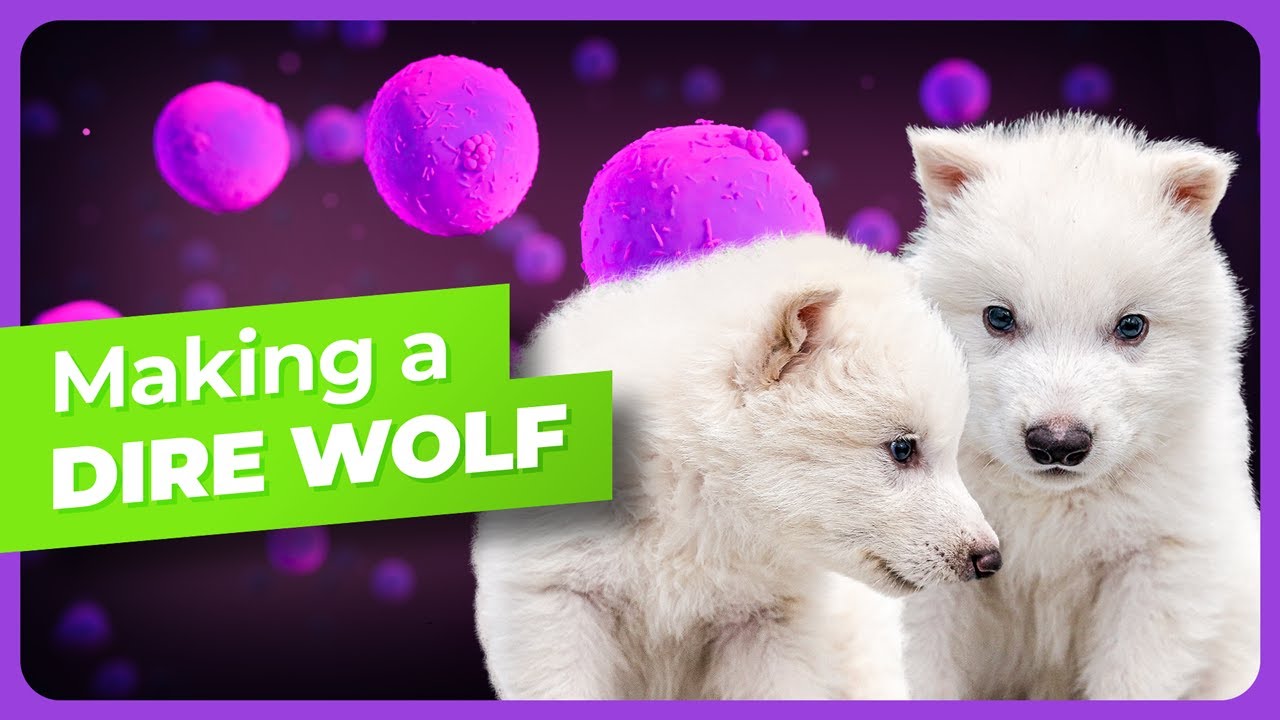
Colossal has shared footage of Romulus and Remus as they take their first steps, make their first howls and develop from newborns into young cubs. They have described the dire wolves as “the world’s first de-extinction.”
However, there has been one other de-extinction: In 2003 scientists in Spain cloned an extinct wild goat species known as a bucardo, or a Pyrenean ibex (Capra pyrenaica pyrenaica). But the newborn goat died only minutes after birth, according to a 2009 study.

Colossal have also announced the birth of two litters of cloned red wolves, the most critically endangered wolf in the world, the company said in a statement.
The announcement comes just months after Colossal unveiled genetically engineered “woolly mice”, which have fur similar to the thick hair of woolly mammoths, marking a major milestone in the company’s project to bring back these ice age titans by 2028.
