
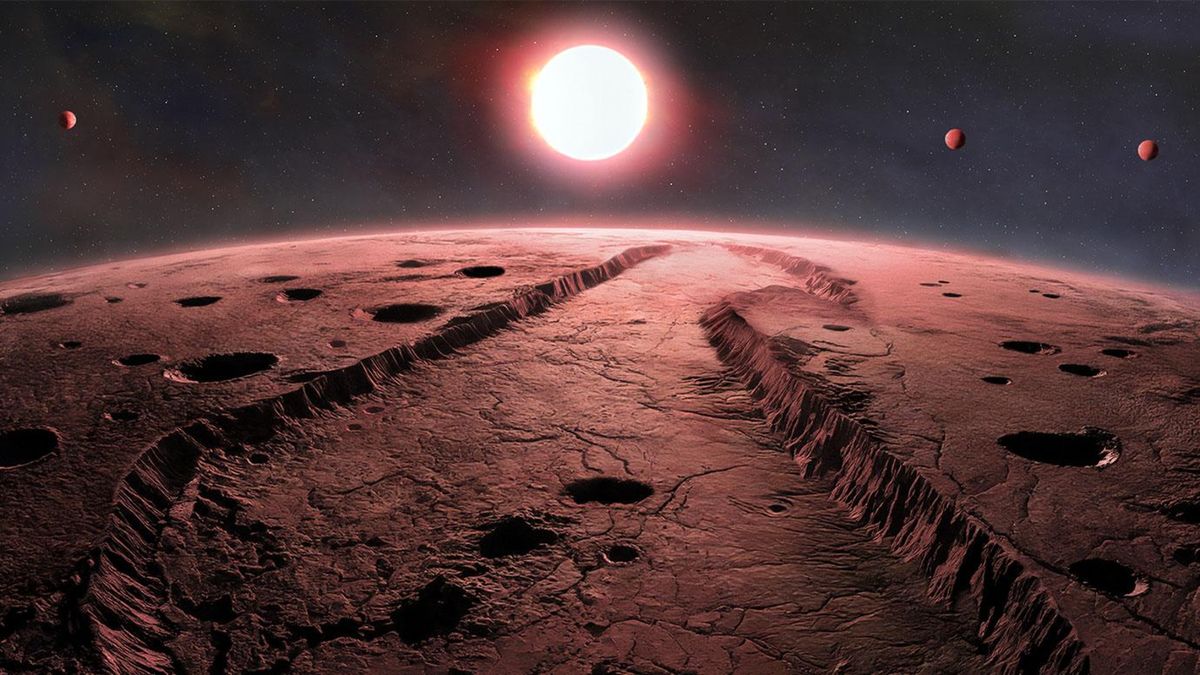
A quartet of Earth-like worlds, each about 20% to 30% the size of our planet, circle one of our closest stellar neighbors, a new study reveals. The rocky alien worlds are close enough that future generations of humans may be able to visit them with futuristic rocket propulsion technology. However, it is unlikely that we will find any life there.
Astronomers have long suspected that there was at least one exoplanet orbiting Barnard’s Star — a red dwarf with a mass around one-sixth that of the sun. At 5.97 light-years from Earth, it is the fourth-closest star to our solar system, after the three interconnected stars of the Alpha Centauri system. (Five potential planets have also been detected around the stars of Alpha Centauri, though not all of them have been confirmed yet.)
In the past, researchers assumed that Barnard’s Star was circled by a gas giant exoplanet similar to Jupiter, because the star frequently wobbles closer to and then farther from Earth. This suggests that something is gravitationally tugging on the star, similar to how the moon pulls on our planet and causes Earth’s tides. However, proving the existence of such a planet has remained elusive.
But in a new study, published March 11 in The Astrophysical Journal Letters, researchers say they have discovered that this wobbling is not caused by the pull of one gas giant but instead by the combined force exerted by four smaller, rocky worlds, each around four times more massive than Mercury.
“It’s a really exciting find,” study lead author Ritvik Basant, a doctoral candidate at the University of Chicago, said in a statement. “Barnard’s Star is our cosmic neighbor, and yet we know so little about it.”
Related: 32 alien planets that really exist

The newly detected worlds, which have not been officially named yet, are “so close to their home star that they zip around the entire star in a matter of days,” the researchers wrote. “That probably means they are too hot to be habitable.”
The new findings also likely rule out the possibility that any other exoplanets circle within the habitable zone of Barnard’s Star, they added.
But that doesn’t mean this system will remain uninhabited forever. Although Barnard’s Star is currently out of reach for humans using current rocket propulsion technology, future human generations might be able to travel to and colonize these newly discovered planets using new forms of rocket propulsion, such as nuclear fusion engines or light sails.
Finding hidden planets
Most exoplanets are discovered when they pass in front of their home star and block out some of the light shining toward Earth. However, in this case, researchers think we are looking at Barnard’s Star from above, meaning its planets do not pass in between it and us. As a result, scientists often refer to our stellar neighbor as “great white whale” of planet hunting, researchers wrote.
To get around this problem, the study team turned to MAROON-X, an instrument attached to the Gemini North telescope on Hawaii’s Mauna Kea volcano. Over 112 nights during a three-year period, the telescope detected subtle shifts in the movement of Barnard’s Star in order to “tease apart the number and masses of the planets that must be circling the star to have this effect,” the researchers wrote.

Initially, MAROON-X identified only three planets. However, in another study, published in October 2024, researchers identified another planet using a similar device, dubbed ESPRESSO, at the Very Large Telescope in Chile. By combining these data with their own, the researchers could see this fourth planet for themselves.
Using data from both MAROON-X and ESPRESSO also challenges the idea that the researchers are being misled by anomalies in either data set, making them more confident in their results.
Red dwarfs are the most common star type in the universe, but most are too far from Earth for researchers to easily spot planets around them. However, the new results hint that small, rocky planets could be abundant around these miniature stars.
But for the study team, the most exciting thing about the new research was finding worlds that are so close to Earth.
“We found something that humanity will hopefully know forever,” Jacob Bean, an astronomer at the University of Chicago who specializes in exoplanet systems, said in the statement. “That sense of discovery is incredible.”
