Close Menu
  • Home
  • UNSUBSCRIBE
  • News
  • Lifestyle
  • Tech
  • Entertainment
  • Sports
  • Travel
Facebook X (Twitter) WhatsApp
Trending
  • Arthritis drug shows antiviral effects against RSV, the leading cause of infant hospitalization
  • Daddy longlegs may be capturing and devouring frogs in the tropical forests of South America
  • Google wants to release 64 million bacteria-riddled mosquitoes across California and Florida. Here’s why scientists are enthusiastic.
  • ‘In an unrecoverable state’: NASA confirms MAVEN spacecraft is officially dead after loss of signal behind Mars
  • 2 rivers merged to form the Euphrates 3.6 million years ago, eventually leading to the Fertile Crescent
  • NASA confirms fireball meteor exploded over northeastern US with force of 230 tons of TNT
  • Astronauts could use lightning-like plasma jets to kill germs on the moon and Mars, demo hints
  • First whole-genome sequence of a Greenland shark holds clues to their extreme longevity
Facebook X (Twitter) WhatsApp
Baynard Media
  • Home
  • UNSUBSCRIBE
  • News
  • Lifestyle
  • Tech
  • Entertainment
  • Sports
  • Travel
Baynard Media
Home»Lifestyle»35,000-year-old ‘tortoise shell’ carving may be Holy Land’s oldest evidence of ritual behavior
Lifestyle

35,000-year-old ‘tortoise shell’ carving may be Holy Land’s oldest evidence of ritual behavior

EditorBy EditorDecember 13, 2024No Comments4 Mins Read
Share Facebook Twitter Pinterest LinkedIn Tumblr Reddit Telegram Email
Share
Facebook Twitter LinkedIn Pinterest Email

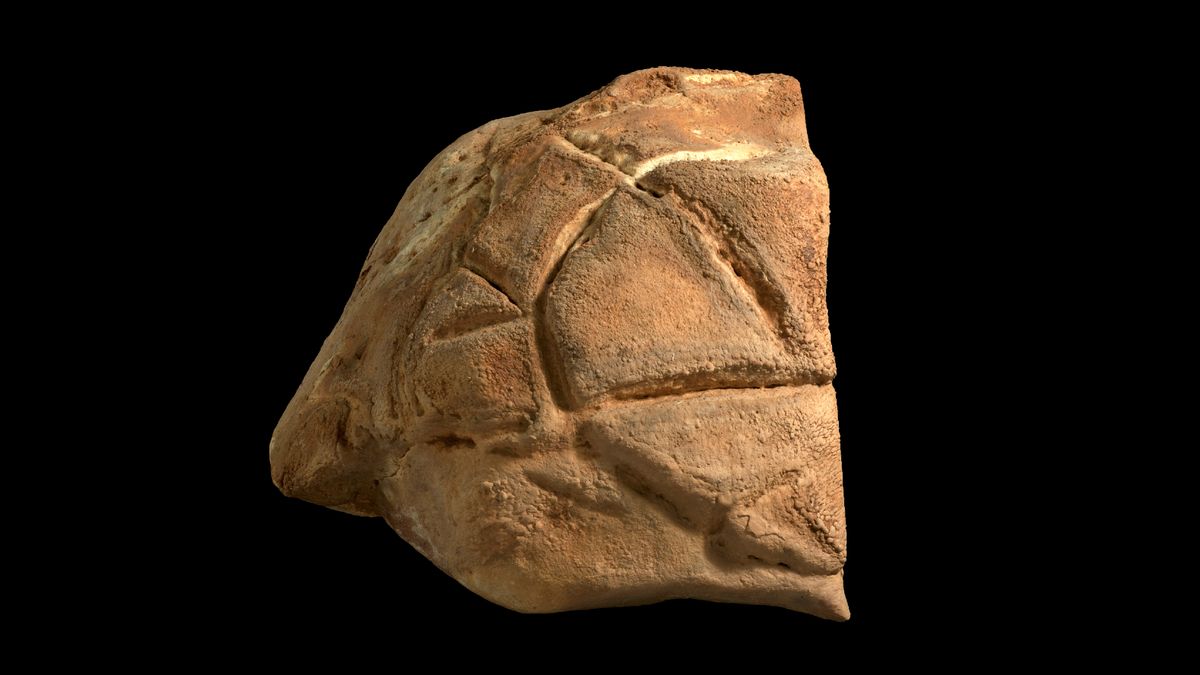
A granite boulder carved more than 35,000 years ago deep in a cave in Israel may be the oldest evidence of ritual practices in the Holy Land, a new study suggests.

The grooves carved into the boulder look strikingly similar to the pattern of a tortoise shell. While it’s unknown what this design means, it’s possible that this was an ancient symbol of unification, according to study co-author Israel Hershkovitz, a physical anthropologist at Tel Aviv University.

In that case, it may be that the sections of the shell, known as “scutes,” may have represented distinctive groups of people who had been integrated into the ancient society, Hershkovitz told Live Science.

The ritual boulder was discovered deep within Manot Cave, in the Galilee region of northern Israel, where Hershkovitz has led excavations since 2010.

The cave was discovered by construction workers in 2008 and the archaeological work initially involved areas near the cave’s entrance where prehistoric people lived, carrying out activities such as shaping stone tools, butchering animals and eating, Hershkovitz said. But the team didn’t discover the ritual boulder deep in the cave until 2013, he said.

“It was quite a surprise, because we were concentrating close to the entrance, where there was more light and people were living,” he said. But “it was so dark and deep there, we rarely visited that part.”

Related: Evidence of Assyrians’ conquest of Holy Land discovered in Jerusalem

Get the world’s most fascinating discoveries delivered straight to your inbox.

Turtle rock

According to the study, the chamber containing the carved boulder was separated from the living areas behind a gallery of large stalagmites and stalactites.

The granite boulder weighs more than 60 pounds (28 kilograms) and is a little less than a foot (30 centimeters) across. It was discovered in a niche in the back wall of the chamber and was the only artifact found nearby.

The rock’s upper surface is carved with deep grooves; the authors noted that the carving was made at roughly the same time as some of the oldest known cave paintings in France.

Although there may be some earlier evidence of ritual practices by modern humans, such as the 40,000-year-old “lion man” stone figurine from a cave in Germany, the study noted that the boulder in the Manot Cave is the earliest evidence of ritual practices in the eastern Mediterranean region.

Image 1 of 3

A photo inside Manot Cave
(Image credit: Guy Geva/Israel Hershkovitz)

The carved boulder was found in a niche in the back wall of the Manot Cave in Israel’s northern Galilee region, roughly near the center of this photograph.

A photo inside Manot Cave
(Image credit: Guy Geva/Israel Hershkovitz)

The ritual chamber is separated from the living areas near the entrance of the cave, which archaeological excavations show was occupied by early humans more than 33,000 years ago.

A photo inside Manot Cave
(Image credit: Guy Geva/Israel Hershkovitz)

The Manot Cave was discovered by construction workers in 2008 but the ritual chamber deep in the cave was not discovered until 2013.


Ancient cave

Examinations of the ritual boulder suggest the grooves were deliberately carved with flint tools, while analysis of the calcite crusts in some of the grooves date it to between 35,000 and 37,000 years ago, according to the study, published Dec. 9 in the journal PNAS.

The dating places the carved boulder within the Early Upper Paleolithic period, from about 33,000 to 48,000 years ago, when Homo sapiens hunter-gatherers were adding new stone tool technologies to much older ones.

According to the study, particles of wood ash found in the outer layers of the stalactites and stalagmites within the boulder chamber indicate that it was illuminated by fire, possibly during ritual gatherings. Acoustic tests also revealed that the chamber was “well-suited for communal gatherings,” by facilitating conversations, speeches and hearing, the researchers found.

“Our data from Manot Cave testified to the existence of some initial forms of collective ritual practices already in the Early Upper Paleolithic,” the authors wrote. “The existence of a ritual compound at Manot Cave is not surprising … [It was] a successful adaptive strategy to cope with the large demographic and economic challenges human society faced in the Upper Paleolithic.”

Source link

Share. Facebook Twitter Pinterest LinkedIn Tumblr Email
Previous ArticleParents Defending Education founder calls Biden admin’s spending spree on DEI in schools a ‘slap in the face’
Next Article 11 gift baskets to consider this Christmas
Editor
  • Website

Related Posts

Lifestyle

Arthritis drug shows antiviral effects against RSV, the leading cause of infant hospitalization

June 4, 2026
Lifestyle

Daddy longlegs may be capturing and devouring frogs in the tropical forests of South America

June 3, 2026
Lifestyle

Google wants to release 64 million bacteria-riddled mosquitoes across California and Florida. Here’s why scientists are enthusiastic.

June 3, 2026
Add A Comment

Comments are closed.

Categories
  • Entertainment
  • Lifestyle
  • News
  • Sports
  • Tech
  • Travel
Recent Posts
  • Arthritis drug shows antiviral effects against RSV, the leading cause of infant hospitalization
  • Daddy longlegs may be capturing and devouring frogs in the tropical forests of South America
  • Google wants to release 64 million bacteria-riddled mosquitoes across California and Florida. Here’s why scientists are enthusiastic.
  • ‘In an unrecoverable state’: NASA confirms MAVEN spacecraft is officially dead after loss of signal behind Mars
  • 2 rivers merged to form the Euphrates 3.6 million years ago, eventually leading to the Fertile Crescent
calendar
June 2026
M T W T F S S
1234567
891011121314
15161718192021
22232425262728
2930  
« May    
Recent Posts
  • Arthritis drug shows antiviral effects against RSV, the leading cause of infant hospitalization
  • Daddy longlegs may be capturing and devouring frogs in the tropical forests of South America
  • Google wants to release 64 million bacteria-riddled mosquitoes across California and Florida. Here’s why scientists are enthusiastic.
About

Welcome to Baynard Media, your trusted source for a diverse range of news and insights. We are committed to delivering timely, reliable, and thought-provoking content that keeps you informed
and inspired

Categories
  • Entertainment
  • Lifestyle
  • News
  • Sports
  • Tech
  • Travel
Facebook X (Twitter) Pinterest WhatsApp
  • Contact Us
  • About Us
  • Privacy Policy
  • Disclaimer
  • UNSUBSCRIBE
© 2026 copyrights reserved

Type above and press Enter to search. Press Esc to cancel.