Close Menu
  • Home
  • UNSUBSCRIBE
  • News
  • Lifestyle
  • Tech
  • Entertainment
  • Sports
  • Travel
Facebook X (Twitter) WhatsApp
Trending
  • Chinese medical practitioners used extremely toxic plant as a topical anesthetic 600 years ago, study finds
  • Bead net funerary shroud: A 2,500-year-old beaded veil from Egypt depicting the deceased’s transformation into Osiris
  • Rare genetic disease makes scientists reconsider what the ‘seat of fear’ in the brain really is
  • It’s illegal to repair most of our devices. There’s a surprising reason for that.
  • Jupiter’s Ganymede, the largest moon in the solar system, may be heating up
  • Bizarre patterns on Venus have scientists puzzled
  • Scientists trained an AI model using an IBM quantum computer — and it answered questions correctly that the base model couldn’t
  • How did animals survive the asteroid that killed the dinosaurs?
Facebook X (Twitter) WhatsApp
Baynard Media
  • Home
  • UNSUBSCRIBE
  • News
  • Lifestyle
  • Tech
  • Entertainment
  • Sports
  • Travel
Baynard Media
Home»Lifestyle»2,200-year-old Celtic settlement discovered in Czech Republic — and it’s awash in gold and silver coins
Lifestyle

2,200-year-old Celtic settlement discovered in Czech Republic — and it’s awash in gold and silver coins

EditorBy EditorJuly 20, 2025No Comments4 Mins Read
Share Facebook Twitter Pinterest LinkedIn Tumblr Reddit Telegram Email
Share
Facebook Twitter LinkedIn Pinterest Email

A 2,200-year-old Celtic settlement containing several hundred coins and over 1,000 pieces of jewelry has been discovered in the Bohemia region of the Czech Republic.

The site, “unparalleled in its scale and character in Bohemia,” held a vast number of ancient riches, including amber and fine pottery, Museum of Eastern Bohemia representatives said in a translated statement. The site was not fortified, suggesting that the people who lived were major players in regional trade.

The settlement was discovered by archaeologists who were surveying the area before a motorway was built. In addition to the valuable artifacts, they found the remains of buildings, including dwellings, production facilities and at least one religious sanctuary, according to the statement.


You may like

The settlement, near the city of Hradec Králové in the north-central Czech Republic, was large — about 62 acres (25 hectares), or about the size of nearly 47 American football fields, said Tomáš Mangel, a professor of archaeology at the University of Hradec Králové who is co-leading the excavation.

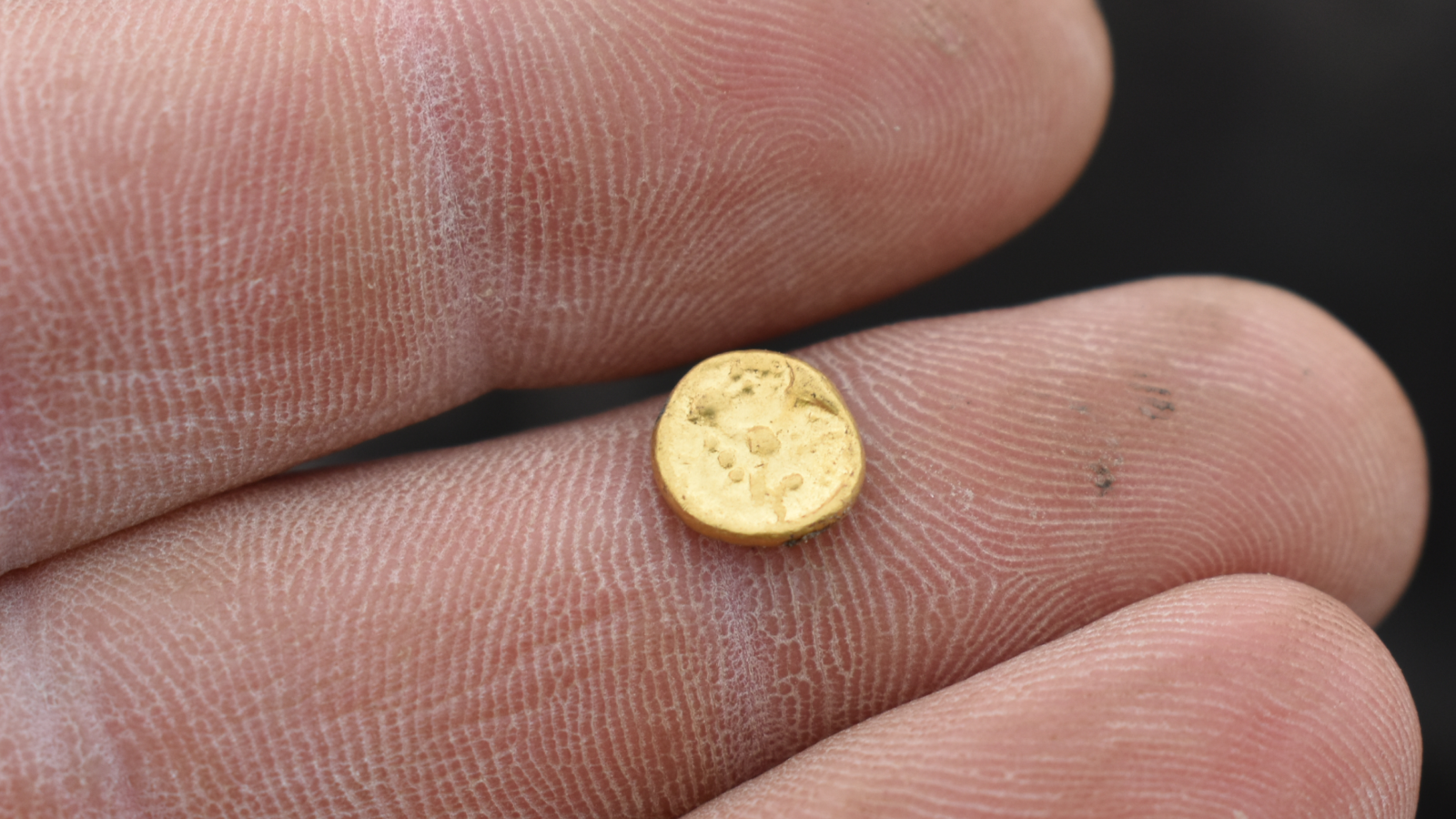
Some of the coins are silver, and some are gold, the statement said. While it’s not yet clear exactly how many coins have been found, there appear to be several hundred, Mangel told Live Science in an email. The jewelry includes “pieces of bronze and iron brooches, fragments of armlets, metallic components of belts, glass beads and armlets,” Mangel said.

The site dates to the La Tène culture, an Iron Age culture that flourished in parts of Europe from roughly 450 to 40 B.C. The culture is generally associated with the Celts and has similarities in the crafting of its art and artifacts, many of which have anthropomorphic designs.

The newly found settlement helps us better understand how settlements were organized between the third century and the first century B.C., Mangel said.

Get the world’s most fascinating discoveries delivered straight to your inbox.

Related: Were the Celts matriarchal? Ancient DNA reveals men married into local, powerful female lineages

Image 1 of 4

Pictured archaeological finds in Hradec Kralove, Czech Republic, July 3, 2025.
(Image credit: David Tanecek/CTK Photo/Alamy Live News )

A piece of pottery depicting a horse was found at the settlement. The people appear to have made luxurious ceramics, possibly for trade.

Archaeological excavation of celtic settlement; small golden coin found in the ground.
(Image credit: Photo courtesy of Tomas Mangel)

The coins were found throughout the Celtic settlement.

An archaeological excavation of Celtic settlement; an archaeologist takes photos of the site with a camera.
(Image credit: Photo courtesy of Tomas Mangel)

The remains of a number of structures were found during the excavations, which were conducted before a new motorway was built in the area.

Archaeological excavation of celtic settlement; excavation photographed next to road.
(Image credit: Photo courtesy of Tomas Mangel)

The ancient Celtic site is spread across roughly 62 acres (25 hectares).


Who lived here?

Historically, the Celts were different groups that lived across continental Europe, including the Gauls in France and the Celtiberians in Iberia. Traditionally, the Celtic people who lived in Bohemia were believed to be from a tribe called the Boii. However, Mangel said we cannot be sure that the Boii actually lived at the newfound site. There were other Celtic groups that lived in the region and no inscriptions have been found at the site that tell us who exactly was living there.

“Bohemia is traditionally really connected with [the] Boii,” Mangel said. “But the research [done recently] shows that we can only say that [the] Boii were settled somewhere in Central Europe.”

Archaeological excavation of celtic settlement; digger removing dirt during excavation.

The settlement dates back around 2,200 years and was situated on a trade route that brought amber north to south. (Image credit: Photo courtesy of Tomas Mangel)

While some researchers used to think the name “Bohemia” came from the word “Boii,” he said, the two words may not be directly related. The name Boii was connected to Boiohaemum, which was an ancient name for the region, Mangel said. The name Boiohaemum was in turn connected to Bohemia, which today is part of the Czech Republic.

The “connection Boii – Boiohaemum – Bohemia – Czech Republic is rather cliché based on misinterpretations of historical sources in the 19th and earlier 20th [century],” Mangel said. “It is simply not correct.”

“Amber route corridor”

The discovery of the rich artifacts, including the amber and fine pottery, suggests that the people who lived there likely traded amber and other products on routes across Europe, the statement said, noting that luxurious ceramics may have been made at the settlement.

Maciej Karwowski, an archaeologist at the University of Vienna who was not involved with the excavation, told Live Science in an email that “the newly discovered site is particularly interesting.”

It is similar to other settlements found on the “amber route corridor,” Karwowski said. This trade system transported amber from the Baltic and North seas to Central Europe during this time period.

A museum exhibit featuring some of the artifacts from the settlement will debut during the winter holidays, the statement said.


Celtic quiz: Test your knowledge about these fierce tribes once described by Julius Caesar

Source link

Share. Facebook Twitter Pinterest LinkedIn Tumblr Email
Previous ArticleFreddie Prinze Jr. shares key to lasting marriage with Sarah Michelle Gellar
Next Article Trump asks Department of Justice to release ‘all Grand Jury testimony’  from Epstein case
Editor
  • Website

Related Posts

Lifestyle

Chinese medical practitioners used extremely toxic plant as a topical anesthetic 600 years ago, study finds

May 26, 2026
Lifestyle

Bead net funerary shroud: A 2,500-year-old beaded veil from Egypt depicting the deceased’s transformation into Osiris

May 25, 2026
Lifestyle

Rare genetic disease makes scientists reconsider what the ‘seat of fear’ in the brain really is

May 25, 2026
Add A Comment

Comments are closed.

Categories
  • Entertainment
  • Lifestyle
  • News
  • Sports
  • Tech
  • Travel
Recent Posts
  • Chinese medical practitioners used extremely toxic plant as a topical anesthetic 600 years ago, study finds
  • Bead net funerary shroud: A 2,500-year-old beaded veil from Egypt depicting the deceased’s transformation into Osiris
  • Rare genetic disease makes scientists reconsider what the ‘seat of fear’ in the brain really is
  • It’s illegal to repair most of our devices. There’s a surprising reason for that.
  • Jupiter’s Ganymede, the largest moon in the solar system, may be heating up
calendar
May 2026
M T W T F S S
 123
45678910
11121314151617
18192021222324
25262728293031
« Apr    
Recent Posts
  • Chinese medical practitioners used extremely toxic plant as a topical anesthetic 600 years ago, study finds
  • Bead net funerary shroud: A 2,500-year-old beaded veil from Egypt depicting the deceased’s transformation into Osiris
  • Rare genetic disease makes scientists reconsider what the ‘seat of fear’ in the brain really is
About

Welcome to Baynard Media, your trusted source for a diverse range of news and insights. We are committed to delivering timely, reliable, and thought-provoking content that keeps you informed
and inspired

Categories
  • Entertainment
  • Lifestyle
  • News
  • Sports
  • Tech
  • Travel
Facebook X (Twitter) Pinterest WhatsApp
  • Contact Us
  • About Us
  • Privacy Policy
  • Disclaimer
  • UNSUBSCRIBE
© 2026 copyrights reserved

Type above and press Enter to search. Press Esc to cancel.