Close Menu
  • Home
  • UNSUBSCRIBE
  • News
  • Lifestyle
  • Tech
  • Entertainment
  • Sports
  • Travel
Facebook X (Twitter) WhatsApp
Trending
  • Thanks to natural selection, Indigenous Andeans may digest potatoes better than anyone else in the world, study finds
  • Doctors need to understand patients' lived experiences to treat them well — but medical schools may stop requiring that training
  • This yeast-based 3D printed biomaterial could one day replace your wallpaper and drapes
  • Flesh-eating screwworm found in Texas cow. Are humans at risk?
  • New Velociraptor cousin was a ‘4-winged’ dragon that hunted prey from the trees of ancient China, fossil find hints
  • AI models are teaching each other ‘violent and antisocial’ traits through hidden data signals, study finds — and scientists can’t figure out why
  • Scientists race to collect the last seeds from a critically endangered tree before it goes extinct
  • What’s the deepest cave in the world?
Facebook X (Twitter) WhatsApp
Baynard Media
  • Home
  • UNSUBSCRIBE
  • News
  • Lifestyle
  • Tech
  • Entertainment
  • Sports
  • Travel
Baynard Media
Home»Lifestyle»20,000-year-old evidence of ancient ‘vehicles’ discovered in New Mexico
Lifestyle

20,000-year-old evidence of ancient ‘vehicles’ discovered in New Mexico

EditorBy EditorFebruary 28, 2025No Comments4 Mins Read
Share Facebook Twitter Pinterest LinkedIn Tumblr Reddit Telegram Email
Share
Facebook Twitter LinkedIn Pinterest Email

The earliest known North Americans used wooden “vehicles” to transport goods, and possibly even people, more than 20,000 years ago, a new study suggests.

Researchers discovered sled-like drag marks alongside ancient footprints at White Sands National Park in New Mexico — potentially the oldest human footprint site in North America.

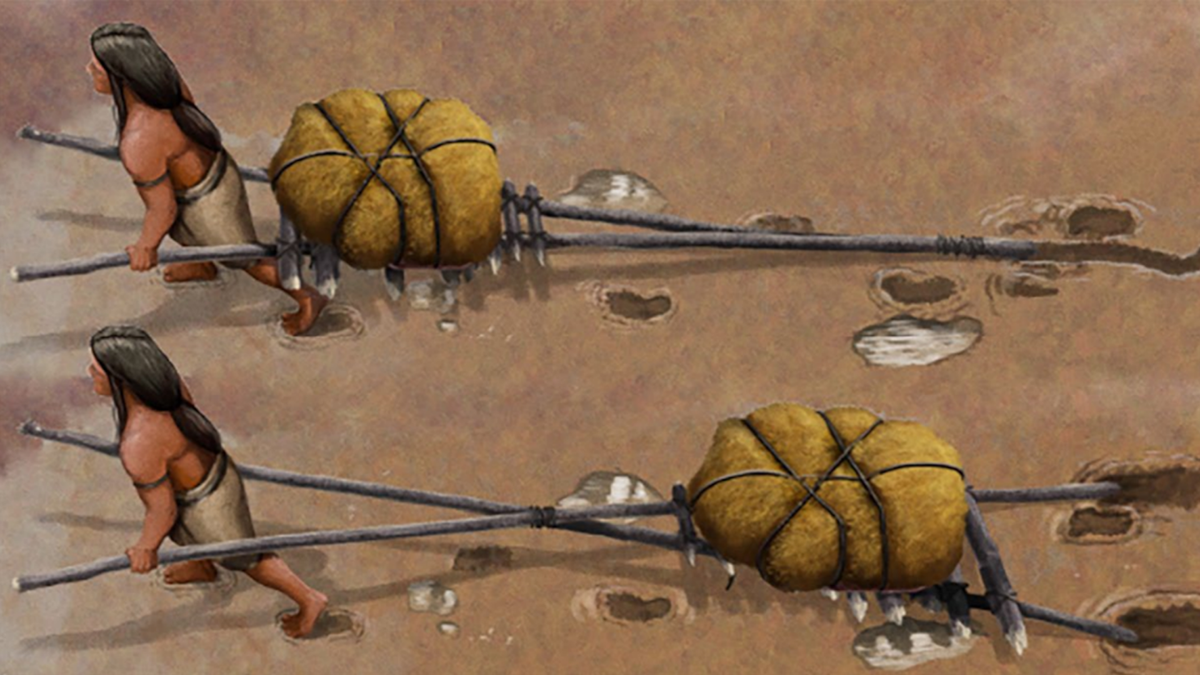
Indigenous people consulted in the research suggested that the marks were left by some kind of travois, a wooden frame made from two poles bound together, according to the study, which was published in the January edition of the journal Quaternary Science Advances.

Indigenous groups of the Great Plains (which includes part of New Mexico) used travois pulled by dogs (and later horses) to transport their houses, furniture and other possessions at the time of early contact with European colonizers around 500 years ago. Children and older women also rode in them at that time, according to the study. Based on the size and positioning of the ancient footprints found next to the drag marks, adults likely pulled the travois while children followed, the researchers said.

“Many people will be familiar with pushing a shopping trolley around a supermarket, moving from location to location with children hanging on,” study lead author Matthew Bennett, a professor of environmental and geographical sciences at Bournemouth University in the U.K., said in a statement. “This appears to be the ancient equivalent, but without wheels.”

Related: The 1st Americans were not who we thought they were

Bennett noted that researchers know our ancestors must have used something to carry their possessions as they migrated around the world, but these wooden vehicles have since rotted away. The recently discovered drag marks provide the first indication of how prehistoric people moved heavy loads before wheels, he said.

Get the world’s most fascinating discoveries delivered straight to your inbox.

Researchers began excavating the drag marks site in 2020. At White Sands, trackways are preserved in ancient dried mud buried beneath sediment. Many millennia ago, people trudged through this landscape alongside mammoths, giant ground sloths, camels and many other ice age creatures.

The drag marks consist of lines in the ground extending upward of 165 feet (50 meters). Some of the marks were single lines, which could have been made by two poles bound together at the end (A-shaped). In other cases, there were two parallel lines, likely made by two poles crossed in the middle (X-shaped), according to the statement.

Image 1 of 4

A researcher experimenting with a travois in Poole Harbour in the U.K.
The researchers experimented with their own travois in Poole Harbour in the U.K.(Image credit: Bournemouth University)

A photo of tracks in the dirt
Drag marks showing two parallel lines. (Image credit: Bournemouth University)

A photo of two crossing tracks making an X shape in the dirt
Two drag marks crossing. (Image credit: Bournemouth University)

A photo of tracks in the dirt
White Sands National Park in New Mexico is potentially the oldest human trackway site in North America. (Image credit: Bournemouth University)

Indigenous people of the Great Plains typically used an A-shaped wooden frame with a connection of bars or net-like baskets to hold objects in place, according to the study. The researchers suspected that ancient people in the region did the same. To test their theory, the team made their own travois out of wooden poles and dragged them along mudflats in the U.K. and along the coast of Maine.

“In our experiments, our footprints and lines in the mud from the poles had the same appearance as the fossilised examples that we found in New Mexico,” Bennett said.

Bennett and his colleagues previously dated the human footprints at White Sands to around 21,000 to 23,000 years ago — challenging the previous assumption that humans arrived in North America 13,000 to 16,000 years ago. Not all researchers agree on the site’s age, but the study authors noted that any dating debate shouldn’t distract from these newly identified features demonstrating ancient Indigenous practices, whatever their age.

“Every discovery that we uncover in White Sands adds to our understanding of the lives of the first people to settle in the Americas,” co-author of the new study Sally Reynolds, a mammalian paleontologist at Bournemouth University, said in the statement. “These people were the first migrants to travel to North America and understanding more about how they moved around is vital to being able to tell their story.”

Source link

Share. Facebook Twitter Pinterest LinkedIn Tumblr Email
Previous Article4 Nations lit the lamp for NHL, but could it work in the NBA or MLB?
Next Article Qatar Airways says crew handled passenger’s midflight death ‘appropriately’
Editor
  • Website

Related Posts

Lifestyle

Thanks to natural selection, Indigenous Andeans may digest potatoes better than anyone else in the world, study finds

June 8, 2026
Lifestyle

Doctors need to understand patients' lived experiences to treat them well — but medical schools may stop requiring that training

June 8, 2026
Lifestyle

This yeast-based 3D printed biomaterial could one day replace your wallpaper and drapes

June 8, 2026
Add A Comment

Comments are closed.

Categories
  • Entertainment
  • Lifestyle
  • News
  • Sports
  • Tech
  • Travel
Recent Posts
  • Thanks to natural selection, Indigenous Andeans may digest potatoes better than anyone else in the world, study finds
  • Doctors need to understand patients' lived experiences to treat them well — but medical schools may stop requiring that training
  • This yeast-based 3D printed biomaterial could one day replace your wallpaper and drapes
  • Flesh-eating screwworm found in Texas cow. Are humans at risk?
  • New Velociraptor cousin was a ‘4-winged’ dragon that hunted prey from the trees of ancient China, fossil find hints
calendar
June 2026
M T W T F S S
1234567
891011121314
15161718192021
22232425262728
2930  
« May    
Recent Posts
  • Thanks to natural selection, Indigenous Andeans may digest potatoes better than anyone else in the world, study finds
  • Doctors need to understand patients' lived experiences to treat them well — but medical schools may stop requiring that training
  • This yeast-based 3D printed biomaterial could one day replace your wallpaper and drapes
About

Welcome to Baynard Media, your trusted source for a diverse range of news and insights. We are committed to delivering timely, reliable, and thought-provoking content that keeps you informed
and inspired

Categories
  • Entertainment
  • Lifestyle
  • News
  • Sports
  • Tech
  • Travel
Facebook X (Twitter) Pinterest WhatsApp
  • Contact Us
  • About Us
  • Privacy Policy
  • Disclaimer
  • UNSUBSCRIBE
© 2026 copyrights reserved

Type above and press Enter to search. Press Esc to cancel.