
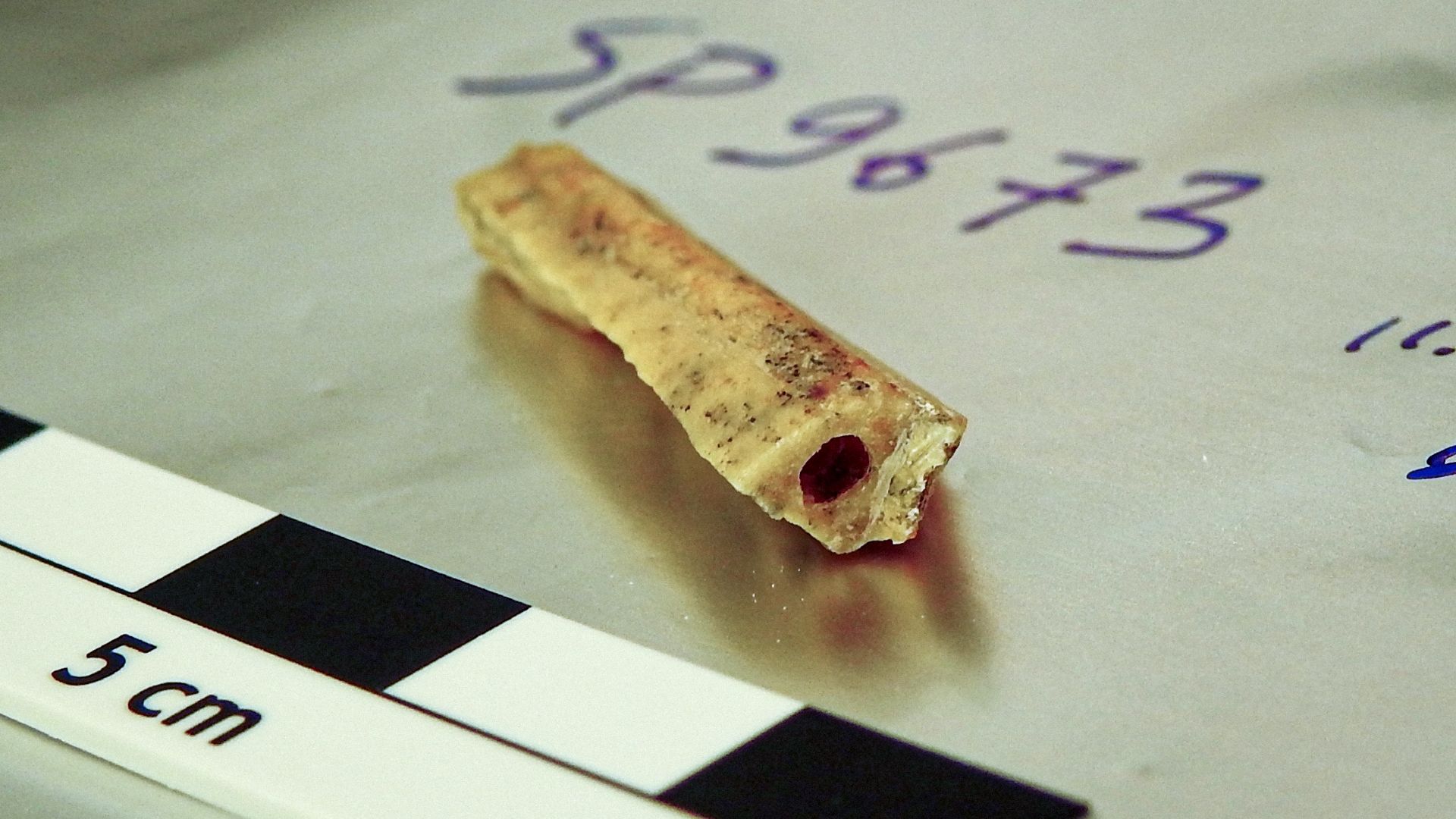
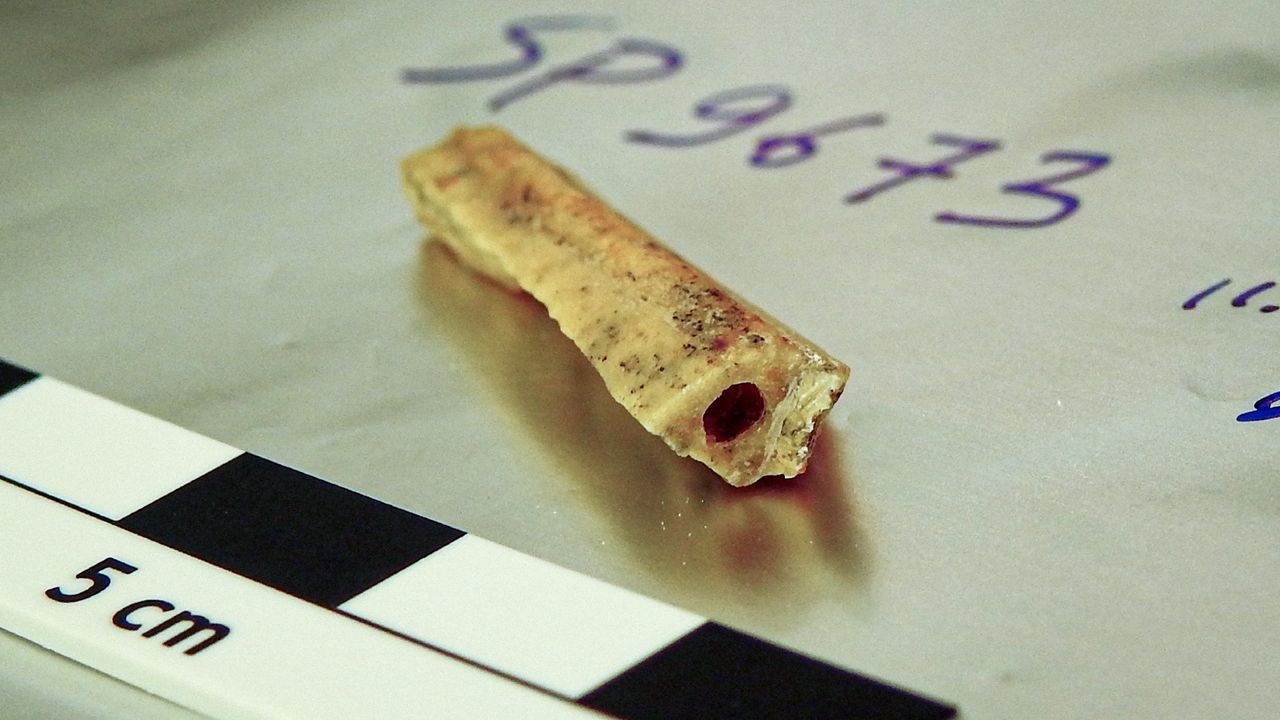
Two Neanderthals present at the same cave site 10 millennia apart were distant relatives, a tiny 110,000-year-old bone fragment from the Altai Mountains in Siberia reveals. The fragment has also produced the fourth full genome of a Neanderthal to date, shedding light on how small and isolated Neanderthals were long before they disappeared around 34,000 years ago.
Researchers found the bone fragment in Denisova Cave, which both Neanderthals and Denisovans lived in off and on for nearly 300,000 years. In a study published Monday (March 23) in the journal PNAS, the researchers compared the genome of the 110,000-year-old Neanderthal male (called D17) with three other complete Neanderthal genomes to better understand Neanderthals’ population structure.
Article continues below
“But it is likely that Denisova Cave was part of a broader landscape used repeatedly by these Neanderthal populations over time, rather than a site occupied by a single, continuous group,” study first author Diyendo Massilani, a genetics professor at the Yale School of Medicine, told Live Science in an email.
The study results also revealed that Neanderthals in the Altai region lived in very small and highly isolated populations of 50 or fewer people, as shown by stronger genetic markers of inbreeding. Specifically, researchers found that the individuals they analyzed had large sections of identical DNA, an indication that their parents were very closely related — as close as first cousins, for example.
The new research complements previous studies that showed Neanderthals lived in smaller and more isolated groups than our own species did. A 2022 study indicated that one Altai Neanderthal community numbered around 20 individuals, while another study provided evidence of a group being isolated for roughly 50,000 years. Many researchers have pointed to inbreeding and isolation as causes for Neanderthals’ disappearance around 34,000 years ago. But the latest results suggest that Neanderthals also survived for long periods under extreme conditions of isolation and small population size.
Massiliani and colleagues also discovered that Altai Neanderthals were very different from later European Neanderthals. In their genetic analysis, the researchers found that Altai Neanderthal D17 was more closely related to D5 than either of them was to Neanderthals in Europe or to later populations in the Altai region. This suggests that Neanderthal populations from eastern and western Eurasia became genetically different from one another in a relatively short time frame and within a fairly small geographic area.
“Even though the individuals from which we have genomes were separated for only about 50,000 years on average, they reached levels of difference similar to what we see today between some of the most distinct human populations, like people from Central Africa and Papua New Guinea that separated about 300,000 years ago,” Massilani said.
We start to have enough Neanderthal genomes to actually have some claim about their population structure. Populations are groups of individuals, so the more data the better.
Léo Planche, population geneticist at Paris-Saclay University’s Interdisciplinary Laboratory for Digital Sciences
Likely because they were small and isolated, Neanderthal populations became genetically distinct from one another much more quickly, Massilani said. This may have been because in small, isolated groups, a process called genetic drift can cause random genetic changes to become more common over time.
“We already knew that Neanderthals were not a single, homogeneous population spread across Eurasia, but a patchwork of groups shaped by complex demographic processes, including divergence, migration, local extinctions and replacements,” he said. “What is striking in our results is just how differentiated these populations could become.”
The high amount of genetic separation and differences between groups may have limited Neanderthals’ ability to adapt to environmental changes, Massilani said.
The study provides new details about how Neanderthal populations were structured, one expert said.
“To have two sequenced Neanderthals in such a close geographic place does bring new and more fine-grained insight” into their population, Léo Planche, a population geneticist at Paris-Saclay University’s Interdisciplinary Laboratory for Digital Sciences who was not involved in the study, told Live Science in an email. “We start to have enough Neanderthal genomes to actually have some claim about their population structure. Populations are groups of individuals, so the more data the better.”
Massilani, D., Peyrégne, S., Iasi, L. N. M., De Filippo, C., Mafessoni, F., Mesa, A. B., Sümer, A. P., Swiel, Y., Popli, D., Silverman, S., Boyle, M. J., Kozlikin, M. B., Shunkov, M. V., Derevianko, A. P., Higham, T., Douka, K., Meyer, M., Zeberg, H., Kelso, J., & Pääbo, S. (2026). A high-coverage Neandertal genome from the Altai Mountains reveals population structure among Neandertals. Proceedings of the National Academy of Sciences, 123(13). https://doi.org/10.1073/pnas.2534576123
