Close Menu
  • Home
  • UNSUBSCRIBE
  • News
  • Lifestyle
  • Tech
  • Entertainment
  • Sports
  • Travel
Facebook X (Twitter) WhatsApp
Trending
  • New robotic heart mimics common, mysterious condition to help researchers study it
  • Canon EOS R6 III review: A wildlife wonder
  • Medieval babies and adults buried together in Sweden were not related, archaeologists discover — raising big questions about early Christian burial practices
  • NASA is creating a fifth state of matter on the ISS, thanks to an upgrade to a mini-fridge-sized quantum lab
  • New sodium metal battery design charges in just 4 minutes and retains its capacity for years
  • Quantum computing wielded to create extremely rare material critical to nuclear fusion
  • Scientists build tiny ‘diving suit’ for cockroaches, turning them into search-and-rescue cyborgs
  • Physicists develop the first working model of quantum mechanics using only ‘real’ numbers
Facebook X (Twitter) WhatsApp
Baynard Media
  • Home
  • UNSUBSCRIBE
  • News
  • Lifestyle
  • Tech
  • Entertainment
  • Sports
  • Travel
Baynard Media
Home»Lifestyle»1st supernovas may have flooded the early universe with water — making life possible just 100 million years after the Big Bang
Lifestyle

1st supernovas may have flooded the early universe with water — making life possible just 100 million years after the Big Bang

EditorBy EditorJanuary 22, 2025No Comments3 Mins Read
Share Facebook Twitter Pinterest LinkedIn Tumblr Reddit Telegram Email
Share
Facebook Twitter LinkedIn Pinterest Email

When the cosmos’ first stars exploded in spectacular supernovas, they may have unleashed enormous amounts of water that flooded the early universe — and potentially made life possible just millions of years after the Big Bang, new simulations suggest.

However, this theory clashes with our current understanding of cosmic evolution and will be extremely difficult to prove.

Water is one of the most abundant compounds in the universe, according to NASA. Aside from Earth, astronomers have found water in several places throughout the solar system, including scattered above and below the surface of Mars, inside the ice caps of Mercury, surrounding the shells of comets and buried in underground oceans on several major moons. Outside our cosmic neighborhood, researchers have also detected water on distant exoplanets and within massive clouds of interstellar gas that permeate the Milky Way.

Until now, scientists assumed that all this water gradually built up over billions of years as hydrogen, the most abundant element in the universe, combined with oxygen that has been forged in the hearts of stars and expelled via supernovas. But in the new study, uploaded Jan. 9 to the preprint server arXiv, researchers simulated the explosive deaths of giant, short-lived early stars — which each had a mass equivalent to around 200 suns — and found that they could create the conditions needed for water to take shape.

The water from these stellar explosions would likely have formed at the hearts of dense clouds of hydrogen, oxygen and other elements left behind by stars. It may have had concentrations up to 30 times higher than the water seen floating in interstellar space within the Milky Way, the researchers wrote in the study, which has not been peer-reviewed yet.

Related: Could a supernova ever destroy Earth?
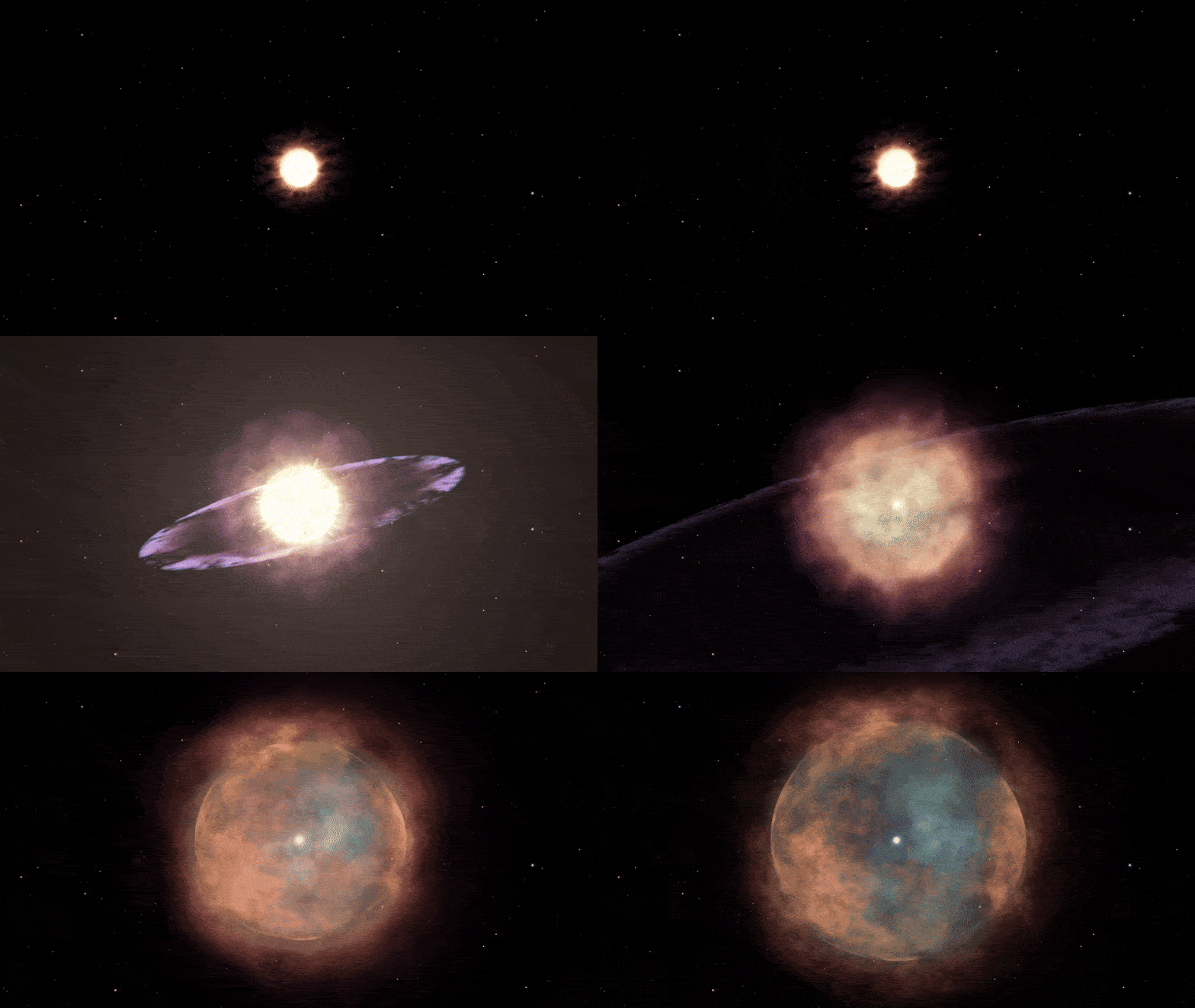
A simulation of a star exploding

Researchers believe the water would have formed at the center of dense clouds of material expelled by the exploding stars. (Image credit: Getty Images)

If correct, the new findings would have big implications for scientists’ understanding of galaxy evolution and extraterrestrial life.

Get the world’s most fascinating discoveries delivered straight to your inbox.

“Besides revealing that a primary ingredient for life was already in place in the universe between 100 million and 200 million years after the Big Bang, our simulations show that water was likely a key constituent of the first galaxies,” the researchers wrote.

Early cosmic uncertainty

One of the biggest issues with the new study is that scientists have never directly observed one of the early stars that the researchers are modeling, known as population III stars. Instead, researchers have only indirectly observed a few of these stellar trailblazers by analyzing the stars that were birthed from their remains, so it’s still not certain what they were really like.

If there was abundant water in the early universe, it would also suggest that the cosmos should have accumulated much more water than we currently see in our surroundings.

One explanation for this that has been posited by other scientists is that the universe underwent a drying-out period during which large quantities of water were lost, according to Universe Today. However, it is unclear what the cause of this event could have been.

“There is also the fact that while water formed early, ionization and other astrophysical processes may have broken up many of these molecules,” Universe Today reported, meaning that the water from the first supernovas may have been short-lived.

Although water is a key ingredient for life on Earth, there is also no guarantee that its presence in the early universe would have made extraterrestrial life more likely.

Source link

Share. Facebook Twitter Pinterest LinkedIn Tumblr Email
Previous ArticleBest Samsung deal: Take 23% off the Samsung Galaxy S24 Ultra
Next Article Score Pink Luxury Handbags up to 60% Off
Editor
  • Website

Related Posts

Lifestyle

New robotic heart mimics common, mysterious condition to help researchers study it

July 11, 2026
Lifestyle

Canon EOS R6 III review: A wildlife wonder

July 10, 2026
Lifestyle

Medieval babies and adults buried together in Sweden were not related, archaeologists discover — raising big questions about early Christian burial practices

July 10, 2026
Add A Comment

Comments are closed.

Categories
  • Entertainment
  • Lifestyle
  • News
  • Sports
  • Tech
  • Travel
Recent Posts
  • New robotic heart mimics common, mysterious condition to help researchers study it
  • Canon EOS R6 III review: A wildlife wonder
  • Medieval babies and adults buried together in Sweden were not related, archaeologists discover — raising big questions about early Christian burial practices
  • NASA is creating a fifth state of matter on the ISS, thanks to an upgrade to a mini-fridge-sized quantum lab
  • New sodium metal battery design charges in just 4 minutes and retains its capacity for years
calendar
July 2026
M T W T F S S
 12345
6789101112
13141516171819
20212223242526
2728293031  
« Jun    
Recent Posts
  • New robotic heart mimics common, mysterious condition to help researchers study it
  • Canon EOS R6 III review: A wildlife wonder
  • Medieval babies and adults buried together in Sweden were not related, archaeologists discover — raising big questions about early Christian burial practices
About

Welcome to Baynard Media, your trusted source for a diverse range of news and insights. We are committed to delivering timely, reliable, and thought-provoking content that keeps you informed
and inspired

Categories
  • Entertainment
  • Lifestyle
  • News
  • Sports
  • Tech
  • Travel
Facebook X (Twitter) Pinterest WhatsApp
  • Contact Us
  • About Us
  • Privacy Policy
  • Disclaimer
  • UNSUBSCRIBE
© 2026 copyrights reserved

Type above and press Enter to search. Press Esc to cancel.