Close Menu
  • Home
  • UNSUBSCRIBE
  • News
  • Lifestyle
  • Tech
  • Entertainment
  • Sports
  • Travel
Facebook X (Twitter) WhatsApp
Trending
  • New robotic heart mimics common, mysterious condition to help researchers study it
  • Canon EOS R6 III review: A wildlife wonder
  • Medieval babies and adults buried together in Sweden were not related, archaeologists discover — raising big questions about early Christian burial practices
  • NASA is creating a fifth state of matter on the ISS, thanks to an upgrade to a mini-fridge-sized quantum lab
  • New sodium metal battery design charges in just 4 minutes and retains its capacity for years
  • Quantum computing wielded to create extremely rare material critical to nuclear fusion
  • Scientists build tiny ‘diving suit’ for cockroaches, turning them into search-and-rescue cyborgs
  • Physicists develop the first working model of quantum mechanics using only ‘real’ numbers
Facebook X (Twitter) WhatsApp
Baynard Media
  • Home
  • UNSUBSCRIBE
  • News
  • Lifestyle
  • Tech
  • Entertainment
  • Sports
  • Travel
Baynard Media
Home»Lifestyle»1,900-year-old Roman sanctuary and coin found in flooded Spanish cave
Lifestyle

1,900-year-old Roman sanctuary and coin found in flooded Spanish cave

EditorBy EditorFebruary 6, 2025No Comments3 Mins Read
Share Facebook Twitter Pinterest LinkedIn Tumblr Reddit Telegram Email
Share
Facebook Twitter LinkedIn Pinterest Email

Archaeologists have discovered evidence of Roman occupation and ritual activity hidden inside a partially flooded cave in Spain. The remains date to about 1,900 years ago, researchers say.

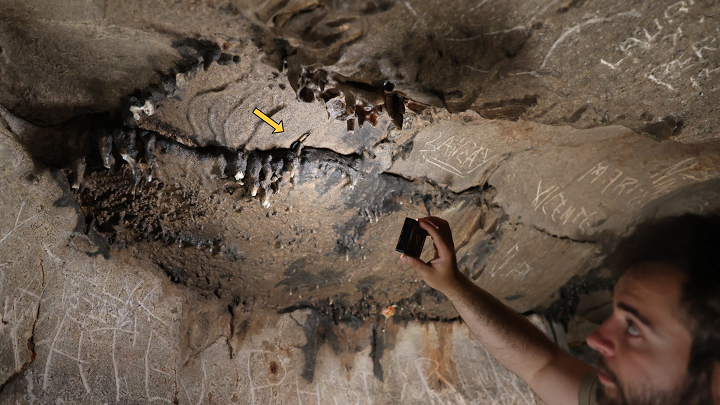
The researchers were exploring the depths of the cave, which is located in eastern Spain, by flashlight when they noticed a rusty coin wedged between a crack in the ceiling and a stalactite, according to a translated statement. Subsequent analyses revealed that the coin dates from the time of Emperor Claudius, who ruled the Roman Empire from A.D. 41 to 54. The coin was likely put there as an offering, the researchers noted.

The team also discovered 15 inscriptions that were likely carved into the rock by people living on the Iberian Peninsula during Roman occupation of the region — although the meaning behind them remains unclear. Together, the markings and the coin indicate that these people considered the cave to be a sanctuary, according to the statement.

Discoveries going back to the 1960s suggest humans have occupied the Cova de les Dones, which in Catalan Spanish means “women’s cave,” for thousands of years.

Related: 7 haunting caves ancient humans used for art, burials and butchering

“The inscriptions and the coin provide irrefutable evidence that the sanctuary continued to be used or was repurposed by the Romans,” Aitor Ruiz-Redondo, a professor of prehistory at the University of Zaragoza in Spain who co-led the cave exploration, told the Spanish regional newspaper Levante.

Image of the front and back of a Roman coin discovered in the Cova de les Dones in Spain.

Analyses revealed that the coin dates from the time of Emperor Claudius. (Image credit: Museu de Prehistòria de València)

The Cova de les Dones is known to hold Iron Age ceramics and prehistoric rock art, including a representation of an auroch’s head and a stag. A 2023 study published in the journal Antiquity catalogued more than 110 paintings deep inside the cave. Cave bear (Ursus spelaeus) claw marks that overlap with some of the paintings suggest the art is more than 24,000 years old, because cave bears went extinct in Europe around this time, according to the study.

Get the world’s most fascinating discoveries delivered straight to your inbox.

Close up image of Roman inscriptions on the walls of a cave.

A section of the Cova de les Dones holds 15 Roman inscriptions, but the meaning behind them is unclear. (Image credit:  A. Ruiz-Redondo, V. Barciela & X. Martorell)

Romans may have performed rituals in the cave during the first century A.D., the new findings indicate. “This discovery confirms the continuity of the site’s ritual use throughout different historical periods,” Ruiz-Redondo said.

The Roman inscriptions are located roughly 660 feet (200 meters) from the cave entrance. The Cova de les Dones consists of a single, 1,640 foot-deep (500 m) chamber and opens onto a steep canyon, according to the 2023 study.

Large sections of the cave remain unexplored, so archaeologists will likely find more evidence of ancient human activity in the coming years, according to the statement. Even the known sections of prehistoric art could yield surprises, as researchers have only studied one-fifth of the paintings in detail so far.

Source link

Share. Facebook Twitter Pinterest LinkedIn Tumblr Email
Previous ArticlePremier League Darts 2025: Luke Humphries breezes to opening-night win in Belfast as Michael van Gerwen beats Luke Littler in classic | Darts News
Next Article Prep for IT certification for just $40
Editor
  • Website

Related Posts

Lifestyle

New robotic heart mimics common, mysterious condition to help researchers study it

July 11, 2026
Lifestyle

Canon EOS R6 III review: A wildlife wonder

July 10, 2026
Lifestyle

Medieval babies and adults buried together in Sweden were not related, archaeologists discover — raising big questions about early Christian burial practices

July 10, 2026
Add A Comment

Comments are closed.

Categories
  • Entertainment
  • Lifestyle
  • News
  • Sports
  • Tech
  • Travel
Recent Posts
  • New robotic heart mimics common, mysterious condition to help researchers study it
  • Canon EOS R6 III review: A wildlife wonder
  • Medieval babies and adults buried together in Sweden were not related, archaeologists discover — raising big questions about early Christian burial practices
  • NASA is creating a fifth state of matter on the ISS, thanks to an upgrade to a mini-fridge-sized quantum lab
  • New sodium metal battery design charges in just 4 minutes and retains its capacity for years
calendar
July 2026
M T W T F S S
 12345
6789101112
13141516171819
20212223242526
2728293031  
« Jun    
Recent Posts
  • New robotic heart mimics common, mysterious condition to help researchers study it
  • Canon EOS R6 III review: A wildlife wonder
  • Medieval babies and adults buried together in Sweden were not related, archaeologists discover — raising big questions about early Christian burial practices
About

Welcome to Baynard Media, your trusted source for a diverse range of news and insights. We are committed to delivering timely, reliable, and thought-provoking content that keeps you informed
and inspired

Categories
  • Entertainment
  • Lifestyle
  • News
  • Sports
  • Tech
  • Travel
Facebook X (Twitter) Pinterest WhatsApp
  • Contact Us
  • About Us
  • Privacy Policy
  • Disclaimer
  • UNSUBSCRIBE
© 2026 copyrights reserved

Type above and press Enter to search. Press Esc to cancel.