
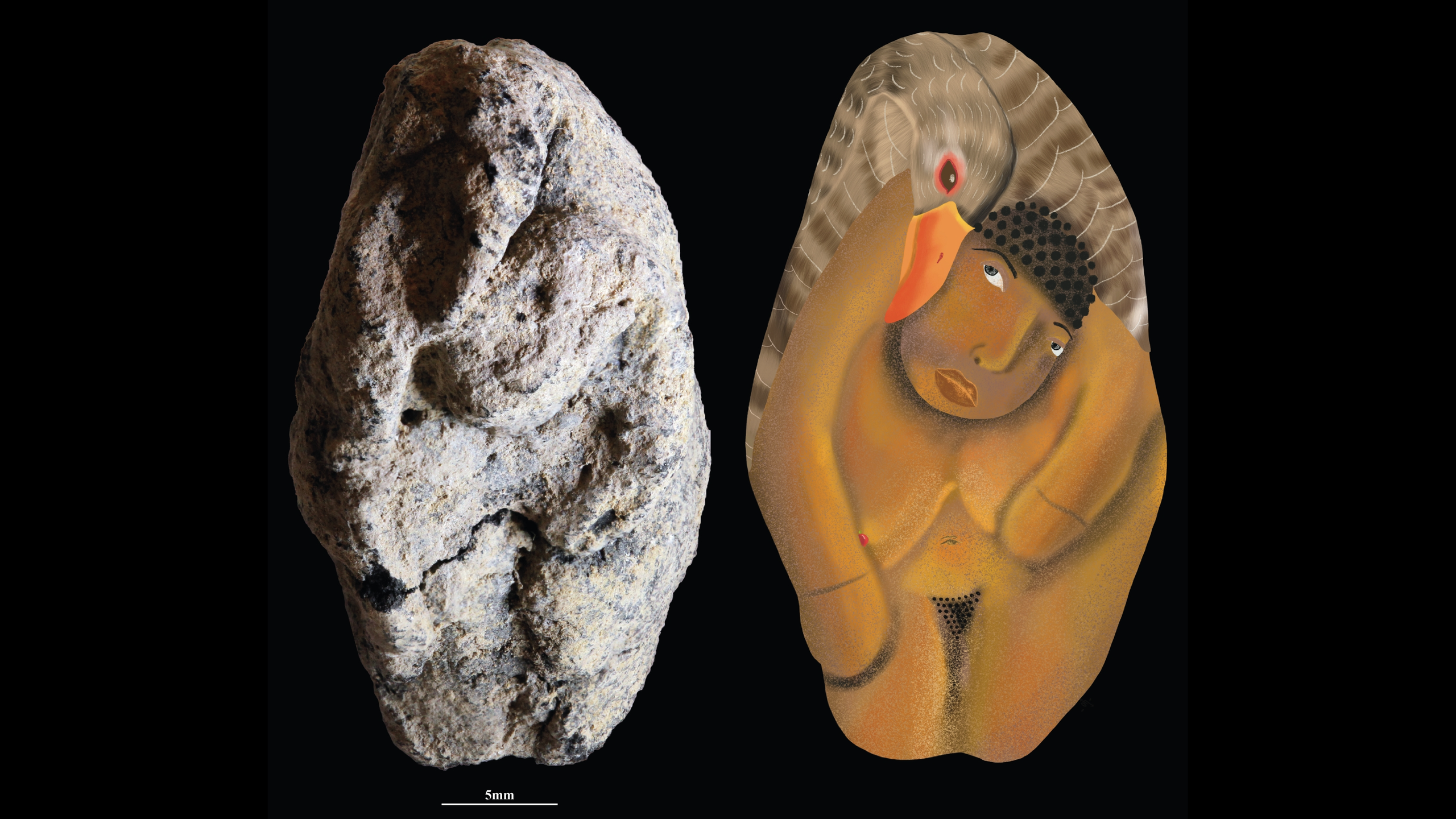
Long before the ancient Greeks imagined Zeus taking the form of a swan to mate with the princess Leda, the Natufian people in southwest Asia were depicting the same thing. Archaeologists recently discovered a 12,000-year-old sculpted piece of fired clay from a prehistoric settlement in Israel that they say represents an early belief system.
“When I took this small block of clay out of its box, I immediately recognized the human figure and then the bird lying on its back,” Laurent Davin, an archaeologist at the Hebrew University of Jerusalem, told Live Science in an email.
The figurine depicts a woman and a bird — thought to be a goose — and is the earliest known depiction of a woman in southwestern Asia, Davin and colleagues wrote in a study published Monday (Nov. 17) in the journal PNAS.
During an investigation, Davin meticulously examined tens of thousands of small clay fragments that had been collected from several Natufian archaeological sites. The Natufians were a sedentary hunter-gatherer culture found in present-day Israel, the Palestinian territories, Jordan, Lebanon and Syria between 15,000 and 11,500 years ago.
One tiny bit of crafted clay from an archaeological site called Nahal Ein Gev II, located about 1.2 miles (2 kilometers) east of the Sea of Galilee in northern Israel, caught Davin’s eye.
“I understood that I held in my hand an exceptional piece, both in terms of the subject depicted and the quality of the modeling created 12,000 years ago,” Davin said. “The human depiction is the most complete and detailed representation of a human body that has been identified so far in the Natufian culture.”
The “extremely rare” clay figurine may be the earliest representation in the world of human–animal interaction, the researchers detailed in the study.
The figurine was modeled from a single block of clay and found fragmented into three pieces, the researchers wrote in the study. It measures just 1.5 inches (3.7 centimeters) tall and was heated in a fireplace before being covered with a red mineral pigment.
At the top of the figurine is a bird resting on the back of a human, its wings spread out and backward to partially envelop the person. An incised triangular area on the lower part of the figurine likely represents a female pubis, and symmetrical oval imprints near the face suggest breasts. The bird is likely a goose, the researchers wrote, as animal bones discovered at the site suggest the Natufians used geese for both food and decoration.

One potential interpretation of the figurine is that it shows a hunter transporting a slain bird back to camp, according to the study. But because the woman is leaning forward and because the goose appears to be alive, the researchers favor a more mythological explanation: a male goose mating with the squatting female by mounting her.
“Imaginary mating between human and animal spirits is known in many myths of historical periods across the world,” Davin said. “This emerging desire to represent female imagery might be related to the growing importance of women in managing the spiritual practices of these communities.”
Davin also noticed a partial fingerprint on the figurine. Based on the fingerprint’s ridge density in comparison with modern fingerprints made by people of known sex, this may indicate the piece was sculpted by a woman.
The figurine was discovered in an area of the site that had been used for burial, along with other unique deposits, including a child burial and a cache of human teeth, the researchers noted in the study.
Taken together, the features of the rare figurine suggest the Natufians were creating complex imagery and potentially expressing animistic beliefs prior to the “Neolithic revolution” in southwest Asia, when people permanently settled down, grew crops and domesticated animals.
The woman and a goose figurine therefore “bridges the world of mobile hunter-gatherers and that of the first settled communities, showing how imagination and symbolic thinking began to shape human culture,” study co-author Leore Grosman, an archaeologist at Hebrew University of Jerusalem, said in a statement.
