Close Menu
  • Home
  • UNSUBSCRIBE
  • News
  • Lifestyle
  • Tech
  • Entertainment
  • Sports
  • Travel
Facebook X (Twitter) WhatsApp
Trending
  • New robotic heart mimics common, mysterious condition to help researchers study it
  • Canon EOS R6 III review: A wildlife wonder
  • Medieval babies and adults buried together in Sweden were not related, archaeologists discover — raising big questions about early Christian burial practices
  • NASA is creating a fifth state of matter on the ISS, thanks to an upgrade to a mini-fridge-sized quantum lab
  • New sodium metal battery design charges in just 4 minutes and retains its capacity for years
  • Quantum computing wielded to create extremely rare material critical to nuclear fusion
  • Scientists build tiny ‘diving suit’ for cockroaches, turning them into search-and-rescue cyborgs
  • Physicists develop the first working model of quantum mechanics using only ‘real’ numbers
Facebook X (Twitter) WhatsApp
Baynard Media
  • Home
  • UNSUBSCRIBE
  • News
  • Lifestyle
  • Tech
  • Entertainment
  • Sports
  • Travel
Baynard Media
Home»Lifestyle»1 million-year-old skull from China holds clues to the origins of Neanderthals, Denisovans and humans
Lifestyle

1 million-year-old skull from China holds clues to the origins of Neanderthals, Denisovans and humans

EditorBy EditorSeptember 25, 2025No Comments3 Mins Read
Share Facebook Twitter Pinterest LinkedIn Tumblr Reddit Telegram Email
Share
Facebook Twitter LinkedIn Pinterest Email

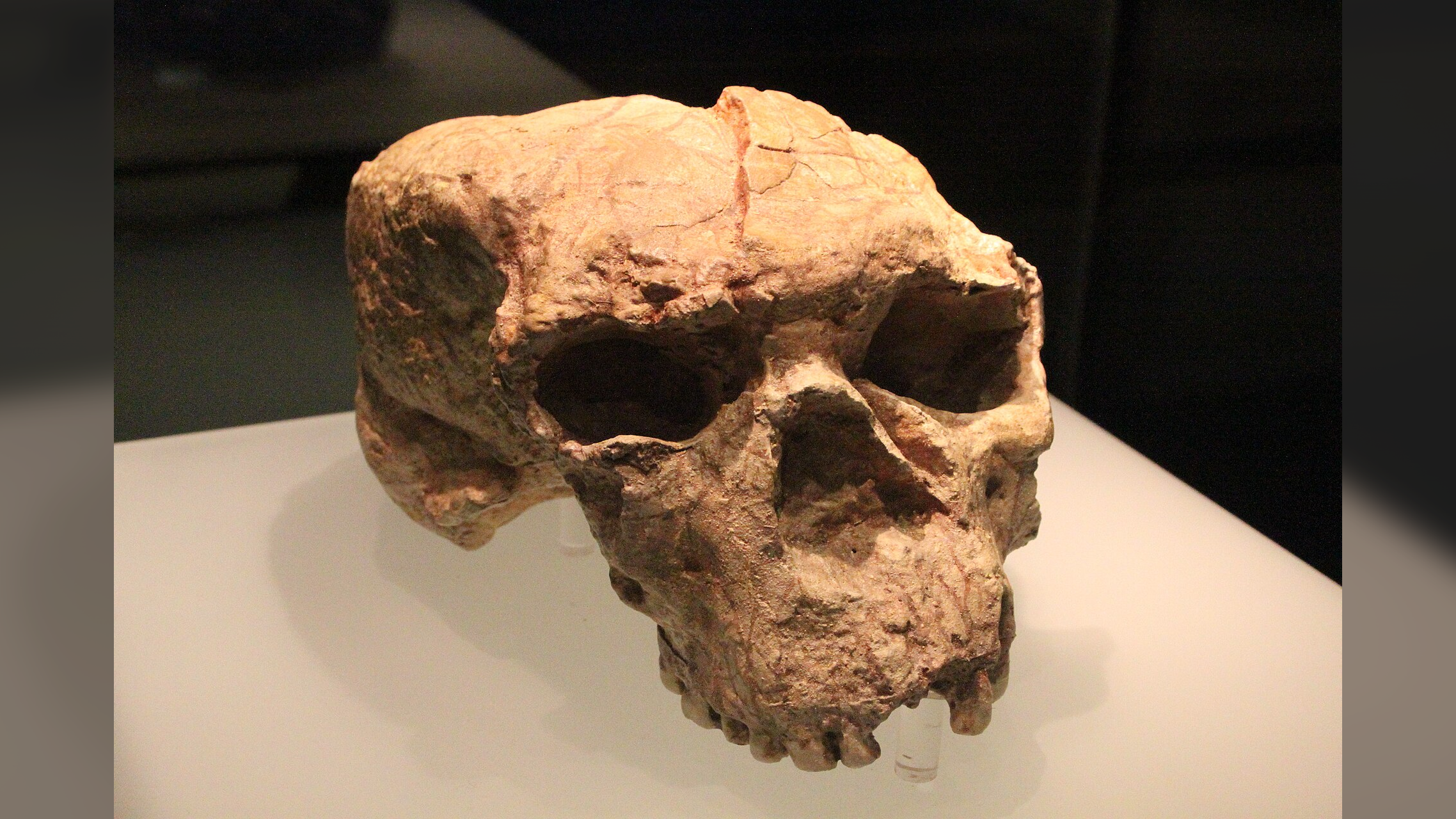
Researchers have virtually reconstructed a crushed and distorted 1 million-year-old human skull discovered in China. The newly restored cranium may have belonged to a relative of the mysterious Denisovans and provides clues to the rapid evolution of Homo sapiens in Asia.

In a study published Thursday (Sept. 25) in the journal Science, researchers presented their reconstruction of the Yunxian 2 skull, which was excavated in 1990 from an archaeological site in Hubei province in central China.

Although experts thought for decades that the Yunxian skull was from the human ancestor Homo erectus, the new analysis revealed the skull is more closely related to “Dragon Man,” an extinct species first described after the discovery of a different skull in northeastern China in 2021, and to Denisovans, a mysterious group of humans that went extinct around 30,000 years ago.


You may like

After digitally reconstructing the Yunxian 2 skull using computed tomography (CT) scans, researchers noticed that it showed a distinctive combination of traits, including a large cranial capacity, a long and low frontal skull bone, and a narrow space between the eye sockets. This set of characteristics is found in what the researchers call the Homo longi clade, a lineage or group of individuals and their descendants that have the same ancestor.

“The Homo longi clade, containing the Denisovans, lasted for over a million years,” study co-author Chris Stringer, a paleoanthropologist at the Natural History Museum in London, told Live Science in an email. “But so did the Neanderthal and sapiens lineages.”

two reconstructions of ancient humans

In December 2024, the Hubei Provincial Museum in China unveiled reconstructions based on two Yunxian skulls. (Image credit: Getty Images)

Based on statistical data from 57 fossil skulls, the researchers estimated that the Neanderthal clade diverged from a common human ancestor first, around 1.38 million years ago. Then, the H. longi clade diverged around 1.2 million years ago, followed by H. sapiens around 1.02 million years ago. (The earliest clear fossil evidence of H. sapiens, however, comes from 300,000-year-old bones from Jebel Irhoud in Morocco.) This short timeframe suggests that rapid diversification took place in all three human groups.

But the researchers are unsure what may have caused these ancient human groups to develop such diverse appearances so quickly. “They lived in small, relatively isolated populations and adapted to diverse paleoenvironments,” study co-author Xijun Ni, a paleoanthropologist at the Chinese Academy of Sciences, told Live Science in an email.

Get the world’s most fascinating discoveries delivered straight to your inbox.

Pushing back the origin of these ancient human groups, however, means experts can look even earlier in time for factors that may have triggered human evolution.

“For example, there were two severe cold events at about 1.1 million and 900,000 years ago,” Stringer said, “and that may have catalysed evolutionary and behavioural changes,” including extinctions.

Given the 1 million-year-old date of the Yunxian 2 skull and its blend of ancient and modern physical traits, the researchers concluded in their study that it likely represents an early form of the group that includes the Denisovans.


Source link

Share. Facebook Twitter Pinterest LinkedIn Tumblr Email
Previous ArticleTrump looms large in New Jersey governor race between Ciattarelli, Sherrill
Next Article Vertical News Brief Pilot – Laura Jarrett
Editor
  • Website

Related Posts

Lifestyle

New robotic heart mimics common, mysterious condition to help researchers study it

July 11, 2026
Lifestyle

Canon EOS R6 III review: A wildlife wonder

July 10, 2026
Lifestyle

Medieval babies and adults buried together in Sweden were not related, archaeologists discover — raising big questions about early Christian burial practices

July 10, 2026
Add A Comment

Comments are closed.

Categories
  • Entertainment
  • Lifestyle
  • News
  • Sports
  • Tech
  • Travel
Recent Posts
  • New robotic heart mimics common, mysterious condition to help researchers study it
  • Canon EOS R6 III review: A wildlife wonder
  • Medieval babies and adults buried together in Sweden were not related, archaeologists discover — raising big questions about early Christian burial practices
  • NASA is creating a fifth state of matter on the ISS, thanks to an upgrade to a mini-fridge-sized quantum lab
  • New sodium metal battery design charges in just 4 minutes and retains its capacity for years
calendar
July 2026
M T W T F S S
 12345
6789101112
13141516171819
20212223242526
2728293031  
« Jun    
Recent Posts
  • New robotic heart mimics common, mysterious condition to help researchers study it
  • Canon EOS R6 III review: A wildlife wonder
  • Medieval babies and adults buried together in Sweden were not related, archaeologists discover — raising big questions about early Christian burial practices
About

Welcome to Baynard Media, your trusted source for a diverse range of news and insights. We are committed to delivering timely, reliable, and thought-provoking content that keeps you informed
and inspired

Categories
  • Entertainment
  • Lifestyle
  • News
  • Sports
  • Tech
  • Travel
Facebook X (Twitter) Pinterest WhatsApp
  • Contact Us
  • About Us
  • Privacy Policy
  • Disclaimer
  • UNSUBSCRIBE
© 2026 copyrights reserved

Type above and press Enter to search. Press Esc to cancel.