
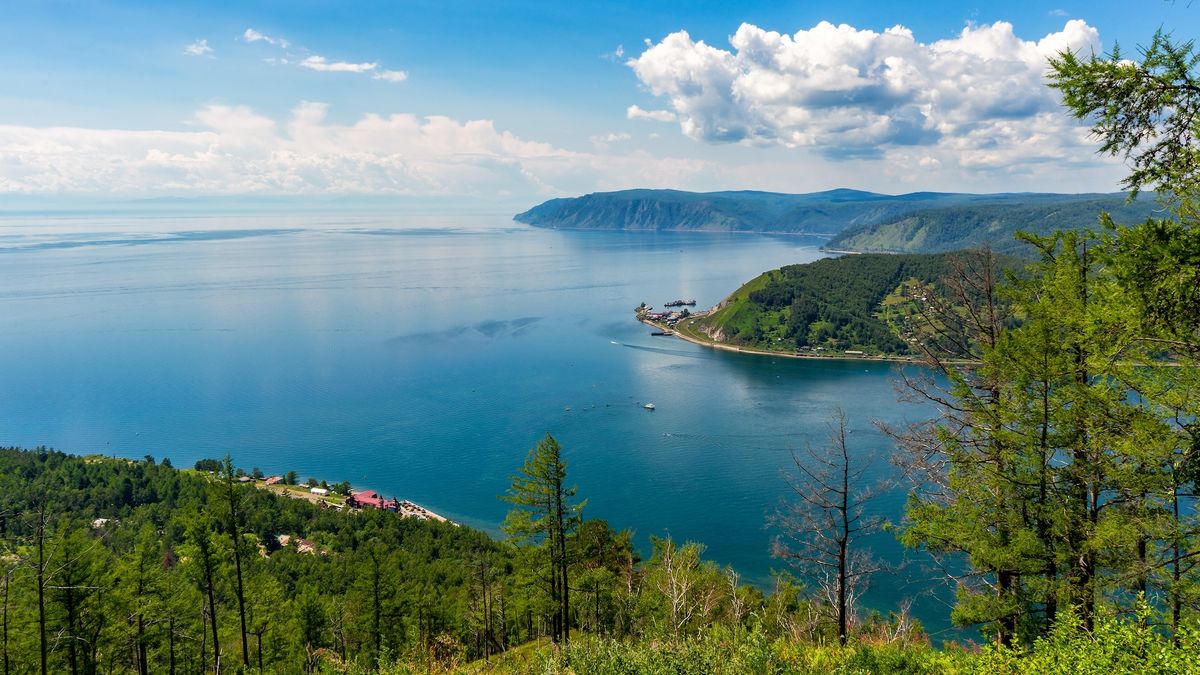
Just like the mountains, lakes on Earth can be ancient, or more than 1 million years old. There are only 20 ancient lakes on the planet, but which is the oldest?
Earth’s oldest lake has a clear winner: Lake Baikal in southeast Siberia. Scientists estimate that this enormous freshwater body is 25 million years old, according to Ted Ozersky, an associate professor of biological limnology (the study of inland bodies of water) at the University of Minnesota. By contrast, the Great Lakes formed less than 20,000 years ago. The second oldest lake on Earth is Lake Issyk-Kul in Kyrgyzstan, which formed about 20 million years ago.
Lake Baikal measures 12,239 square miles (31,700 square kilometers), making it Earth’s seventh-largest lake. It is not only the world’s oldest lake but also the deepest one, at about 1 mile (1.6 kilometers). But that’s just the water depth. “The actual basin is much more than a mile deep,” Ozersky told Live Science, including between 3.1 and 4.3 miles (5 to 7 km) of sediment at the bottom. In the case of Lake Baikal, where there are miles of sediment, researchers use seismic surveys to estimate the average rate of sediment formation, Ozersky said.
This sediment is key to dating the lake. Researchers measure a lake’s age through isotopic dating. This technique involves measuring the ratios of radioactive isotopes. In this case, limnologists analyze lake sediments for radioactive versions of cesium, lead and carbon. This analysis tells them how old the different layers of sediment are and how fast that sediment accumulates, Ozersky explained
Related: How much water is in Earth’s crust?
By understanding lake formation — and Lake Baikal’s formation, in particular — researchers can get a better idea of how it has persisted for millions of years. Many lakes form as glacial features, Mark Edlund, a senior scientist and the director of aquatic research and collections at the Science Museum of Minnesota, told Live Science. Glaciers score a pocket in the landscape and deposit chunks of ice that eventually melt and fill the depression. “But in the grand scheme, they’re very short-lived systems,” Edlund said.
On the other hand, Lake Baikal is a rift lake. Rift lakes form when two continental plates start moving away from each other, creating a chasm. This chasm is called a graben. As these plates continue to drift apart, the graben continues to deepen. “As a result, that site never fills in,” Edlund said, which is why rift lakes can last so long.
In fact, Ozersky said Lake Baikal gets an inch (2.5 centimeters) wider every year. Some of the world’s other oldest lakes, like Lake Malawi (up to 5 million years old) and Lake Tanganyika (up to 12 million years old) — both in Southeast Africa — also come from rifts.
Lake Baikal also claims the title of Earth’s most biologically diverse lake, according to Ozersky.

“Evolution has had so much time to work in that system without being interrupted,” he said. It also has the highest rate of flora and fauna endemic to its ecosystem, meaning those plants and animals aren’t found anywhere else on Earth. Perhaps the best and most beloved example is the Baikal seal (Pusa sibirica), the only freshwater seal species. (Although other seal species may inhabit lakes, those seals have “invaded” them through streams, Ozersky noted.)
This ancient lake also hosts hundreds of species of freshwater shrimp, which gives researchers the opportunity to study speciation and diversification. “Trying to understand how evolution works is one thing that is really interesting about Baikal,” Ozersky said.
Edlund also studies diatoms, which are a unicellular type of algae. These organisms pull dissolved silica from the water and turn it into biologically produced glass, which encases them. Diatoms are typically between 10 and 50 microns (about half the width of a human hair) in diameter, but Baikal’s diatoms are unusually large at about 50 to 150 microns. “When we look at the diatoms in Lake Baikal, they just blow your mind,” Edlund said.
The lake is also open to human visitors. But because it’s covered with ice five months out of the year, it’s not a great swimming destination. Its average surface temperature is 39 degrees Fahrenheit (4 degrees Celsius). “It’s a bitterly cold lake,” Edlund said. “If you want to swim in it, you’ve got to gird your loins.”
What’s inside Earth quiz: Test your knowledge of our planet’s hidden layers
