
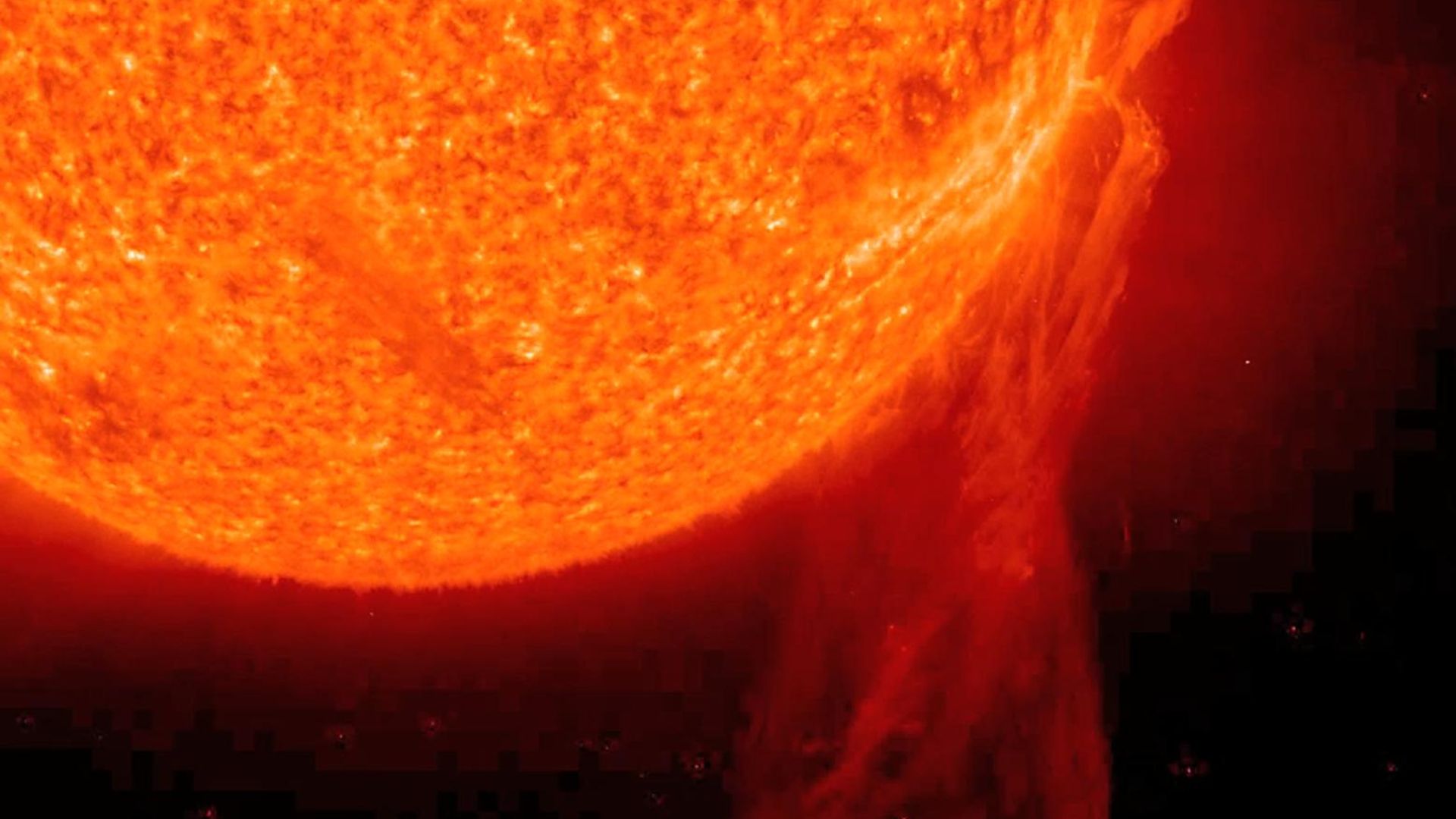
The sun has been Earth’s constant companion ever since our planet emerged. But if the sun were to suddenly disappear, what would happen to our home planet?
To understand the fate of a sunless Earth, it’s important to know how both arose. The sun formed about 4.6 billion years ago, when a massive spinning cloud of gas and dust collapsed in on itself and condensed, creating the biggest object in what would become our solar system and eventually reaching a temperature of 27 million degrees Fahrenheit (15 million degrees Celsius) at its core.
Article continues below
SIGN UP FOR OUR NEWSLETTER

Sign up for our weekly Life’s Little Mysteries newsletter to get the latest mysteries before they appear online.
If the sun suddenly vanished, Earth and the vast majority of life would be in dire straits. It would start “a ticking time bomb on the survival of every living thing on earth that relies on photosynthesis, which is the vast majority of surface life and all of humanity,” Timothy Cronin, an associate professor of atmospheric science at MIT, told Live Science over email.
For at least 8 minutes, 20 seconds, no one would know the sun went missing — that’s how long it takes light from the sun to reach Earth. During that time, “we’d almost certainly have no idea that anything had happened,” Cronin said.
Then, the real trouble would begin.
After the sun’s eight-minute swan song, there would be “a sudden blackout,” Cronin said. Without sunlight, artificial lighting from electricity, oil or gas would be the main ways we could still generate light, along with fire, bioluminescence and fluorescence. We’d lose track of day and night. The moon, which reflects the sun’s light, would go completely dark, although distant stars in the sky would still be visible. And without the sun’s mass and gravity keeping the planets and other celestial bodies in orbit, “all the planets would fly off in the direction of their current travel,” Cronin said.
But humanity would have more immediate problems than flying off into interstellar space. No sunlight would mean crucial processes, such as growing food, would become much more complicated.
Photosynthetic organisms would be done for, Michael Summers, a professor of planetary sciences and astronomy at George Mason University in Virginia, told Live Science. Most plants that weren’t grown under artificial lighting would quickly suffer. And while some “might stay dormant for weeks to months, like they do in the wintertime, eventually all photosynthetic organisms would die.”
Fungi, meanwhile, feed on living or dead matter, and “there would be a great deal of dead material available,” Summers said. So fungi likely wouldn’t die from a lack of food, but from the cold.
Cold planet
It wouldn’t take long for frigid temperatures to change the Earth as we know it.
At first, Earth would cool by an average of roughly 36 F (20 C) every 24-hour period, Summers said. “That plunges almost the whole world into subfreezing temperatures within just two to three days,” although as it got colder, the temperature change per day would decrease, he said. Small ponds might freeze over within a week, whereas lakes might take weeks or months. The oceans could persist “for many years, maybe decades,” and in certain places, like “the deepest parts of the oceans where you have volcanoes, they might stay liquid for potentially as long as the volcanoes last,” Summers said. “And that could be billions of years.”
To understand how cold Earth would ultimately get, let’s consider Pluto. Right now, Pluto is “about 40 times as far from the sun as Earth is, and the temperature there now is about minus 400 degrees Fahrenheit [minus 240 C],” Summers said. “Once you eject the Earth out of our solar system, it’s going to get much further away than Pluto very quickly.”

But Earth’s temperature wouldn’t reach absolute zero, thanks to the Big Bang that happened around 13.8 billion years ago. Even “the lowest temperatures in the universe are limited by heat that’s left over from the Big Bang,” Summers said. “Take any object very far away from a star and let it cool for a million years,” and it will still remain a few degrees above absolute zero. The temperature of the leftover radiation known as the cosmic microwave background is about minus 454 F (minus 270 C), whereas absolute zero is slightly chillier at about minus 459 F (minus 273 C).
At an ultracold temperature, human civilization and most of life would almost certainly collapse. “It’s conceivable that people could survive underground in caves, sustained by geothermal or nuclear energy, with plants grown under artificial lighting,” Cronin said, “but this would be an extinction event to make all others look puny.”
What would survive?
One thing that might survive? Near-microscopic animals called tardigrades, also known as water bears. “Ugly little critters,” Summers said, but “hard to kill.” They can be zapped with radiation or immersed in certain types of alcohol and still survive; perhaps hitting them with a hammer would kill them, he suggested. “Otherwise, they’re pretty much one of the hardiest forms of life on Earth.”

Fortunately for humanity, there is no reason to believe the sun will vanish in the blink of an eye. Over time, however, the sun will die. It will continue to create heat and light for another 5 billion years or so, but once its fuel runs out, it will expand into a red giant, swallowing Mercury and Venus and perhaps Earth. Regardless, humans likely won’t last that long; the sun’s gradual increase in brightness is expected to vaporize Earth’s oceans in a little over a billion years from now.
While those impacts may be a long way away, Summers said it’s important to consider the potential outcomes. When “we understand more about stars and how they can change over time, on short timescales and on long timescales, we understand the universe better.”
