Close Menu
  • Home
  • UNSUBSCRIBE
  • News
  • Lifestyle
  • Tech
  • Entertainment
  • Sports
  • Travel
Facebook X (Twitter) WhatsApp
Trending
  • Hawaii man dies after entering closed section of Kilauea volcano caldera
  • Everything Apple announced: M5 chips, iPhone 17e, new displays
  • Andrea Pavan: Italian golfer discharged from hospital five days after falling down lift shaft | Golf News
  • 450-Unit Housing Project in Anaheim Hills Gets Green Light
  • ‘Truly extraordinary’: Mega-laser shooting at us from halfway across the universe is the brightest ‘cosmic beacon’ we’ve ever seen
  • As the U.S. wages war with Iran, social media users face worsening disinformation
  • Live Commentary – Newcastle vs Man Utd
  • Why Billy Idol Says Smoking Crack Helped Him Quit Heroin
Facebook X (Twitter) WhatsApp
Baynard Media
  • Home
  • UNSUBSCRIBE
  • News
  • Lifestyle
  • Tech
  • Entertainment
  • Sports
  • Travel
Baynard Media
Home»Lifestyle»‘Truly extraordinary’: Mega-laser shooting at us from halfway across the universe is the brightest ‘cosmic beacon’ we’ve ever seen
Lifestyle

‘Truly extraordinary’: Mega-laser shooting at us from halfway across the universe is the brightest ‘cosmic beacon’ we’ve ever seen

EditorBy EditorMarch 4, 2026No Comments4 Mins Read
Share Facebook Twitter Pinterest LinkedIn Tumblr Reddit Telegram Email
Share
Facebook Twitter LinkedIn Pinterest Email

Astronomers have discovered a supercharged space laser shooting at Earth from halfway across the universe. The cosmic energy beam, which was partially revealed to us via a weird space-time trick first predicted by Einstein, is the brightest and most distant of its kind ever seen.

The natural laser, called a “hydroxyl megamaser” is essentially a giant beam of electromagnetic radiation emitted when a pair of galaxies violently merge. During these cosmic collisions, giant clouds of gas are compressed, exciting large reservoirs of hydroxyl (OH) molecules that release high-energy microwaves.

This is similar to human-made lasers, which work by exciting particles and then amplifying the resulting light waves with mirrors. But for masers, microwaves are amplified instead of visible light — hence the “M” at the beginning of their name. (Laser is an acronym for “light amplification by stimulated emission of radiation”; replace “light” with “microwave” and you get a maser.)


You may like

Researchers are particularly interested in megamasers because they can shed light on how ancient galaxies form, grow, evolve and die. As a result, they are often dubbed “cosmic beacons.”

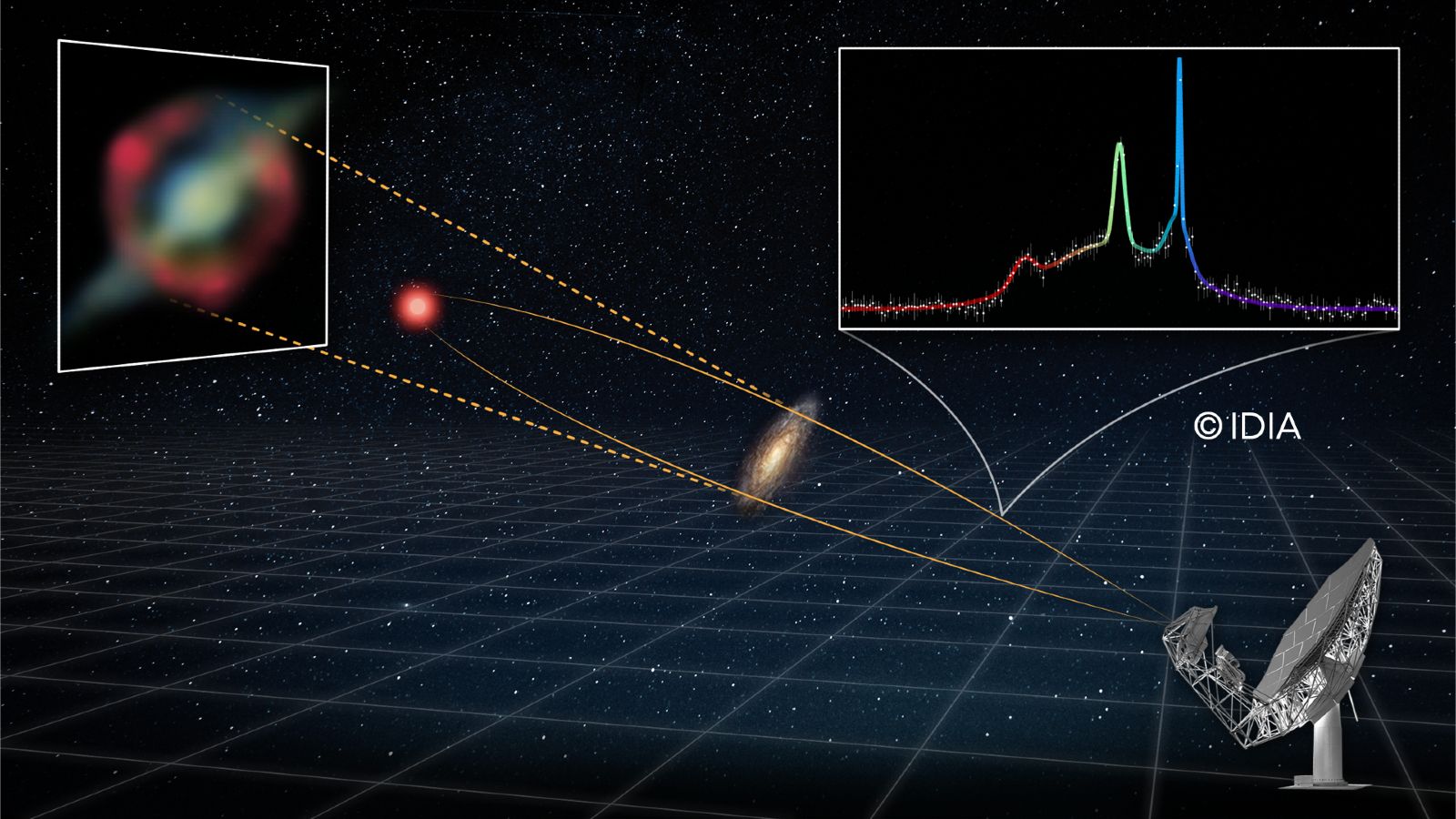
In a new study, uploaded Feb. 13 to the preprint server arXiv and accepted for future publication in the journal Monthly Notices of the Royal Astronomical Society: Letters, researchers using the MeerKAT telescope — an array of 64 radio dishes located in South Africa — discovered a new hydroxyl megamaser coming from a pair of colliding galaxies dubbed HATLAS J142935.3–002836.

A photo of two radio dishes pointed up at the night sky

The megamaser coming from HATLAS J142935.3–002836 was detected by the MeerKAT telescope in South Africa, which is made up of 64 linked radar dishes. (Image credit: SARAO/MeerKAT)

The microwaves shooting out of this system are very stretched, around 18 centimeters in length (7 inches or 1,665 megahertz), and are so much brighter than other megamasers that the researchers have proposed that the signal should be classified as a “gigamaser” — the next theoretical order of magnitude for these space lasers.

HATLAS J142935.3–002836 was first discovered in 2014 and is around 8 billion light-years from Earth, meaning the microwaves we see were emitted when the universe was about half its current age. This comfortably makes it the most distant megamaser seen to date.

Get the world’s most fascinating discoveries delivered straight to your inbox.

“This system is truly extraordinary,” study first author Thato Manamela, an astronomer at the University of Pretoria in South Africa, said in a statement. “We are seeing the radio equivalent of a laser halfway across the universe.”

Normally, signals from so far away are too faint to be picked up by telescopes like MeerKAT. However, the maser shooting from HATLAS J142935.3–002836 has been further amplified by a rare phenomenon, dubbed gravitational lensing, which was first predicted by Albert Einstein‘s theory of relativity in 1905.

Side by side images of the Einstein ring from the study taken by different telescopes

HATLAS J142935.3–002836 is only visible to us thanks to a phenomenon known as gravitational lensing. These 2014 images, captured by the Hubble Space Telescope (left) and the Atacama Large Millimeter/submillimeter Array (ALMA) telescope (right), show a partial “Einstein ring” of magnified light from the distant galaxy merger. (Image credit: ALMA (ESO/NAOJ/NRAO)/NASA/ESA/W. M. Keck Observatory)

Gravitational lensing occurs when electromagnetic radiation from a distant object, such as a galaxy, is bent around a massive object positioned directly between the source and the observer. Obviously, the radiation doesn’t actually bend (because light always travels in a straight line): Instead, it passes through warped space-time that has been pulled out of shape by the immense gravity of the middle object.

From the observer’s point of view, this phenomenon often creates a halo of light around the middle object, known as an “Einstein ring.” But it also magnifies the light source — or in this case, microwave source — making it much easier to analyze the distant object.

The team is now planning to point MeerKAT at similar systems in the hopes of discovering more secret megamasers or gigamasers lurking within gravitationally lensed objects, which could drastically increase the number of these otherwise rare space lasers they can study.

“This is just the beginning,” Manamela said. “We don’t want to find just one system — we want to find hundreds to thousands.”

Source link

Share. Facebook Twitter Pinterest LinkedIn Tumblr Email
Previous ArticleAs the U.S. wages war with Iran, social media users face worsening disinformation
Next Article 450-Unit Housing Project in Anaheim Hills Gets Green Light
Editor
  • Website

Related Posts

Lifestyle

Chewed-up orca fins on Russian beach point to cannibalism, and scientists say it may explain why some pods are so tight-knit

March 4, 2026
Lifestyle

Meet the world’s smallest AI supercomputer — it packs ‘doctorate-level intelligence’, its makers say, and can fit into your pocket

March 4, 2026
Lifestyle

Vanuatu’s ‘barefoot volcanologist’ stands at ash- and sulfur-spewing Mount Yasur in award-winning photograph

March 4, 2026
Add A Comment

Comments are closed.

Categories
  • Entertainment
  • Lifestyle
  • News
  • Sports
  • Tech
  • Travel
Recent Posts
  • Hawaii man dies after entering closed section of Kilauea volcano caldera
  • Everything Apple announced: M5 chips, iPhone 17e, new displays
  • Andrea Pavan: Italian golfer discharged from hospital five days after falling down lift shaft | Golf News
  • 450-Unit Housing Project in Anaheim Hills Gets Green Light
  • ‘Truly extraordinary’: Mega-laser shooting at us from halfway across the universe is the brightest ‘cosmic beacon’ we’ve ever seen
calendar
March 2026
M T W T F S S
 1
2345678
9101112131415
16171819202122
23242526272829
3031  
« Feb    
Recent Posts
  • Hawaii man dies after entering closed section of Kilauea volcano caldera
  • Everything Apple announced: M5 chips, iPhone 17e, new displays
  • Andrea Pavan: Italian golfer discharged from hospital five days after falling down lift shaft | Golf News
About

Welcome to Baynard Media, your trusted source for a diverse range of news and insights. We are committed to delivering timely, reliable, and thought-provoking content that keeps you informed
and inspired

Categories
  • Entertainment
  • Lifestyle
  • News
  • Sports
  • Tech
  • Travel
Facebook X (Twitter) Pinterest WhatsApp
  • Contact Us
  • About Us
  • Privacy Policy
  • Disclaimer
  • UNSUBSCRIBE
© 2026 copyrights reserved

Type above and press Enter to search. Press Esc to cancel.