Close Menu
  • Home
  • UNSUBSCRIBE
  • News
  • Lifestyle
  • Tech
  • Entertainment
  • Sports
  • Travel
Facebook X (Twitter) WhatsApp
Trending
  • TCL releases RayNeo Air 4 Pro smart glasses for $249
  • T20 World Cup: Rehan Ahmed ‘adds value’ to England after ‘upping the ante’ in dream debut against New Zealand | Cricket News
  • Demi Moore’s Bob Hairstyle at Milan Fashion Week
  • Ads funded by AI industry are flooding the 2026 election. They’re about everything except AI.
  • The sun just experienced its first ‘spotless days’ in 4 years — but we’re not in the clear yet
  • Portable power station deal: Save over 40% on the Anker Solix C800x
  • Explained: Why Prem's relegation is being scrapped
  • SKIMS Spring Loungewear Sale 2026: Best Cozy Deals
Facebook X (Twitter) WhatsApp
Baynard Media
  • Home
  • UNSUBSCRIBE
  • News
  • Lifestyle
  • Tech
  • Entertainment
  • Sports
  • Travel
Baynard Media
Home»Lifestyle»The sun just experienced its first ‘spotless days’ in 4 years — but we’re not in the clear yet
Lifestyle

The sun just experienced its first ‘spotless days’ in 4 years — but we’re not in the clear yet

EditorBy EditorFebruary 27, 2026No Comments6 Mins Read
Share Facebook Twitter Pinterest LinkedIn Tumblr Reddit Telegram Email
Share
Facebook Twitter LinkedIn Pinterest Email

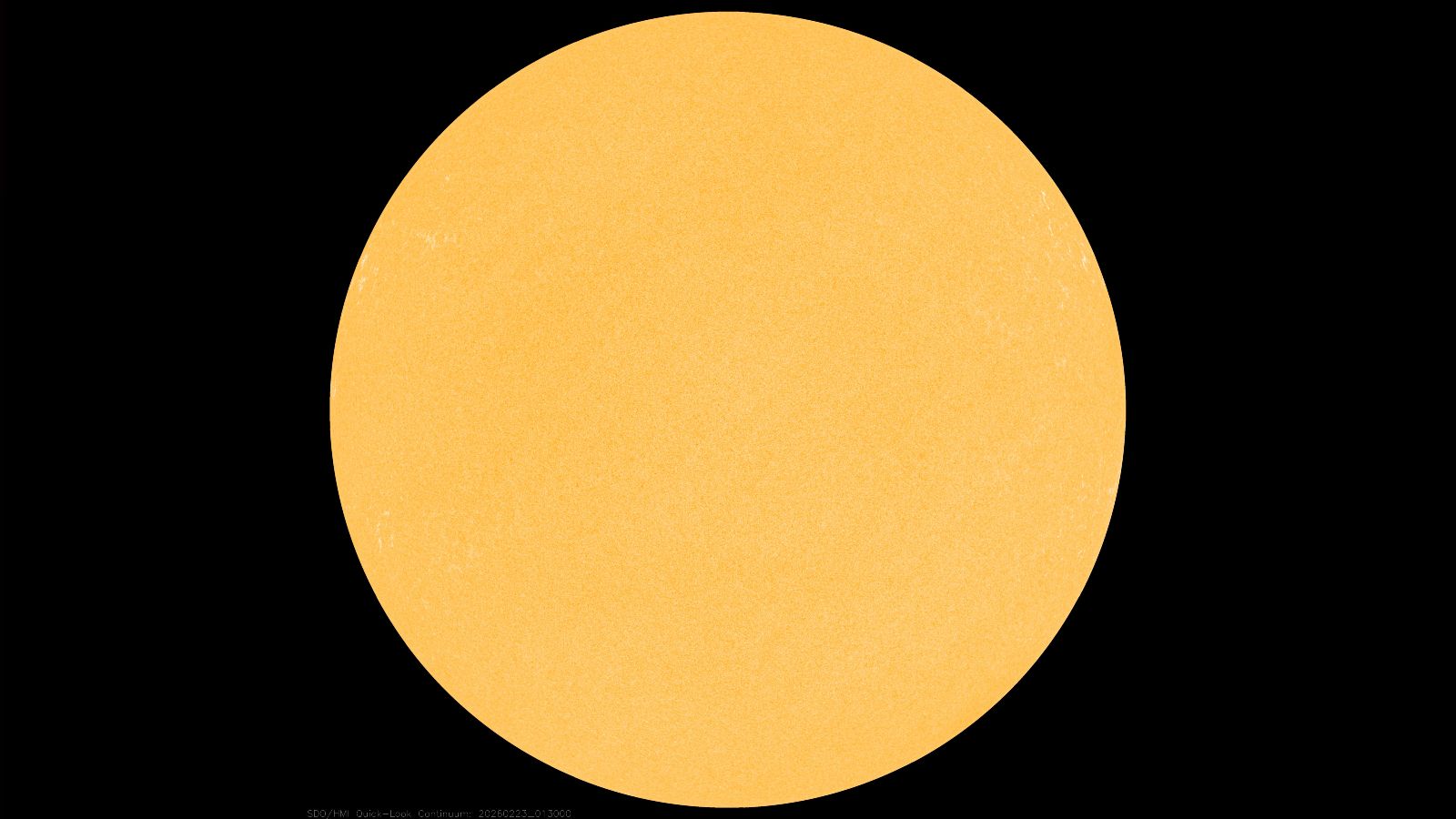
After nearly four years of being covered in dark blotches like an acne-covered teenager, the sun’s face has suddenly turned smooth for consecutive days, hinting that solar activity is on the decline. But while this surprising “spotless” spectacle is a sign of things to come, it’s still too soon to let our guard down, experts warn.

On Sunday (Feb. 22), there were zero visible sunspots on the Earth-facing side of the sun for the first time since June 8, 2022, Live Science’s sister site Space.com reported. This “spotless day” ended a 1,335-day-streak of consecutive sunspot sightings, throughout which there has been a constant and looming threat that one of these dark patches may shoot out a potentially dangerous solar storm that could later hit Earth.

This unexpected development continued throughout Monday (Feb. 23) and Tuesday (Feb. 24), which were also spotless, according to Spaceweather.com. But on Wednesday (Feb. 25), a pair of sunspots from the sun’s far side rotated into view across our home star’s eastern limb, reestablishing the perpetual threat of an incoming solar storm.


You may like

The blemish-free solar disk was surprising given that we have only recently emerged from solar maximum — the peak in the sun’s roughly 11-year solar cycle, when sunspots litter the solar surface and constantly spit out solar flares and coronal mass ejections (CMEs).

In recent weeks, we have also been hit by a major solar radiation event and witnessed one of the most explosive sunspots of the current solar cycle, which makes the sudden turn of events even more confusing.

a close-up image of a sunspot

Sunspots occur in regions of magnetic instability on the solar surface. They appear black because they contain plasma that is much cooler than the surrounding solar surface. This photo, captured last year by the newly operational Daniel K. Inouye Solar Telescope in Hawaii, is one of the most detailed sunspot images captured to date. (Image credit: U.S. National Science Foundation’s Daniel K. Inouye Solar Telescope)

But don’t let the sun’s facade fool you, because the current cycle (Solar Cycle 25) is far from over and we are almost guaranteed to see some more space weather events before our home star transitions to a more permanent state of spotlessness.

“Solar Cycle 25 still has years of life left in it,” Spaceweather.com representatives wrote. “However, these spotless days tell us that the current cycle is waning,” they added.

Get the world’s most fascinating discoveries delivered straight to your inbox.

Counting sunspots

Sunspots appear when the sun’s magnetic field is unstable, which happens in and around solar maximum, when the solar magnetic field completely flips . This makes the dark patches a key indicator of solar cycle progression.

The sudden and sharp rise of sunspots in early 2022 was the first clue that solar maximum would arrive sooner than official forecasts initially suggested, which turned out to be the case. The peak of Solar Cycle 25 (SC25) has also been much more active than expected, with the average number of sunspots climbing to 215.5 in August 2024 — the highest monthly total in more than 23 years.
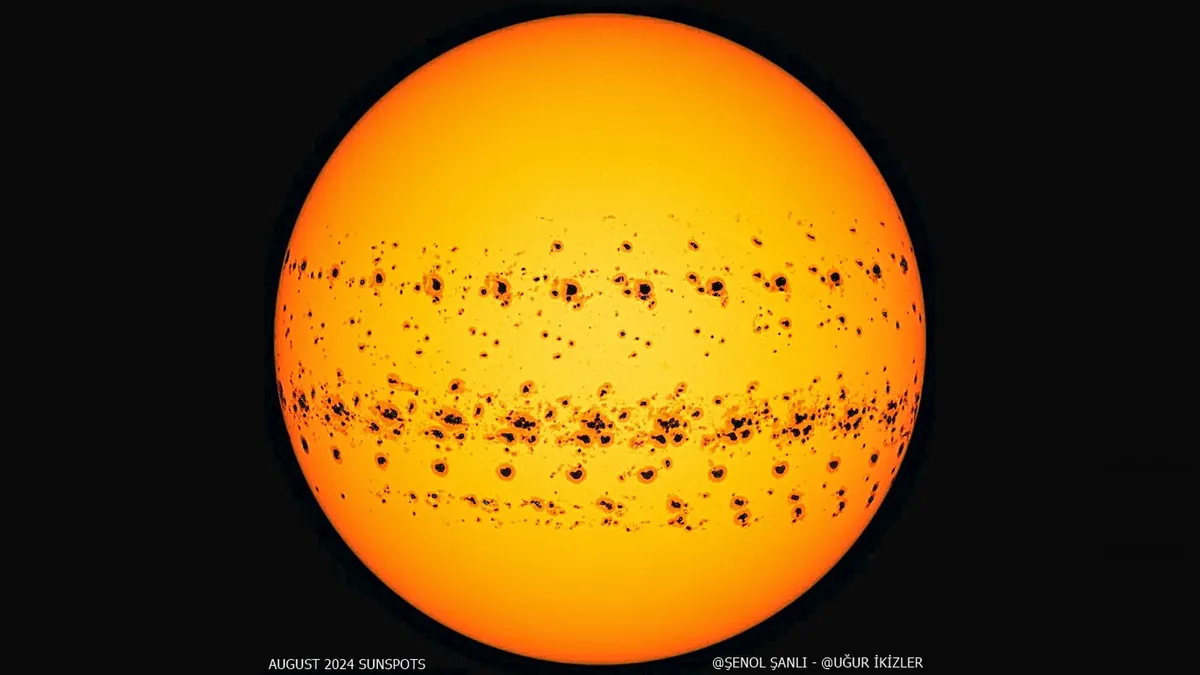
A time lapse image of the sun showing all the sunspots that have appeared in August

Solar maximum peaked in August 2024 with an average of 215.5 daily sunspots. This incredible time-lapse photo shows how each of these dark spots transited the solar surface that month. (Image credit: SDO/Şenol Şanlı/Uğur İkizler)

Over the last few years we have also seen a record number of X-class flares explode from sunspots (partially due to an advance in solar observation technology), and been hit by several major solar storms, including the famous Mothers’ Day storm of 2024, which briefly disrupted GPS technology and triggered some of the most widespread auroras in centuries.


You may like

Solar maximum likely ended sometime in early 2025 and, despite recent surges in solar activity, the sun is starting to quiet down. For example, there was an average of 112.6 sunspots in January, which is almost half of 2024’s peak, according to the Space Weather Prediction Center. But even accounting for this downward trend, it is still very surprising to see consecutive spotless days so soon in the current cycle.

Normally, we’d have to wait for the sun’s weakest phase, dubbed solar minimum, to see consecutive spotless days. For example, there were more than 700 spotless days between 2018 and 2020, around the last solar minimum, according to Spaceweather.com.

More to come

Several experts, including Scott McIntosh — the VP of space operations at Lynker Space and former deputy director of the National Center for Atmospheric Research in Colorado, who was one of the first solar physicists to accurately forecast SC25 — have previously told Live Science that solar activity can remain unusually high in the years following solar maximum.

Recent research by Lynker Space has also revealed that the years after solar maximum, dubbed the “battle zone,” can be even more chaotic than a cycle’s peak, due to instability between different parts of the sun’s newly flipped magnetic field: “The potential for large, dangerous geomagnetic storms in the next few years is very real,” McIntosh told Live Science in December 2024.

A photo of the exploding sun with an inset photo showing the giant sunspot that caused it

In May 2024, a sunspot around the same size as the one that birthed the Carrington Event of 1859 unleashed a barrage X-class flares and CMEs toward Earth, triggering a rare G5-level geomagnetic storm. (Image credit: Main: NASA/SDO and the AIA, EVE, and HMI science teams/helioviewer.org; Inset: NASA/SDO/SpaceWeatherLive.com; with annotations by Harry Baker)

The magnetic configuration of sunspots is more important than their size or frequency when determining how risky they are, meaning that the next big storm could theoretically come from almost any of them, according to The Planetary Society.

The worst-case-scenario is that we are hit by a superstorm on par with the Carrington Event of 1859 — the most extreme space weather event in recorded history, which erupted during a solar cycle similar to SC25. Such a storm has the capacity to wipe out almost every satellite orbiting Earth and cause significant damage to the energy infrastructure on our planet’s surface.

A recent study, published in October 2025, estimated that there is roughly a 5% chance that such an event could occur in the next decade. We have also already seen several Carrignton-size sunspots during the current cycle, although none of them have been as active.

All this goes to show that, just like a good book, we shouldn’t judge the sun purely by its cover.


Sun quiz: How well do you know our home star?


Source link

Share. Facebook Twitter Pinterest LinkedIn Tumblr Email
Previous ArticlePortable power station deal: Save over 40% on the Anker Solix C800x
Next Article Ads funded by AI industry are flooding the 2026 election. They’re about everything except AI.
Editor
  • Website

Related Posts

Lifestyle

Just in time for the total lunar eclipse, this beginner-friendly telescope is now $100 off at Amazon

February 27, 2026
Lifestyle

‘Thermodynamic computer’ can mimic AI neural networks — using orders of magnitude less energy to generate images

February 27, 2026
Lifestyle

‘The limits of human longevity have still not been reached,’ study suggests

February 27, 2026
Add A Comment

Comments are closed.

Categories
  • Entertainment
  • Lifestyle
  • News
  • Sports
  • Tech
  • Travel
Recent Posts
  • TCL releases RayNeo Air 4 Pro smart glasses for $249
  • T20 World Cup: Rehan Ahmed ‘adds value’ to England after ‘upping the ante’ in dream debut against New Zealand | Cricket News
  • Demi Moore’s Bob Hairstyle at Milan Fashion Week
  • Ads funded by AI industry are flooding the 2026 election. They’re about everything except AI.
  • The sun just experienced its first ‘spotless days’ in 4 years — but we’re not in the clear yet
calendar
February 2026
M T W T F S S
 1
2345678
9101112131415
16171819202122
232425262728  
« Jan    
Recent Posts
  • TCL releases RayNeo Air 4 Pro smart glasses for $249
  • T20 World Cup: Rehan Ahmed ‘adds value’ to England after ‘upping the ante’ in dream debut against New Zealand | Cricket News
  • Demi Moore’s Bob Hairstyle at Milan Fashion Week
About

Welcome to Baynard Media, your trusted source for a diverse range of news and insights. We are committed to delivering timely, reliable, and thought-provoking content that keeps you informed
and inspired

Categories
  • Entertainment
  • Lifestyle
  • News
  • Sports
  • Tech
  • Travel
Facebook X (Twitter) Pinterest WhatsApp
  • Contact Us
  • About Us
  • Privacy Policy
  • Disclaimer
  • UNSUBSCRIBE
© 2026 copyrights reserved

Type above and press Enter to search. Press Esc to cancel.