

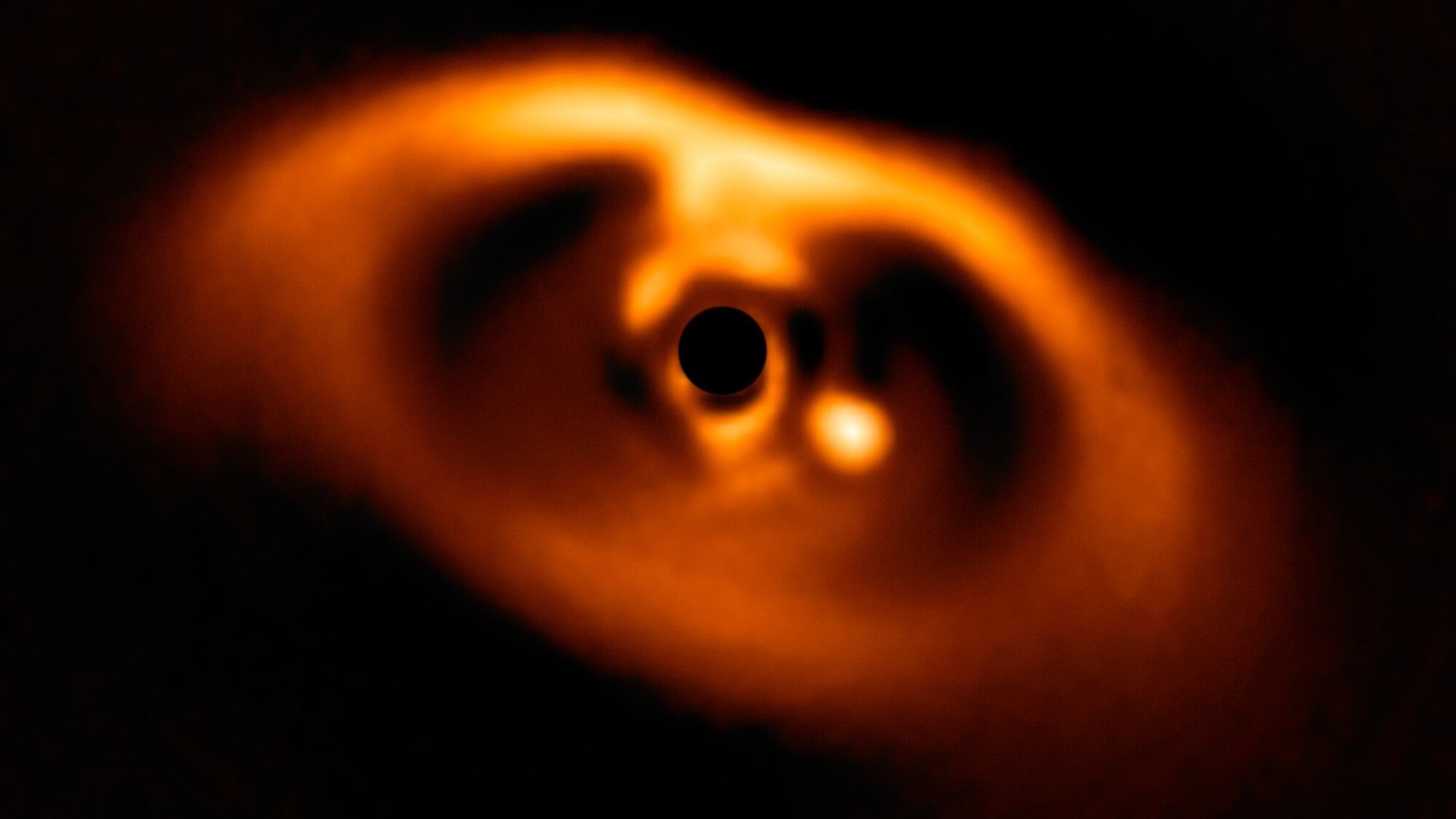
Scientists’ best theories on how planets form could be wrong, new research suggests. Astronomers studying a still-forming planet beyond our solar system have found that its chemical makeup doesn’t fully match the swirling gas and dust disk from which it formed. The finding challenges standard models of planet formation and implies they may be overly simplistic, the researchers say.
The budding planet, called PDS 70b, is a world nearly thrice as big as Jupiter and resides about 400 light-years from Earth in the constellation Centaurus. It is part of a two-planet system — one of the few known where planets are still coalescing, providing a valuable environment for astronomers to examine the link between newborn planets and their natal disk. PDS 70b circles its host star at a distance similar to Uranus’ orbit around the sun, and previous observations have hinted that it could be nearing the end of its newborn era after accumulating mass for about 5 million years.
In May, astronomers used Hawaii’s Keck II telescope to study the chemical makeup of PDS 70b, specifically looking at the abundance of carbon monoxide and water. The team used this information to infer how much carbon and oxygen is present in the planet’s atmosphere — two of the most common elements in our universe after hydrogen and helium and thus key traces of planet formation.
By comparing these observations with archival data on the gases in the system’s protoplanetary disk, the researchers found that the planet’s atmosphere contains much less carbon and oxygen than expected. They described their findings in a paper published Wednesday (Dec. 18) in the Astrophysical Journal Letters.
“That was a bit surprising, and it shows that our widely accepted picture of planet formation was too simplified,” study lead author Chih-Chun Hsu, an observational astrophysicist who is currently a postdoctoral researcher at Northwestern University in Illinois, said in a statement.
The puzzling rise of planets
Scientists believe that planets, including those in our solar system, form when particles in the protoplanetary disk collide and stick together, eventually forming larger bodies through accretion. If this is indeed a universal process, planets should have similar chemical compositions to their disks.
Related: Scientists followed a mysterious signal — and found 2 black holes gorging on something like never before
The researchers propose two scenarios that could explain the observed discrepancy. First, PDS 70b could have incorporated the majority of its carbon and oxygen not directly from the gas in the protoplanetary disk but from solid material like ice and dust, which would have contained trapped carbon and oxygen.
Recent James Webb Space Telescope observations of other planetary systems suggest such a process is possible and can hold sway over the chemical makeup of fledgling planets. If PDS 70b followed the same route, “that ice and dust would have evaporated before going into the planet,” study co-author Jason Wang, an assistant professor of physics and astronomy at Northwestern University, said in the statement. “So, it might be telling us that we can’t just compare gas versus gas — the solid components might be making a big difference in the carbon to oxygen ratio.”
Alternatively, the protoplanetary disk may have become enriched in carbon relatively recently, as other models of planet formation predict. Existing data about the system is not sufficient to distinguish between these two possibilities, but forthcoming observations of the second planet, PDS 70c, may provide the necessary insights for more detailed modeling of the system, the researchers said.
“By studying these two planets together, we can understand the system’s formation history even better,” Hsu said. “But this is just one system. Ideally, we need to identify more of them to better understand how planets form.”
