Close Menu
  • Home
  • UNSUBSCRIBE
  • News
  • Lifestyle
  • Tech
  • Entertainment
  • Sports
  • Travel
Facebook X (Twitter) WhatsApp
Trending
  • George Kittle’s wife shares live reaction to Achilles injury
  • ‘The scientific cost would be severe’: A Trump Greenland takeover would put climate research at risk
  • Headlines Across OC as Angel Stadium Sale Debate Intensifies
  • Anti-Islam activists clash with pro-Muslim counter-protesters in Dearborn, Michigan
  • Best monitor deal: Get the 45-inch LG Ultragear gaming monitor for its lowest price yet
  • Slovakia U21 0 – 4 England U21
  • 13 Top Sleep Products That Transform Your Bedtime Routine for Better Rest
  • Firefighters rescue puppies from burning house
Facebook X (Twitter) WhatsApp
Baynard Media
  • Home
  • UNSUBSCRIBE
  • News
  • Lifestyle
  • Tech
  • Entertainment
  • Sports
  • Travel
Baynard Media
Home»Lifestyle»Sea of Saharan ‘star dunes’ clashes with otherworldly terrain where 2 countries meet — Earth from space
Lifestyle

Sea of Saharan ‘star dunes’ clashes with otherworldly terrain where 2 countries meet — Earth from space

EditorBy EditorSeptember 30, 2025No Comments3 Mins Read
Share Facebook Twitter Pinterest LinkedIn Tumblr Reddit Telegram Email
Share
Facebook Twitter LinkedIn Pinterest Email

QUICK FACTS

Where is it? Grand Erg Oriental, Sahara [30.13306820, 9.306920931]

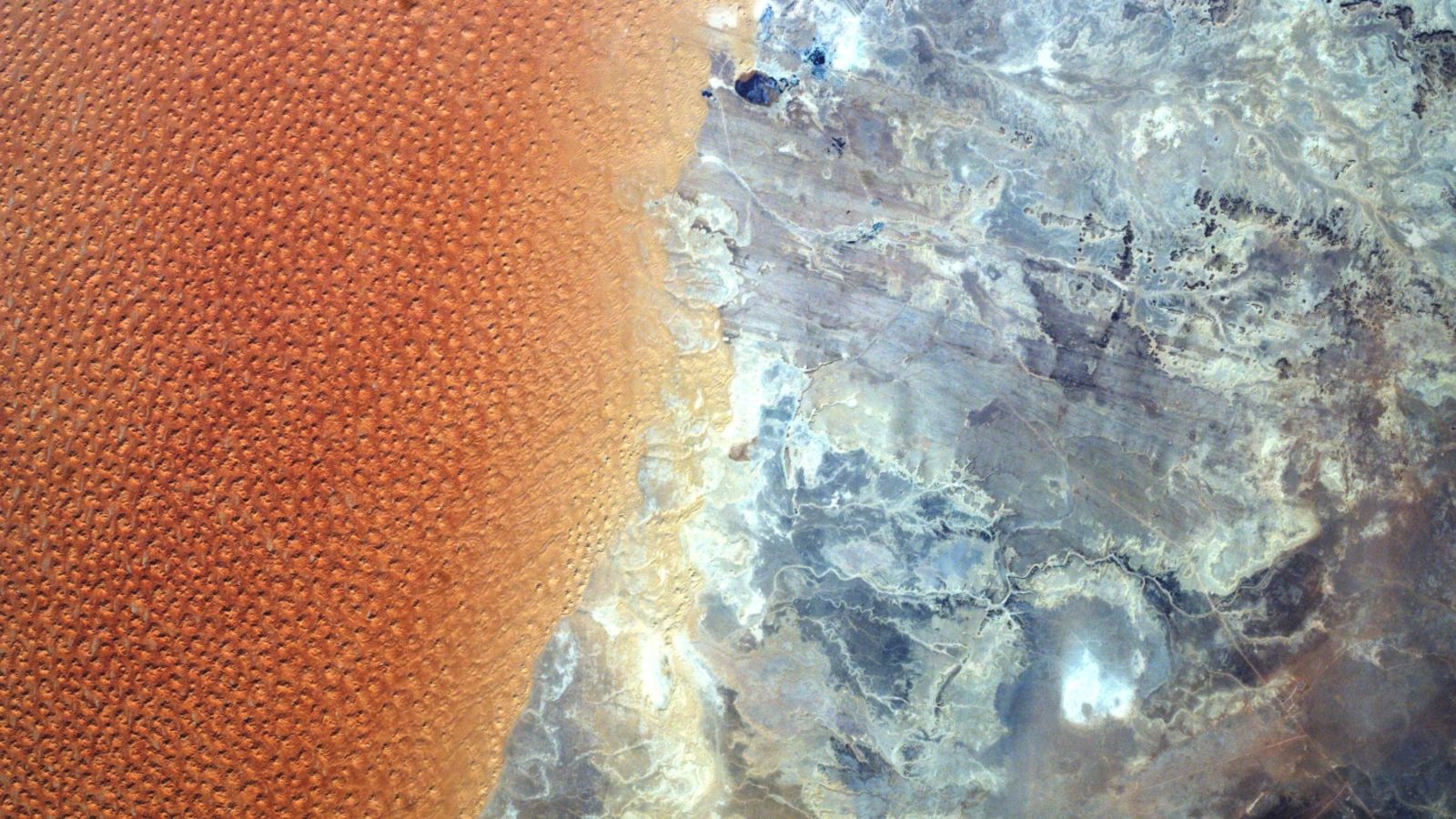
What’s in the photo? The stark contrast where a field of “star dunes” meets rocky hills

Which satellite took the photo? EarthKAM camera, on board the International Space Station

When was it taken? Oct. 31, 2017

This striking satellite image shows the stark difference between a giant field of sandy “stars” and a barren rocky wilderness in the Sahara Desert. The contrasting biomes also overlap with the border where two African countries meet.

The sea of orange sand visible in this image is part of the Grand Erg Oriental — a giant field of dunes, or erg, that covers around 55,000 square miles (140,000 square kilometers) in the northern Sahara.

This part of the erg has hundreds of prominent “star dunes,” which have at least three ridges coming from a central peak, giving them a star-like appearance when viewed from above. Star dunes can grow to be over 300 feet (90 meters) tall and only form in locations where wind directions change constantly, which allows their different slopes to form, according to the National Park Service.


You may like

The dunes overlap with a windswept rocky terrain, which is among “the driest parts of the Sahara Desert” and almost completely devoid of vegetation, according to NASA’s Earth Observatory. This terrain is covered with overlapping geological features, giving it an otherworldly quality.

One of the most striking features is a large white patch in the heart of the rocky terrain, which is the remnant of an ancient lake. You may also be able to see a series of parallel grooves in the rock (in the top half of the rocky terrain), which were carved by eons of unidirectional winds that blew long before the multi-faced dunes were formed.

Related: See all the best images of Earth from space

A photo of an orange sand dune with a defined point

Experts believe that a majority of the sand in the satellite image likely originated from the surrounding rocky terrain. (Image credit: Getty Images)

The dunes in the image are all located within Algeria, while most of the rocky terrain is in Libya. The invisible boundary between the two countries is largely located down the very center of this image. However, at one point, just to the left of a Libyan town called Ghadames (visible as a dark spot near the top of the image), the border between the countries almost exactly overlaps with the line where the sand and rock meet.

Get the world’s most fascinating discoveries delivered straight to your inbox.

While the contrasting ecosystems appear to have nothing to do with each other, they are more linked than you might imagine. Geologists believe that a majority of the erg’s sand was deposited by ancient rainwater that took loose sediments from the rocky terrain and dumped them within a natural depression, or sink, in the landscape.

This process likely took hundreds of thousands, if not millions, of years — and if you look closely, you can see that some of the erg’s sand has spilled back out into the ancient “winding water courses” that helped to deposit the sand within the erg, according to the Earth Observatory.

The erg is also partly formed above the bed of an ancient river. When rain infrequently falls on the erg’s sands, the moisture is funneled away into underground aquifers, which can support pockets of vegetation on the surface. If this did not happen, this valuable moisture would quickly evaporate back into the atmosphere.

Source link

Share. Facebook Twitter Pinterest LinkedIn Tumblr Email
Previous ArticleTyler Robinson appears remotely without video in Charlie Kirk case
Next Article Nicole Kidman and Keith Urban separate after 19 years
Editor
  • Website

Related Posts

Lifestyle

‘The scientific cost would be severe’: A Trump Greenland takeover would put climate research at risk

January 17, 2026
Lifestyle

New ‘Transformer’ humanoid robot can launch a shapeshifting drone off its back — watch it in action

November 19, 2025
Lifestyle

Medieval spear pulled from Polish lake may have belonged to prince or nobleman

November 19, 2025
Add A Comment

Comments are closed.

Categories
  • Entertainment
  • Lifestyle
  • News
  • Sports
  • Tech
  • Travel
Recent Posts
  • George Kittle’s wife shares live reaction to Achilles injury
  • ‘The scientific cost would be severe’: A Trump Greenland takeover would put climate research at risk
  • Headlines Across OC as Angel Stadium Sale Debate Intensifies
  • Anti-Islam activists clash with pro-Muslim counter-protesters in Dearborn, Michigan
  • Best monitor deal: Get the 45-inch LG Ultragear gaming monitor for its lowest price yet
calendar
February 2026
M T W T F S S
 1
2345678
9101112131415
16171819202122
232425262728  
« Jan    
Recent Posts
  • George Kittle’s wife shares live reaction to Achilles injury
  • ‘The scientific cost would be severe’: A Trump Greenland takeover would put climate research at risk
  • Headlines Across OC as Angel Stadium Sale Debate Intensifies
About

Welcome to Baynard Media, your trusted source for a diverse range of news and insights. We are committed to delivering timely, reliable, and thought-provoking content that keeps you informed
and inspired

Categories
  • Entertainment
  • Lifestyle
  • News
  • Sports
  • Tech
  • Travel
Facebook X (Twitter) Pinterest WhatsApp
  • Contact Us
  • About Us
  • Privacy Policy
  • Disclaimer
  • UNSUBSCRIBE
© 2026 copyrights reserved

Type above and press Enter to search. Press Esc to cancel.