
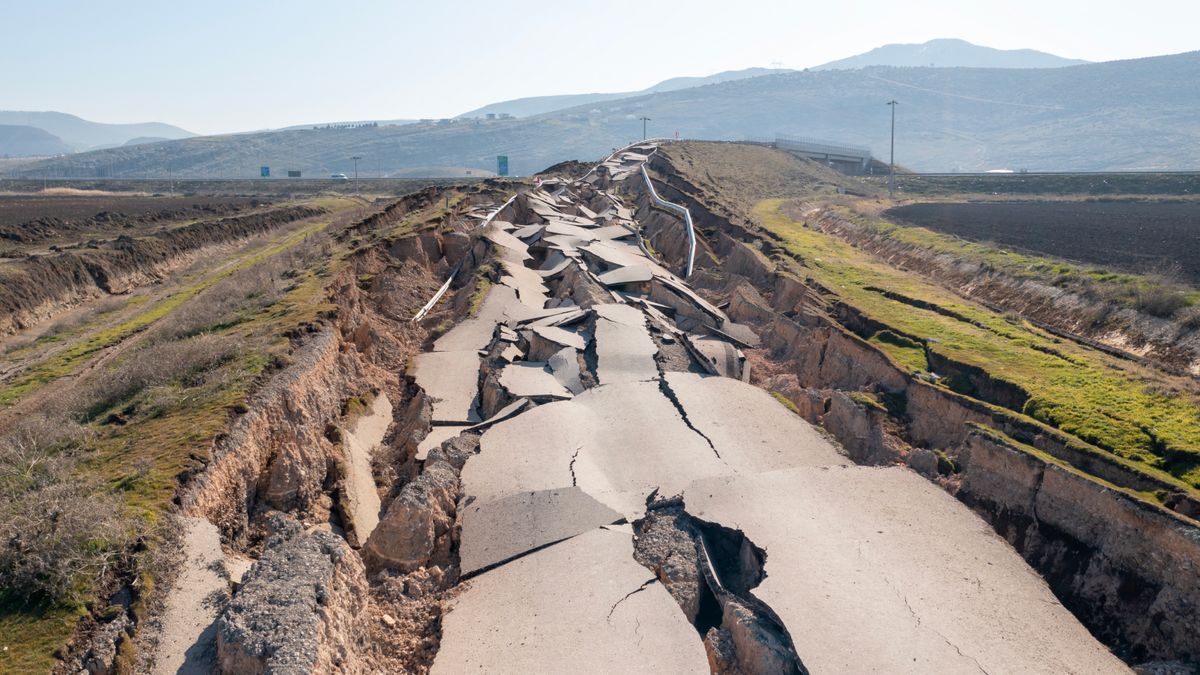

A period of slow, creeping movement without any shaking may be a necessary prelude to earthquakes, a new study suggests.
The research, which was on the fundamentals of how materials rupture, focused on cracks snaking through sheets of plastic in a laboratory. But the experiments revealed some basic physics of how fractures work — particularly how a buildup of friction at the interface of two bodies transforms into a sudden rupture. And those findings do apply to real-world earthquakes, said study author Jay Fineberg, a physicist at The Hebrew University of Jerusalem.
“The material composing the contacting plates will not matter,” Fineberg told Live Science. “The same physical process will take place in both cases — the explosive spring of the bent plates will release in the same way.”
Earthquakes form when two tectonic plates moving against one another get stuck, allowing the fault to build up stress. “The plates are increasingly stressed by the forces trying to move them, but are stuck at the brittle part of the interface that separates them,” Fineberg said. This brittle section, which doesn’t deform in response to stress, has a finite thickness and is what breaks during a quake.
“The fracture process doesn’t happen all at once. First, a crack needs to be created,” Fineberg said. When that crack reaches the borders of the brittle interface, that crack accelerates rapidly to speeds close to the speed of sound. That’s what makes the earth shake.
“The question is how does nature create the crack which then becomes an earthquake?” Fineberg.
Fineberg and his colleagues investigated the question with a mix of theoretical math and laboratory experiments. They reproduce earthquake-like fractures in the lab with blocks made of a thermoplastic called polymethyl methacrylate, better known as plexiglass. The researchers clamp sheets of plexiglass together and apply a shear, or sidelong, force, similar to those found at a strike-slip fault like Califonia’s San Andreas Fault. Though the materials are different, the mechanics of the fracture are the same.
Once a crack starts, it acts like a one-dimensional line ripping through the material. Fineberg and his team had previously shown that before the crack forms, though, the material develops a kind of precursor phase called a nucleation front. These nucleation fronts — the seeds of cracks — move through the material, but much more slowly than standard cracks. It wasn’t clear how this seed could rapidly transition into a fast-moving fracture.
Fineberg and his colleagues were perplexed about how this could be. With a combination of lab experiments and theoretical calculations, they realized that they needed a math update: The nucleation fronts need to be modeled in 2D, not 1D.
Instead of thinking of a crack as a line separating broken from unbroken material, Fineberg said, imagine the crack as a patch that starts within the plane where two plexi-glass “plates” meet. The energy it takes to break new material at the border of the patch is linked with the patch’s perimeter: As the perimeter grows, so does the energy it takes for new material to crack.
That means the patch moves slowly and doesn’t yet cause a rapid fracture that would create the seismic waves and subsequent shaking motion associated with an earthquake. While the rapid acceleration of a standard, rapid crack, releases kinetic energy into the surrounding material, the slow movement of the initial patch doesn’t release any kinetic energy into its surroundings. Therefore, its movement is known as “aseismic.”
Eventually, though, the patch expands outside of the brittle zone where the two plates meet. Outside this zone, the energy it takes to break new material no longer grows with the size of the broken region, and instead of a balance of energy, there is now excess energy that needs somewhere to go.
“This extra energy now causes the explosive motion of the crack,” Fineberg said.
The findings, published Jan. 8 in the journal Nature, show how a slow creep before a crack can transition rapidly to an earthquake, he said. Theoretically, if one could measure aseismic movement before a rupture — on a fault line, for example, or even in a mechanical object like an airplane wing — it might be possible to predict a break before it happens. This may be complicated in real-world faults, many of which undergo aseismic creep over long periods of time without releasing any earthquakes.
Nevertheless, Fineberg and his team are now trying to detect signs of the transition from aseismic to seismic in their laboratory materials.
“In the lab, we can watch this thing unfold and we can listen to the noises that it makes,” Fineberg said. “So maybe we can uncover what you can’t really do in a real fault, because you have no detailed information on what an earthquake is doing until it explodes.”
