Close Menu
  • Home
  • UNSUBSCRIBE
  • News
  • Lifestyle
  • Tech
  • Entertainment
  • Sports
  • Travel
Facebook X (Twitter) WhatsApp
Trending
  • George Kittle’s wife shares live reaction to Achilles injury
  • ‘The scientific cost would be severe’: A Trump Greenland takeover would put climate research at risk
  • Headlines Across OC as Angel Stadium Sale Debate Intensifies
  • Anti-Islam activists clash with pro-Muslim counter-protesters in Dearborn, Michigan
  • Best monitor deal: Get the 45-inch LG Ultragear gaming monitor for its lowest price yet
  • Slovakia U21 0 – 4 England U21
  • 13 Top Sleep Products That Transform Your Bedtime Routine for Better Rest
  • Firefighters rescue puppies from burning house
Facebook X (Twitter) WhatsApp
Baynard Media
  • Home
  • UNSUBSCRIBE
  • News
  • Lifestyle
  • Tech
  • Entertainment
  • Sports
  • Travel
Baynard Media
Home»Lifestyle»Scientists detect monster ‘coronal mass ejection’ from nearby star that could rip the atmosphere off a planet
Lifestyle

Scientists detect monster ‘coronal mass ejection’ from nearby star that could rip the atmosphere off a planet

EditorBy EditorNovember 12, 2025No Comments4 Mins Read
Share Facebook Twitter Pinterest LinkedIn Tumblr Reddit Telegram Email
Share
Facebook Twitter LinkedIn Pinterest Email

A powerful blast spotted from a dwarf star was strong enough to strip away the atmosphere of any Earth-like planets that might have been lurking close by, new research suggests.

The study, published Wednesday (Nov. 12) in the journal Nature, was the first to confirm a coronal mass ejection (CME) — a massive, high-speed blast of plasma — from a star besides the sun. As scientists search for habitable worlds, understanding how strongly and frequently stars erupt will be essential to figuring out where to center our search, the study’s authors argue.

A fast CME is visible in a “type II radio burst,” which occurs due to the shock wave a CME creates as it moves from a star’s atmosphere into interplanetary space. That burst in radio waves was spotted in a star 40 light-years from Earth, which is about 10 times farther from us than the nearest star system, Alpha Centauri. While extrasolar CMEs have been proposed before, this is the first type II radio burst definitively detected coming from another star, making it the most convincing detecting yet.


You may like

The star, called StKM 1-1262, is an M dwarf. Statistically, M dwarfs are smaller than the sun and far more active, meaning they send off more solar flares and CMEs. M dwarfs are nevertheless popular targets for life searches, because they are common in our universe. It’s also easier to spot planets around these stars; because M dwarf are so small, planets tend to form much closer to them (and are therefore easier to detect) than those around larger sun-like stars.

But there’s a caveat: Because M dwarfs are more active, and the “Goldilocks zone” where water could exist on a theoretical rocky planet’s surface is closer to the dimmer star than Earth is to the sun, any Earth 2.0 would likely be more exposed to more CMEs than we experience with the sun.

“One of the problems could be [that] these CMEs happen so regularly, and they’re hitting the planets so regularly, that they strip the atmosphere,” lead study author Joe Callingham, a radio astronomer at the Netherlands Institute for Radio Astronomy, told Live Science in an interview. “So, great — you’re in the Goldilocks zone, but you’ve got no help here, because the stellar activity destroyed [the chances for life].”

An atmosphere-shredding storm

The researchers spotted the initial burst in radio waves with the Low Frequency Array (LOFAR) radio telescope — a European network of antennas located primarily in the Netherlands — and assisted by new data processing methods from co-authors at the Paris Observatory. LOFAR is the most sensitive radio telescope ever built, Callingham noted, adding that the algorithms allowed the researchers to “get lucky” in finding the small burst of light in the sky.

Get the world’s most fascinating discoveries delivered straight to your inbox.

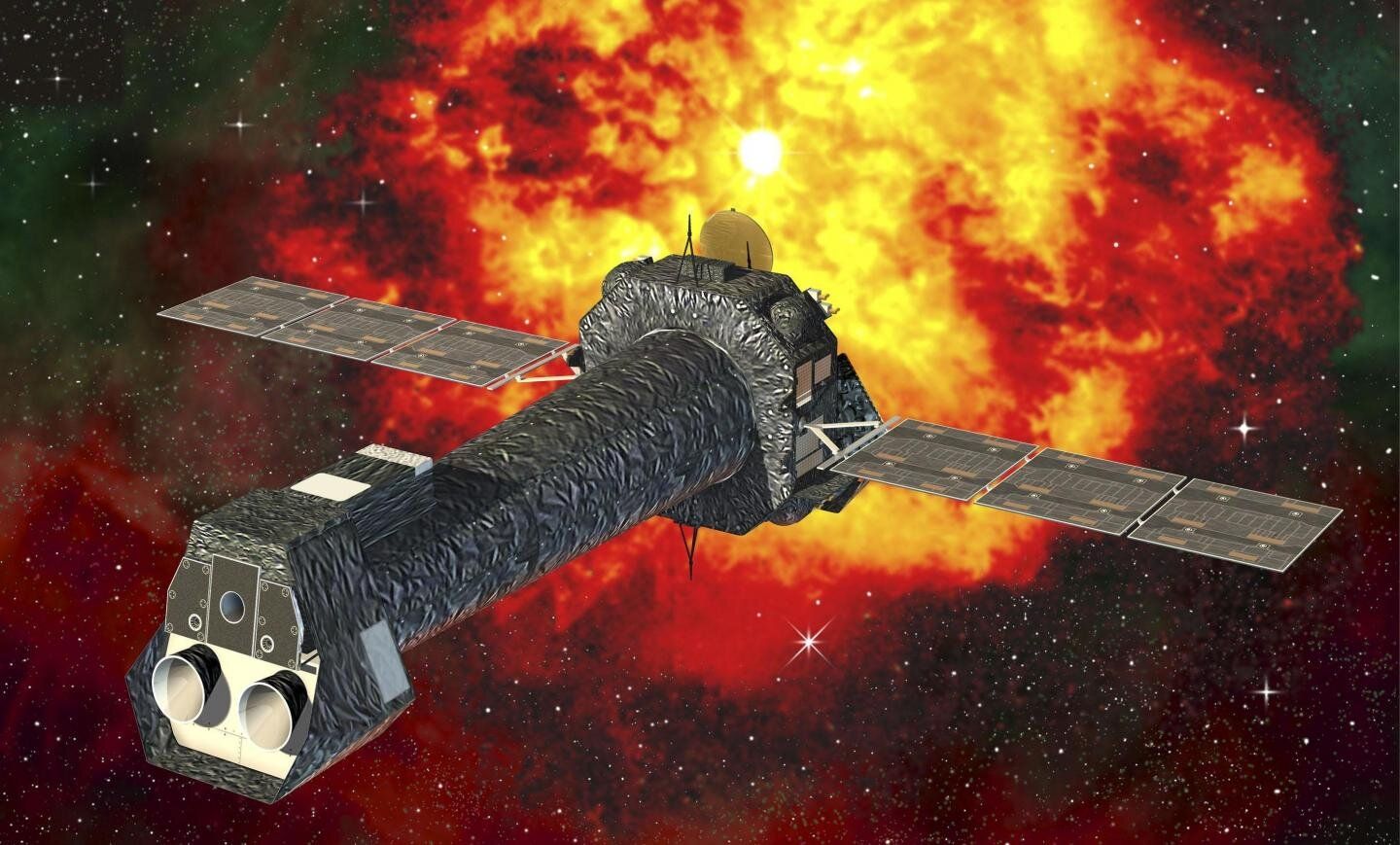
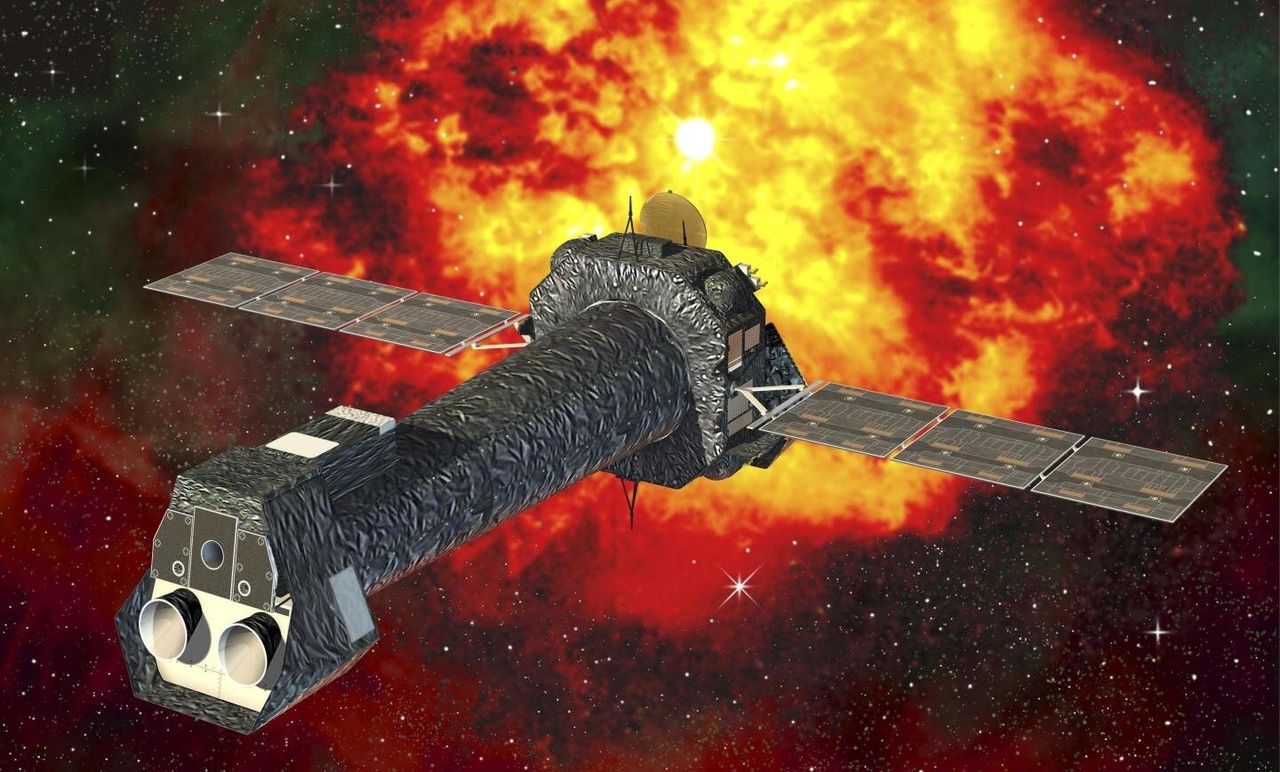
Follow-up observations with the European Space Agency’s XMM-Newton space telescope showed the star’s temperature, confirming that it is an M dwarf, along with its rotation (20 times faster than the sun) and its brightness in X-rays.

The rotation and brightness revealed the motion of the CME, which was moving at nearly 1,500 miles per second (2,400 kilometers per second) — a speed seen in only 5% of similar bursts happening on the sun. The combined telescope observations also showed that the CME is moving fast enough, and with enough density, to blow away atmospheres of any planets in a close orbit with the star.

While LOFAR is powerful, Callingham said the challenge is that this observation (paired with the new data processing techniques) is approaching the telescope’s resolution limit. To see more extrasolar CMEs, the research team is looking forward to science operations of the Square Kilometer Array, an enormous radio telescope project being built in Australia and South Africa, in the 2030s.

Callingham said the Square Kilometer Array should be able to spot “tens to hundreds” of extrasolar CMEs within the first year, which would allow the team to better chart how often an atmospheric-stripping blow would occur and how CMEs vary by types of star.

“It’s so impactful,” he said of the search, “because we really are, as astronomers, trying to find a habitable planet. … It’s one of the key goals of astronomy over the next, I would hope, decade. But maybe it’s going to take longer, or maybe the rest of my life, to find Earth 2.0.”

Source link

Share. Facebook Twitter Pinterest LinkedIn Tumblr Email
Previous ArticleFox News Sports Huddle Newsletter: Trump makes rare NFL appearance, trans athlete challenges SCOTUS case
Next Article Pope Leo lists his four favorite movies
Editor
  • Website

Related Posts

Lifestyle

‘The scientific cost would be severe’: A Trump Greenland takeover would put climate research at risk

January 17, 2026
Lifestyle

New ‘Transformer’ humanoid robot can launch a shapeshifting drone off its back — watch it in action

November 19, 2025
Lifestyle

Medieval spear pulled from Polish lake may have belonged to prince or nobleman

November 19, 2025
Add A Comment

Comments are closed.

Categories
  • Entertainment
  • Lifestyle
  • News
  • Sports
  • Tech
  • Travel
Recent Posts
  • George Kittle’s wife shares live reaction to Achilles injury
  • ‘The scientific cost would be severe’: A Trump Greenland takeover would put climate research at risk
  • Headlines Across OC as Angel Stadium Sale Debate Intensifies
  • Anti-Islam activists clash with pro-Muslim counter-protesters in Dearborn, Michigan
  • Best monitor deal: Get the 45-inch LG Ultragear gaming monitor for its lowest price yet
calendar
February 2026
M T W T F S S
 1
2345678
9101112131415
16171819202122
232425262728  
« Jan    
Recent Posts
  • George Kittle’s wife shares live reaction to Achilles injury
  • ‘The scientific cost would be severe’: A Trump Greenland takeover would put climate research at risk
  • Headlines Across OC as Angel Stadium Sale Debate Intensifies
About

Welcome to Baynard Media, your trusted source for a diverse range of news and insights. We are committed to delivering timely, reliable, and thought-provoking content that keeps you informed
and inspired

Categories
  • Entertainment
  • Lifestyle
  • News
  • Sports
  • Tech
  • Travel
Facebook X (Twitter) Pinterest WhatsApp
  • Contact Us
  • About Us
  • Privacy Policy
  • Disclaimer
  • UNSUBSCRIBE
© 2026 copyrights reserved

Type above and press Enter to search. Press Esc to cancel.