Close Menu
  • Home
  • UNSUBSCRIBE
  • News
  • Lifestyle
  • Tech
  • Entertainment
  • Sports
  • Travel
Facebook X (Twitter) WhatsApp
Trending
  • George Kittle’s wife shares live reaction to Achilles injury
  • ‘The scientific cost would be severe’: A Trump Greenland takeover would put climate research at risk
  • Headlines Across OC as Angel Stadium Sale Debate Intensifies
  • Anti-Islam activists clash with pro-Muslim counter-protesters in Dearborn, Michigan
  • Best monitor deal: Get the 45-inch LG Ultragear gaming monitor for its lowest price yet
  • Slovakia U21 0 – 4 England U21
  • 13 Top Sleep Products That Transform Your Bedtime Routine for Better Rest
  • Firefighters rescue puppies from burning house
Facebook X (Twitter) WhatsApp
Baynard Media
  • Home
  • UNSUBSCRIBE
  • News
  • Lifestyle
  • Tech
  • Entertainment
  • Sports
  • Travel
Baynard Media
Home»Lifestyle»Science news this week: Powerful solar storms, exploding comets and pigs from hell
Lifestyle

Science news this week: Powerful solar storms, exploding comets and pigs from hell

EditorBy EditorNovember 15, 2025No Comments6 Mins Read
Share Facebook Twitter Pinterest LinkedIn Tumblr Reddit Telegram Email
Share
Facebook Twitter LinkedIn Pinterest Email

The stars of the show in this week’s science news were actually the stars themselves. It was a truly brilliant week for updates and discoveries related to these celestial furnaces.

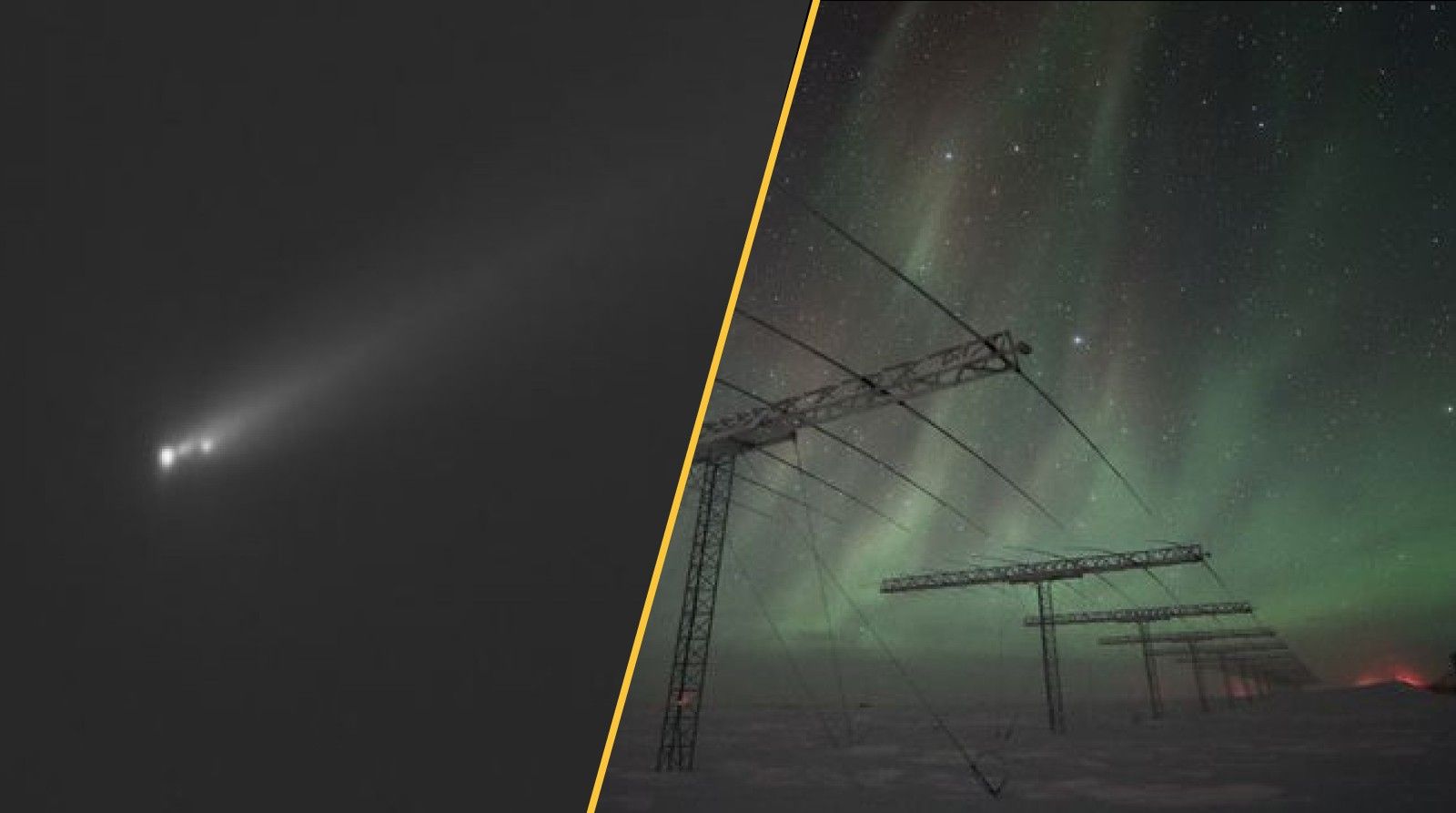
Starting close to home, the sun spit out three consecutive solar outbursts toward Earth, causing this month’s second launch attempt of Blue Origin’s New Glenn rocket to be scrubbed and bringing auroras as far south as Florida. Luckily, our planet’s protective magnetosphere sheltered us from any harmful effects, but severe geomagnetic storms could be more damaging in the future, owing to a newly discovered weak spot in Earth’s invisible shield.

The sun also played havoc on the “other comet ATLAS,” when the sun’s extreme gravity caused the comet to explode into pieces following a close flyby. Thankfully, its famous namesake — the interstellar comet 3I/ATLAS — didn’t explode. But it did give off a radio signal — and no, that doesn’t mean it’s aliens.

Earth has it pretty good compared with other planets, however, as astronomers revealed a first-of-its-kind detection of a distant star firing a monster blast powerful enough to rip off the atmospheres of any planets in its habitable zone (a minor blow to the search for extraterrestrial life). Meanwhile, the James Webb Space Telescope may have discovered the earliest and most monstrous stars ever to have formed from hydrogen, helium and dark matter in the young universe.

If all that solar activity leaves you feeling that those pesky stars think everything revolves around them, take some solace: We may have already passed peak star formation, according to the Euclid telescope, and the universe will only get “colder and deader” from here on out.

Scientists spot brains zoning out in real time

Grey scale brain scan showing changes in blood flow in red and cerebrospinal fluid in blue.

Tired brains flush more often. (Image credit: Zinong Yang)

Ever get that feeling — say, at the end of the week — when you really want to pay attention to something important, but you just zone out and see people’s lips moving?

Well, scientists finally have a physiological explanation for why this happens when you’re sleep-deprived: Your brain is literally flushing out cerebrospinal fluid, making it nigh-impossible for you to concentrate. The exact functional reason for this is still unclear, but scientists think it could have something to do with sleep-deprived brains switching into sleep-like states, possibly as a form of waking brain waste disposal you missed out on the night before.

Get the world’s most fascinating discoveries delivered straight to your inbox.

Discover more health news

—Brain benefits of exercise come from the bloodstream — and they may be transferrable, mouse study finds

—New antivenom works against 17 dangerous African snake species, study suggests

—Diagnostic dilemma: A woman’s homemade juice led to life-threatening ‘toxic squash syndrome’

Life’s Little Mysteries

a box jellyfish swimming with its tentacles out to the left hand side

Whether brainless animals can think depends upon your definition of cognition. (Image credit: Auscape/Getty Images)

Can you have thoughts without a brain? Probably not in the sense that we tend to define them, but it doesn’t mean that brainless creatures — such as jellyfish, sea urchins or sea stars — don’t show some signs of cognition.

—If you enjoyed this, sign up for our Life’s Little Mysteries newsletter

Like a pig out of hell

A photo of a large Archaeotherium skull on display at John Day Fossil Beds National Monument in Oregon.

A hellishly-large hell pig skull. (Image credit: Gabbro via Alamy)

Ever heard of a “hell pig?” Me neither, until this week, but these ancient North American beasts in the genus Archaeotherium could weigh up to 2,000 pounds (1,000 kilograms).

Now, a new tooth analysis has revealed that the hell pigs had different feeding strategies depending on their sizes: The smaller species typically sheared flesh, while the larger species crushed bones with their horrifying teeth (there’s the “hell” part).

Archaeotherium was technically more closely related to hippos and whales than to pigs, but it’s a great name for an animal we’re mostly glad isn’t around anymore — especially as the preserved bites of the larger ones are indistinguishable from those of lions.

Discover more animals news

—Mammoth RNA sequenced for the first time, marking a giant leap toward understanding prehistoric life

—240 million-year-old ‘warrior’ crocodile ancestor from Pangaea had plated armor — and it looked just like a dinosaur

—Tiny spiders that build giant ‘puppet’ decoys from disembodied prey discovered in Peru and Philippines

Also in science news this week

—Exotic ‘time crystals’ could be used as memory in quantum computers, promising research finds

—Chinese astronauts are back on Earth after suspected ‘space junk’ strike left them stranded in space

—Prehistoric Jomon people in Japan had ‘little to no’ DNA from the mysterious Denisovans, study finds

—For the first time, physicists peer inside the nucleus of a molecule using electrons as a probe

Science Spotlight

A pixel art-style illustration of a castle representing the protection of data

Cryptographers are racing to make computers quantum-proof. (Image credit: Supertotto)

Compared with classical computers, where do quantum computers excel? One answer sticks out: hacking.

Quantum systems can solve problems related to encryption significantly faster than the classical computers used by nearly all organizations, and cryptographers are facing a major challenge in designing algorithms that will be safe from quantum hacking. But how do you quantum-hack-proof a laptop? Live Science investigated in this Science Spotlight.

Something for the weekend

If you’re looking for something a little longer to read over the weekend, here are some of the best news analyses, crosswords and polls published this week.

—Some people love AI, others hate it. Here’s why. [Analysis]

—Live Science crossword puzzle #18: First human-made satellite in space — 11 across [Crossword]

—Science history: Russian mathematician quietly publishes paper — and solves one of the most famous unsolved conjectures in mathematics — Nov. 11, 2002 [Science history]

Science in pictures

A close up image of the silhouette of a skydiver against the fiery surface of the sun

A skydiver falls across the sun in this exquisitely planned shot (Image credit: Andrew McCarthy/cosmicbackground.io)

This week’s science picture is something truly special and, despite its preposterous appearance, entirely real. The stunning shot was taken by an astrophotographer who captured a skydiver falling from a plane 8,000 feet (2,440 meters) away. The image is named “The Fall of Icarus” and more than lives up to its mythic title.

Something for the skywatchers

a photo of a meteor shower during sunset with the silhouette of a single tree

Monday morning will bring a special shower of meteors to skywatchers. (Image credit: wenbin via Getty Images)

Save all your wishes for Monday (Nov. 17), when the Leonid meteor shower peaks.

The annual flurry of shooting stars is set to appear in the early hours that day and is produced by tiny particles from the Comet 55P/Tempel-Tuttle that burn up in the atmosphere to make meteors. This year could offer one of the best viewing windows for the fast-moving shower, owing to a nearly moonless night.

Follow Live Science on social media

Want more science news? Follow our Live Science WhatsApp Channel for the latest discoveries as they happen. It’s the best way to get our expert reporting on the go, but if you don’t use WhatsApp we’re also on Facebook, X (formerly Twitter), Flipboard, Instagram, TikTok, Bluesky and LinkedIn.


Source link

Share. Facebook Twitter Pinterest LinkedIn Tumblr Email
Previous ArticleFake Geek Squad scam email tricks users with phony invoices and charges
Next Article Penguin living conditions at London aquarium stir icy response from protesters
Editor
  • Website

Related Posts

Lifestyle

‘The scientific cost would be severe’: A Trump Greenland takeover would put climate research at risk

January 17, 2026
Lifestyle

New ‘Transformer’ humanoid robot can launch a shapeshifting drone off its back — watch it in action

November 19, 2025
Lifestyle

Medieval spear pulled from Polish lake may have belonged to prince or nobleman

November 19, 2025
Add A Comment

Comments are closed.

Categories
  • Entertainment
  • Lifestyle
  • News
  • Sports
  • Tech
  • Travel
Recent Posts
  • George Kittle’s wife shares live reaction to Achilles injury
  • ‘The scientific cost would be severe’: A Trump Greenland takeover would put climate research at risk
  • Headlines Across OC as Angel Stadium Sale Debate Intensifies
  • Anti-Islam activists clash with pro-Muslim counter-protesters in Dearborn, Michigan
  • Best monitor deal: Get the 45-inch LG Ultragear gaming monitor for its lowest price yet
calendar
February 2026
M T W T F S S
 1
2345678
9101112131415
16171819202122
232425262728  
« Jan    
Recent Posts
  • George Kittle’s wife shares live reaction to Achilles injury
  • ‘The scientific cost would be severe’: A Trump Greenland takeover would put climate research at risk
  • Headlines Across OC as Angel Stadium Sale Debate Intensifies
About

Welcome to Baynard Media, your trusted source for a diverse range of news and insights. We are committed to delivering timely, reliable, and thought-provoking content that keeps you informed
and inspired

Categories
  • Entertainment
  • Lifestyle
  • News
  • Sports
  • Tech
  • Travel
Facebook X (Twitter) Pinterest WhatsApp
  • Contact Us
  • About Us
  • Privacy Policy
  • Disclaimer
  • UNSUBSCRIBE
© 2026 copyrights reserved

Type above and press Enter to search. Press Esc to cancel.