Close Menu
  • Home
  • UNSUBSCRIBE
  • News
  • Lifestyle
  • Tech
  • Entertainment
  • Sports
  • Travel
Facebook X (Twitter) WhatsApp
Trending
  • Democrats bring Epstein victims to State of the Union to pressure Trump
  • Best power station deal: Get the Bluetti Elite 10 mini portable power station for its lowest price
  • Eric Ramsay sacked: West Brom part company with boss after failing to win in eight league games | Football News
  • David Bowie and Iman’s Daughter Details Being Sent to Rehab at 14
  • Google set to build data center near Rochester
  • ‘One of the strangest in the solar system’: James Webb telescope spots widespread auroras rolling through Uranus’ atmosphere
  • The Aura frame lets me upload toddler photos on the go
  • Man Utd join chase for Nottingham Forest’s Morgan Gibbs-White – Paper talk and football transfer gossip | Football News
Facebook X (Twitter) WhatsApp
Baynard Media
  • Home
  • UNSUBSCRIBE
  • News
  • Lifestyle
  • Tech
  • Entertainment
  • Sports
  • Travel
Baynard Media
Home»Lifestyle»Science history: Invention of the transistor ushers in the computing era — Oct. 3, 1950
Lifestyle

Science history: Invention of the transistor ushers in the computing era — Oct. 3, 1950

EditorBy EditorOctober 3, 2025No Comments5 Mins Read
Share Facebook Twitter Pinterest LinkedIn Tumblr Reddit Telegram Email
Share
Facebook Twitter LinkedIn Pinterest Email

Quick facts

Milestone: Transistor patented

Date: Oct. 3, 1950

Where: Bell Labs; Murray Hill, New Jersey

Who: John Bardeen, Walter Brattain and William Shockley

On Oct. 3, 1950, three scientists at Bell Labs in New Jersey received a U.S. patent for what would become one of the most important inventions of the 20th century — the transistor.

John Bardeen, Walter Brattain and William Shockley had submitted the patent application for a “three-electrode circuit element utilizing semiconductor materials” two years earlier, and it would be another few years before the full significance of this technology became clear.

The transistor was initially designed because AT&T wanted to improve its telephone network. At the time, AT&T amplified and transmitted phone signals using triodes. These devices encased a positive and negative terminal and a wire mesh in a vacuum tube, which ensured electrons could flow without bumping into air molecules.


You may like

But triodes were power hogs that often overheated, so by the 1930s, Bell Labs President Mervin Kelly began to look for alternatives. He was intrigued by the potential of semiconductors, which have electrical properties between those of insulators and conductors. In 1925, Julius Lilienfeld had patented a semiconductor precursor to the transistor, but it used copper sulfide, which was unreliable, and the underlying physics were poorly understood.

At the end of World War II, as the lab shifted its focus from war technology, Kelly recruited a team, led by Shockley, to find a replacement for vacuum-tube triodes. The team conducted a number of experiments, including plunging silicon into a hot thermos, with limited success. The problem was that they didn’t get much amplification.

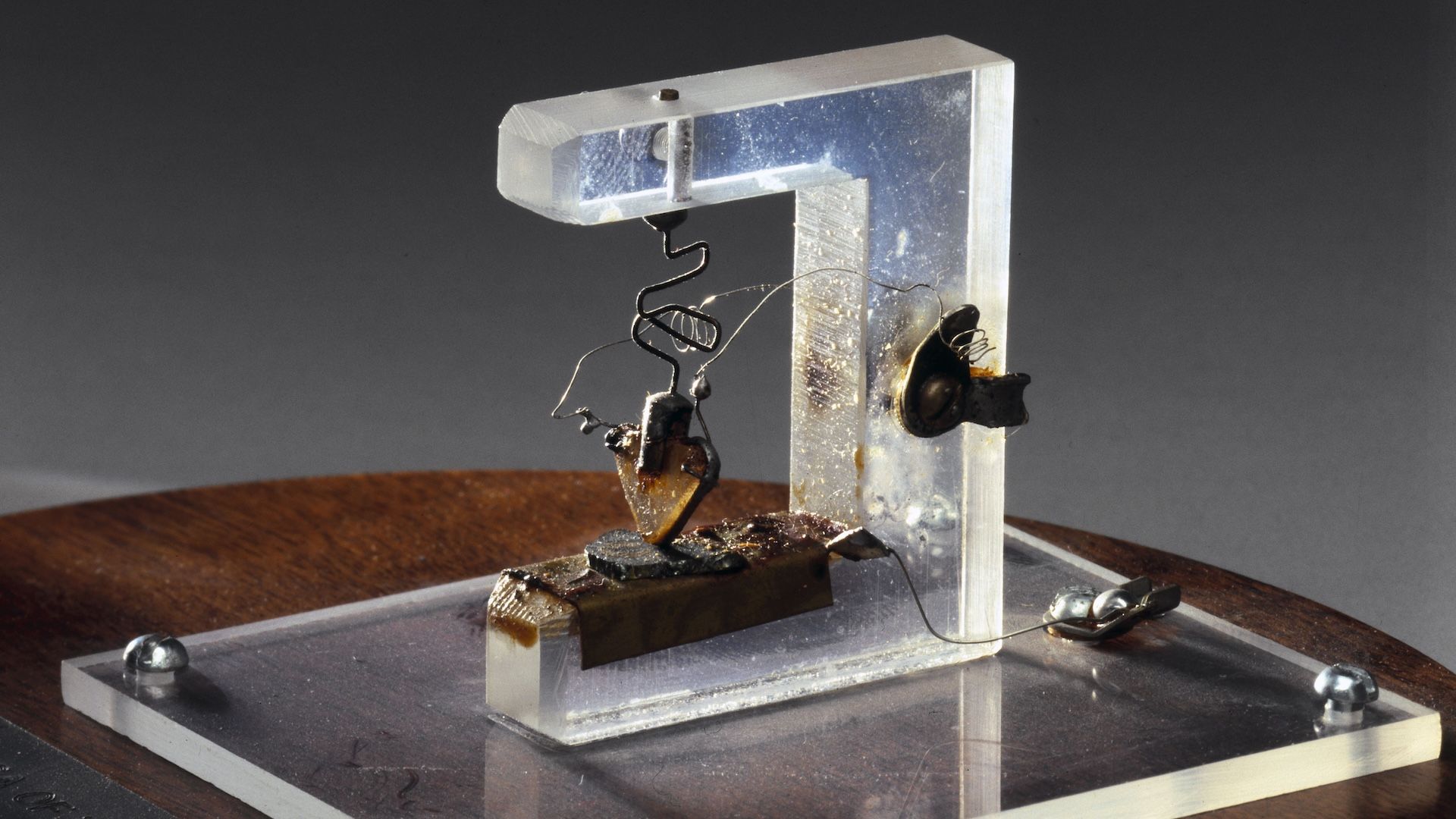
Then, in 1947, Brattain and Bardeen switched from silicon to germanium and helped clarify the physics at play in the semiconductor. Their work led to a “point-contact” transistor that used a little spring to press two thin slips of gold foil into a germanium slab. Notably, this early transistor took some finessing to work, requiring Brattain to wiggle things “just right” to get the impressive 100-fold amplification in signal.

An array of triode vacuum tube light bulbs

Triode vacuum tubes from the first half of the 20th century, shown in chronological order from left (1918) to right (1949). Triodes were integral components of phone networks prior to the invention of the transistor, but they used lots of power, overheated and were unreliable, which spurred AT&T to look for alternatives. (Image credit: RJB1, via Wikimedia Commons; CC BY-SA 4.0)

In 1948, Shockley iterated on that design with what would later be termed the junction transistor, the subject of the patent that would go on to form the basis of most modern transistors.

Get the world’s most fascinating discoveries delivered straight to your inbox.

The key to the technology is that when a voltage is applied to a semiconductor, electrons migrate within the material, leaving positively charged “holes” behind, according to the patent.

Thus, it’s possible to create “N-type” or “P-type” semiconductors — areas that carry an excess of either negative or positive charges. When a metal electrode contacts a semiconductor, the current flow would go one way if touching an N-type material and the opposite direction in a P-type material, the patent noted.

a close-up of three miniature M-1 transistors against a dime

A close-up of three miniature M-1 transistors photographed against a dime. This photo was taken in 1956, and shows just how much transistors developed in the six years after Bardeen, Brattain and Shockley were awarded their patent for the first transistor. (Image credit: AFP via Getty Images)

The junction transistor takes advantage of this property with a semiconductor with three attached electrodes. By modifying the voltage applied and the properties of the electrodes and the semiconductor, it’s possible to reliably amplify the current. This amplification would soon prove invaluable in radios, televisions and telephone networks.


You may like

But amplification isn’t what ushered in the era of modern computing. Rather, the junction transistor was a tiny, reliable, low-power, “on-off” switch that didn’t heat up much. Vacuum tubes were the switches in the first computers, and the transistor was just a much better on-off switch.

Shockley was a notoriously bad boss (and a eugenicist and racist). The key researchers went their separate ways, with Bardeen moving to the University of Illinois and Shockley helping to found the modern Silicon Valley semiconductor industry. The trio would win the 1956 Nobel Prize in physics for their work on the “transistor effect.”

John Bardeen, William Shockley, and Walter Brattain standing at a laboratory table

John Bardeen (left), William Shockley (center) and Walter Brattain (right) pose in a laboratory in 1955. The trio would win the 1956 Nobel Prize for their work on transistors. (Image credit: Hulton Archive via Getty Images)

A few years later, physical chemist Morris Tanenbaum, who worked briefly under Shockley at Bell Labs, would invent the first silicon transistor. In 1959, Jack Kilby of Texas Instruments filed a patent for the first integrated circuit, which would form the basis for the modern computer chip. And by the early 1960s, the vacuum-tube computer was functionally extinct.

In 1968, Gordon Moore, the founder of Intel, noted in a talk that transistors were being miniaturized and chips were getting twice as powerful at a predictable rate, ushering in the era of Moore’s law, which would continue for another four decades.

But with Moore’s law now obsolete and AI demanding ever-more-powerful computing, scientists are banking that quantum computers — which can encode multiple quantum states in a qubit, or “quantum bit” — will usher in the next era of computing.

Source link

Share. Facebook Twitter Pinterest LinkedIn Tumblr Email
Previous ArticleThe political rebellion of Marjorie Taylor Greene against Donald Trump
Next Article Fire at Los Angeles-area Chevron oil refinery is contained
Editor
  • Website

Related Posts

Lifestyle

‘One of the strangest in the solar system’: James Webb telescope spots widespread auroras rolling through Uranus’ atmosphere

February 24, 2026
Lifestyle

Scientists find genetic ‘switch’ in mice that turns caring dads into violent brutes

February 24, 2026
Lifestyle

Far fewer people are related to Genghis Khan than previously assumed, new genomic study suggests

February 24, 2026
Add A Comment

Comments are closed.

Categories
  • Entertainment
  • Lifestyle
  • News
  • Sports
  • Tech
  • Travel
Recent Posts
  • Democrats bring Epstein victims to State of the Union to pressure Trump
  • Best power station deal: Get the Bluetti Elite 10 mini portable power station for its lowest price
  • Eric Ramsay sacked: West Brom part company with boss after failing to win in eight league games | Football News
  • David Bowie and Iman’s Daughter Details Being Sent to Rehab at 14
  • Google set to build data center near Rochester
calendar
February 2026
M T W T F S S
 1
2345678
9101112131415
16171819202122
232425262728  
« Jan    
Recent Posts
  • Democrats bring Epstein victims to State of the Union to pressure Trump
  • Best power station deal: Get the Bluetti Elite 10 mini portable power station for its lowest price
  • Eric Ramsay sacked: West Brom part company with boss after failing to win in eight league games | Football News
About

Welcome to Baynard Media, your trusted source for a diverse range of news and insights. We are committed to delivering timely, reliable, and thought-provoking content that keeps you informed
and inspired

Categories
  • Entertainment
  • Lifestyle
  • News
  • Sports
  • Tech
  • Travel
Facebook X (Twitter) Pinterest WhatsApp
  • Contact Us
  • About Us
  • Privacy Policy
  • Disclaimer
  • UNSUBSCRIBE
© 2026 copyrights reserved

Type above and press Enter to search. Press Esc to cancel.