Close Menu
  • Home
  • UNSUBSCRIBE
  • News
  • Lifestyle
  • Tech
  • Entertainment
  • Sports
  • Travel
Facebook X (Twitter) WhatsApp
Trending
  • George Kittle’s wife shares live reaction to Achilles injury
  • ‘The scientific cost would be severe’: A Trump Greenland takeover would put climate research at risk
  • Headlines Across OC as Angel Stadium Sale Debate Intensifies
  • Anti-Islam activists clash with pro-Muslim counter-protesters in Dearborn, Michigan
  • Best monitor deal: Get the 45-inch LG Ultragear gaming monitor for its lowest price yet
  • Slovakia U21 0 – 4 England U21
  • 13 Top Sleep Products That Transform Your Bedtime Routine for Better Rest
  • Firefighters rescue puppies from burning house
Facebook X (Twitter) WhatsApp
Baynard Media
  • Home
  • UNSUBSCRIBE
  • News
  • Lifestyle
  • Tech
  • Entertainment
  • Sports
  • Travel
Baynard Media
Home»Lifestyle»Science history: Chemists discover buckyballs — the most perfect molecules in existence — Nov. 14, 1985
Lifestyle

Science history: Chemists discover buckyballs — the most perfect molecules in existence — Nov. 14, 1985

EditorBy EditorNovember 14, 2025No Comments4 Mins Read
Share Facebook Twitter Pinterest LinkedIn Tumblr Reddit Telegram Email
Share
Facebook Twitter LinkedIn Pinterest Email

QUICK FACTS

Milestone: ‘Buckyballs’ discovered and described

Date: Nov. 14, 1985

Where: Rice University, Houston, Texas

Who: Harry Kroto, Richard Smalley and Robert Curl

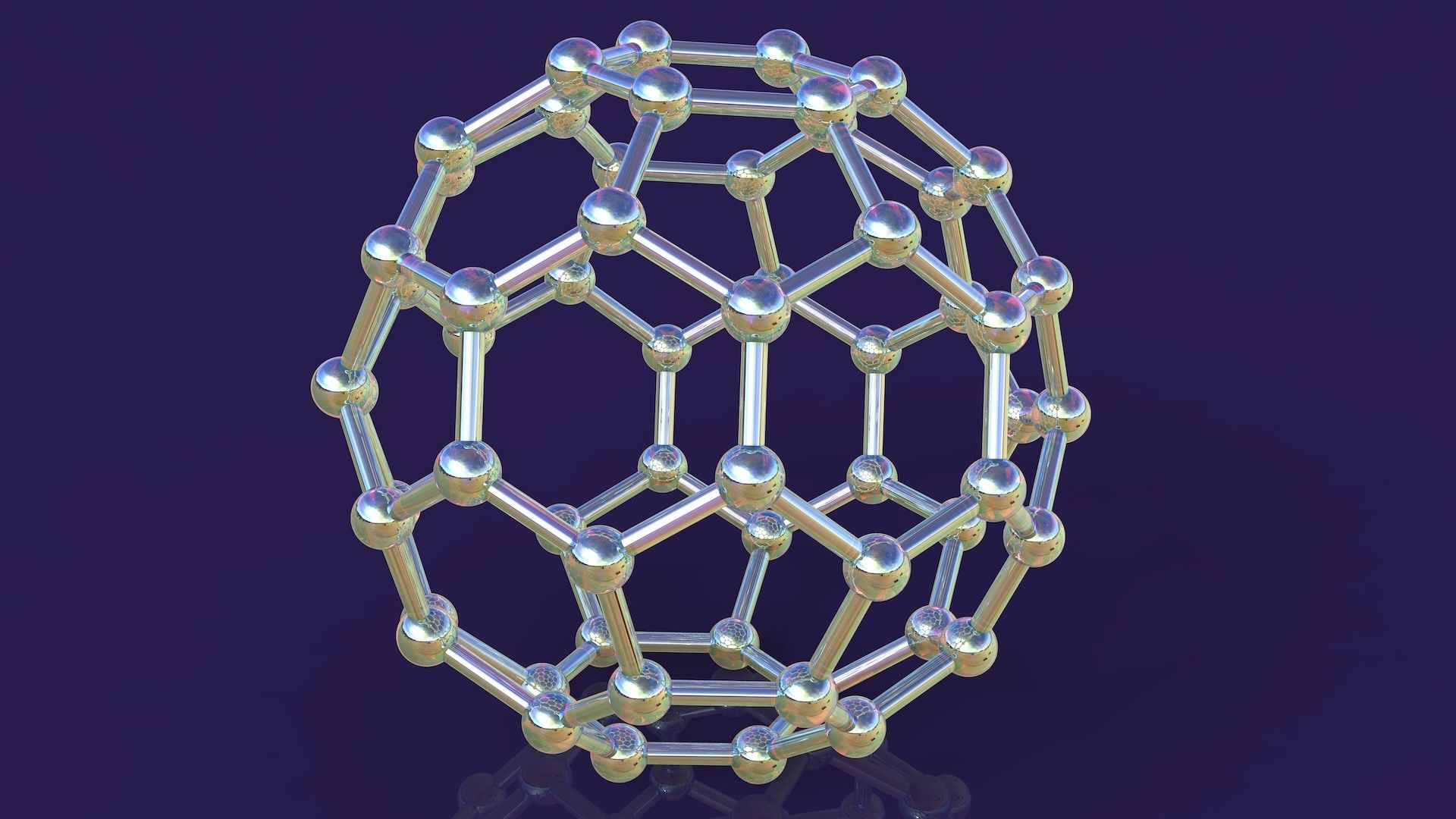
Over a feverish 10-day period in 1985, scientists conceived of a new molecule of perfect symmetry — and named it after one of the 20th century’s most famous inventors and futurists.

The hunt started in the 1970s when Harry Kroto, a lab chemist at the University of Sussex in the U.K., was puzzling over the discovery of a primordial soup of organic molecules in the “vast dark clouds that lie between the stars,” Kroto said in his Nobel Prize speech.

But radio and light-based data from this interstellar medium suggested there were many more long carbon-chains than should have been possible given the astrophysical molecular synthesis theories of the time. Scientists began to wonder whether cooling red giant stars were pumping the interstellar medium full of these six to eight carbon chains.


You may like

The eureka moment for Kroto was a visit to the Rice University laboratories of chemists Robert Kurl and Richard Smalley. Smalley had a special apparatus in which a laser beam vaporized atoms on the surface of a metal disk, then swept them up into a helium cloud and a vacuum to cool them, finally analyzing their makeup using another laser.

Kroto began to wonder if they could simulate the outer shells of cool red giants by swapping out the metal disk for one made of graphite, a form of carbon.

Over the first 10 days of September, the trio, along with graduate students Sean O’Brien, and Jim Heath, produced the six-to-eight-carbon chains that supported the red giant theory.

But there were some interlopers: strange forms of carbon made up of 60 carbon atoms, and a smaller concentration of an even-larger byproduct made up of 70 carbon atoms. These “uninvited guests,” as Kroto called them, had actually been found in an experiment from Exxon Corporate Research Science Laboratory in New Jersey about a year earlier, but no one had paid them much attention.

Get the world’s most fascinating discoveries delivered straight to your inbox.

After days of working, on Sept. 9, the team came to a conclusion about its structure. “C60 appeared to be really quite unreactive, а behavior difficult to reconcile with a flat hexagonal graphene sheet-the most obvious first thought,” Kroto said.

In theory, a flat graphene sheet would have had tons of dangling bonds that would make it more reactive.

For many days, the scientists worked with toothpicks and jellybeans, paper cutouts of hexagons and pentagons, and other “low-tech” modeling solutions to try to puzzle out the structure of this 60-carbon molecule.


You may like

Kroto thought back to the 1967 Expo in Montreal, where 20th-century futurist and inventor Buckminster Fuller was showcasing a geodesic dome, a spherical structure with a network of triangles on its surface, which he had patented in the 1950s. Smalley went to his office to grab a book detailing Fuller’s work, and they figured out the proposed structure.

The architect stands in front of his creation, a geodesic dome which acts as the US pavilion at the 1967 World's Fair

Buckminster Fuller, who patented the geodesic dome in the 1950s, stands in front of his creation at the U.S. pavilion of the 1967 World’s Fair. Fuller’s dome inspired researchers to decipher the structure of the 60-carbon molecule known as buckminster fullerene. (Image credit: Bettmann via Getty Images)

The resulting compound, which they named buckminster fullerene, was a molecule of incredible symmetry. The paper describing their new molecule was published Nov. 14, 1985 in the journal Nature, and they were soon nicknamed buckyballs.

Over the next few years, the team deduced the properties of the class of closed molecules, called fullerenes. And by 1990, scientists had figured out that by putting an electric arc between two sticks of carbon, they could produce scads of buckyballs.

Kroto, Smalley and Curl won the 1996 Nobel Prize in Chemistry for their discovery and characterization of buckyballs.

Fullerenes as a class have proven useful, and chemical relatives of buckyballs, called nanotubes, are super strong and have high thermal and electrical conductivity. These nanotubes have become crucial in atomic force microscopes, batteries, coatings and biosensors. But though scientists have proposed using buckyballs in everything from quantum computing to drug delivery, they have yet to find their niche in mainstream applications.

Source link

Share. Facebook Twitter Pinterest LinkedIn Tumblr Email
Previous ArticleLawsuit alleges horrifying conditions at California migrant detention center
Next Article Man behind viral Jonas Brothers resume speaks out
Editor
  • Website

Related Posts

Lifestyle

‘The scientific cost would be severe’: A Trump Greenland takeover would put climate research at risk

January 17, 2026
Lifestyle

New ‘Transformer’ humanoid robot can launch a shapeshifting drone off its back — watch it in action

November 19, 2025
Lifestyle

Medieval spear pulled from Polish lake may have belonged to prince or nobleman

November 19, 2025
Add A Comment

Comments are closed.

Categories
  • Entertainment
  • Lifestyle
  • News
  • Sports
  • Tech
  • Travel
Recent Posts
  • George Kittle’s wife shares live reaction to Achilles injury
  • ‘The scientific cost would be severe’: A Trump Greenland takeover would put climate research at risk
  • Headlines Across OC as Angel Stadium Sale Debate Intensifies
  • Anti-Islam activists clash with pro-Muslim counter-protesters in Dearborn, Michigan
  • Best monitor deal: Get the 45-inch LG Ultragear gaming monitor for its lowest price yet
calendar
February 2026
M T W T F S S
 1
2345678
9101112131415
16171819202122
232425262728  
« Jan    
Recent Posts
  • George Kittle’s wife shares live reaction to Achilles injury
  • ‘The scientific cost would be severe’: A Trump Greenland takeover would put climate research at risk
  • Headlines Across OC as Angel Stadium Sale Debate Intensifies
About

Welcome to Baynard Media, your trusted source for a diverse range of news and insights. We are committed to delivering timely, reliable, and thought-provoking content that keeps you informed
and inspired

Categories
  • Entertainment
  • Lifestyle
  • News
  • Sports
  • Tech
  • Travel
Facebook X (Twitter) Pinterest WhatsApp
  • Contact Us
  • About Us
  • Privacy Policy
  • Disclaimer
  • UNSUBSCRIBE
© 2026 copyrights reserved

Type above and press Enter to search. Press Esc to cancel.