
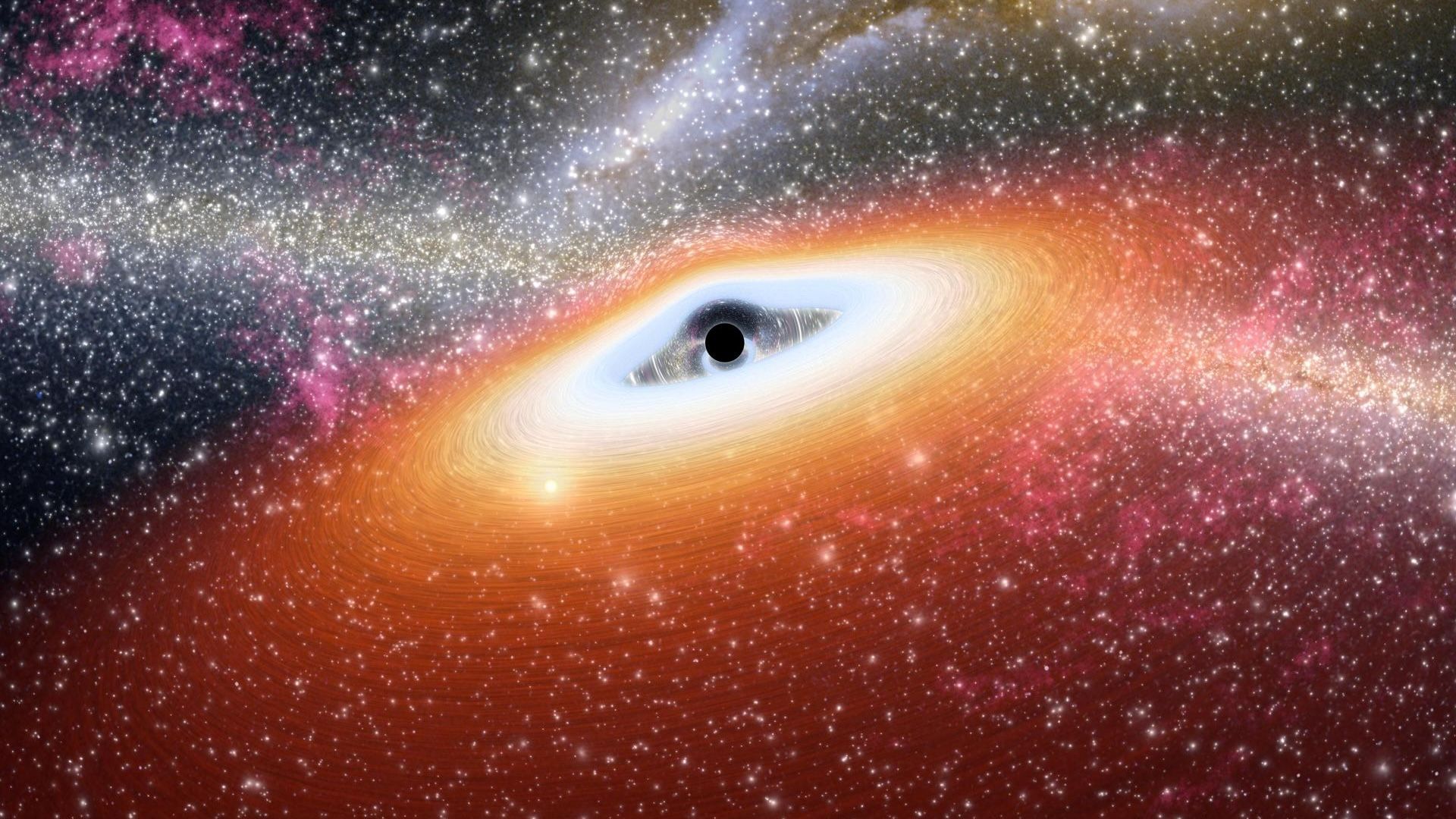
Milestone: Black hole radiation theorized
Date: March 1, 1974
Where: Cambridge, England
Who: Stephen Hawking
In 1974, a brilliant 32-year-old physicist published a not-quite-two-page paper in the journal Nature — and blew up one of our fundamental assumptions about black holes.
According to Einstein’s theory of relativity, black holes are so massive that nothing, not even light, can escape their clutches. By that logic, black holes should grow only as the universe ages, devouring nearby matter or merging with other black holes to eventually reach supermassive scales.
But for a few years prior to his seminal paper, Hawking had been investigating how quantum mechanics — the strange laws that govern subatomic particles — would impact black hole growth and evolution. Building on the work of theoretical physicist Jacob Bekenstein, he combined general relativity, the laws of thermodynamics and relatively simple quantum physics to deduce that black holes radiate minuscule amounts of heat.

In his popular 1988 book “A Brief History of Time,” Hawking claimed that was because pairs of “virtual” particles pop in and out of existence throughout the universe, annihilating on contact.Occasionally, however, one member of the pair would emerge just outside a black hole’s event horizon, while the other would be just inside that boundary. One would fall in, while the other would escape, carrying a tiny bit of heat with it. Over time, this loss of heat, or radiation, would shrink the black hole, leading its surface gravity to increase. That, in turn, would make the black hole accelerate the radiation, leading to the black hole’s eventual evaporation, possibly via explosion.
(In fact, later research showed that particle-antiparticle explanation is grossly simplified, and Hawking radiation actually appears as a result of the acceleration of an observer close to a black hole’s event horizon.)
For black holes with the mass of the sun or bigger, evaporation by what’s now known as “Hawking radiation” would take longer than the age of the universe, the study concluded. But Hawking also wondered whether tiny primordial black holes were formed from “quantum fluctuations” at the dawn of time. These tiny black holes, smaller than about 1 trillion kilograms, would have long since blown up, he concluded.
“This is a fairly small explosion by astronomical standards but it is equivalent to about 1 million 1 Mton hydrogen bombs,” Hawking dryly noted in his paper.

Hawking radiation soon became firmly entrenched in physics theory. But it also revealed a huge paradox in black hole physics: Evaporation meant that “information” that fell into a black hole was lost forever. That, in turn, would violate a central tenet of quantum mechanics: that information cannot be created or destroyed. For the next four decades, until his death in 2018, Hawking would chip away at the black hole information paradox.
In a 2015 public lecture in Sweden, Hawking reiterated his proposal that information can indeed escape a black hole, possibly via a wormhole.
“Black holes ain’t as black as they are painted. They are not the eternal prisons they were once thought,” Hawking said. “Things can get out of a black hole both on the outside and possibly come out in another universe.”
After his death, some of his collaborators published a series of papers that seemed to resolve the paradox; information is not lost once it enters a black hole, they posited, but regurgitated.
And in 2024, physicists proposed a way to find it: The information gobbled up by a black hole would leave traces in subtle ripples in the space-time surrounding these cosmic monsters. These ripples would reveal themselves in gravitational waves we’re already detecting using massive observatories.
Scientists have yet to find direct evidence for black hole explosions or primordial black holes. But the James Webb Space Telescope recently detected an ancient galaxy that could be explained by primordial black holes.
