Close Menu
  • Home
  • UNSUBSCRIBE
  • News
  • Lifestyle
  • Tech
  • Entertainment
  • Sports
  • Travel
Facebook X (Twitter) WhatsApp
Trending
  • George Kittle’s wife shares live reaction to Achilles injury
  • ‘The scientific cost would be severe’: A Trump Greenland takeover would put climate research at risk
  • Headlines Across OC as Angel Stadium Sale Debate Intensifies
  • Anti-Islam activists clash with pro-Muslim counter-protesters in Dearborn, Michigan
  • Best monitor deal: Get the 45-inch LG Ultragear gaming monitor for its lowest price yet
  • Slovakia U21 0 – 4 England U21
  • 13 Top Sleep Products That Transform Your Bedtime Routine for Better Rest
  • Firefighters rescue puppies from burning house
Facebook X (Twitter) WhatsApp
Baynard Media
  • Home
  • UNSUBSCRIBE
  • News
  • Lifestyle
  • Tech
  • Entertainment
  • Sports
  • Travel
Baynard Media
Home»Lifestyle»Science history: Alexander Fleming wakes up to funny mold in his petri dish, and accidentally discovers the first antibiotic — Sept. 28, 1928
Lifestyle

Science history: Alexander Fleming wakes up to funny mold in his petri dish, and accidentally discovers the first antibiotic — Sept. 28, 1928

EditorBy EditorSeptember 28, 2025No Comments4 Mins Read
Share Facebook Twitter Pinterest LinkedIn Tumblr Reddit Telegram Email
Share
Facebook Twitter LinkedIn Pinterest Email

QUICK FACTS

Milestone: Discovery of penicillin

Date: Sept. 28, 1928

Where: St Mary’s Hospital, London

Who: Scottish microbiologist Alexander Fleming

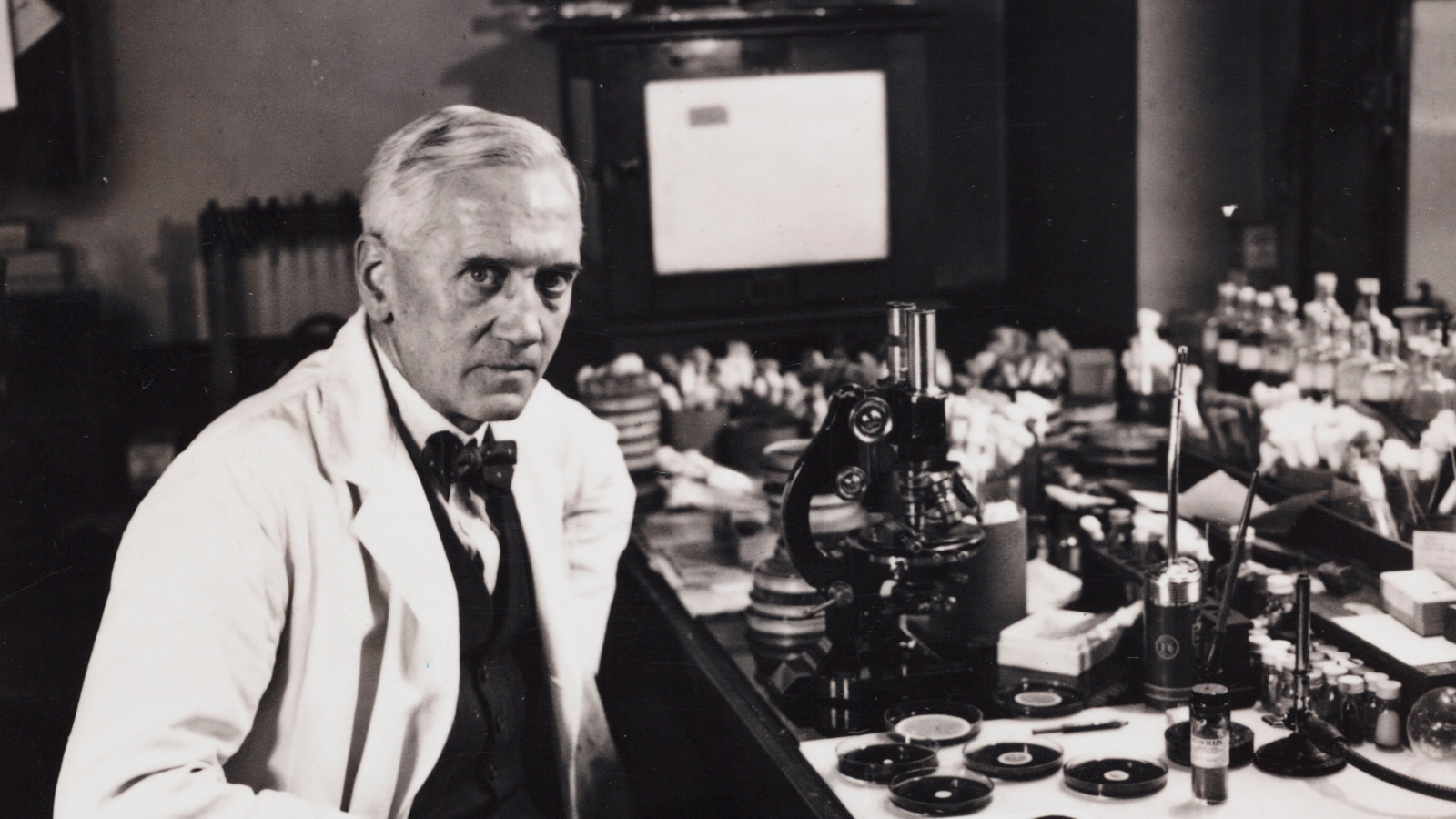
On Sept. 28, 1928, Alexander Fleming woke up to check on his experiments investigating bacterial growth — and accidentally discovered the world’s first antibiotic.

The Scottish physicist and microbiologist had been doing experiments in a cramped, roughly 12-square-foot (1 square meter) room in a turret inside London’s St Mary’s Hospital. The famously untidy scientist would culture bacteria from infected hospital patients; he would leave those cultures around for two or three weeks until his bench was crammed with 40 to 50 plates. Then, he would inspect each plate to see if anything interesting had grown in it, before tossing it out.

The discovery of penicillin occurred when Fleming returned from a two-week break. He looked at his plates of Staphylococcus aureus that had been cultured from an infected wound. On one of the plates, Fleming noticed a patch of green mold intersecting the golden-yellow bacterial colonies, according to an account from his assistant, V.D. Allison. Near the green patch, the bacteria were translucent, colorless and dead. The substance that killed the bacteria would form the basis of the first antibiotic, though the term wasn’t coined until 1941.


You may like

“When I woke up just after dawn on September 28, 1928, I certainly didn’t plan to revolutionize all medicine by discovering the world’s first antibiotic, or bacteria killer,” Fleming later said. “But I suppose that was exactly what I did.”

This petri dish labelled 'P notatum v Bacteria' contains a culture medium and shows the effect of penicillin on bacteria colonies. As seen in the film 'Penicillin' made by Realist Films in 1945.

A petri dish that contains bacterial colonies with the mold P. notatum growing in the upper right-hand corner. A chemical produced by the fungus would form the basis of the drug penicillin. (Image credit: SSPL/Getty Images)

Fleming determined that the “mold juice” came from a fungal species he eventually identified as Penicillium. When he described the discovery to his fellow doctors at a meeting the next year, he was met with almost total disinterest. Isolating the elusive “mold juice” also proved challenging, so the discovery languished for a decade, Allison wrote in personal recollections.

Then, in 1939, scientists Howard Florey and Ernst Chain took an interest in the substance. They created a research team and, along with scientists such as Margaret Jennings, Edward Abraham and Norman Heatley, managed to isolate penicillin from the mold, test it and use the yellowy, powdery substance to cure a handful of patients. However, the compound was still relatively impure.

In 1942, Fleming was treating a young patient who was seriously ill with meningitis. He found the powder killed the patient’s bacterial infection, and he phoned Florey and Chain for some of their stash, even though it was not purified. After Fleming injected it into the boy’s spinal cord, the patient recovered.

Get the world’s most fascinating discoveries delivered straight to your inbox.

After this miraculous recovery, Fleming was convinced that penicillin needed to be mass-produced. He pitched it to the government, and soon there was a joint effort between the U.S. and the U.K. to mass-produce the substance. By 1945, the first antibiotic was widely available.

A view of a man filling a syringe with penicillin in front of a counter filled with penicillin vials, 1940s.

By the 1940s, penicillin was being mass produced. Here, a man draws out a dose of penicillin using a glass syringe. (Image credit: Anthony Potter Collection/Getty Images)

Fleming, Florey and Chain would win the 1945 Nobel Prize in medicine for their work on the discovery, isolation and production of penicillin. In 1964, Dorothy Hodgkin would earn the Nobel Prize in chemistry for elucidating its crystal structure, which helped chemists design later antibiotics.

It’s estimated that since its discovery, penicillin has saved 500 million lives and, along with its derivatives, is still a mainstay in the treatment of myriad illnesses, including ear infections, strep throat, and urinary tract infections.

Penicillin also led to the development of hundreds of different antibiotics. But widespread use and misuse of these wonder drugs have meant that many bacterial strains have evolved resistance against common antibiotics, including penicillin. In the arms race against superbugs, scientists are now finding totally new ways to fight bacteria, from harnessing the power of viruses to attack bacteria to using the gene-editing tool CRISPR to design new drugs.

Source link

Share. Facebook Twitter Pinterest LinkedIn Tumblr Email
Previous ArticleLivvy Dunne fires back at negative social media comment
Next Article Chuck Schumer says Trump meeting ‘only a first step’ to avoiding shutdown: Full interview
Editor
  • Website

Related Posts

Lifestyle

‘The scientific cost would be severe’: A Trump Greenland takeover would put climate research at risk

January 17, 2026
Lifestyle

New ‘Transformer’ humanoid robot can launch a shapeshifting drone off its back — watch it in action

November 19, 2025
Lifestyle

Medieval spear pulled from Polish lake may have belonged to prince or nobleman

November 19, 2025
Add A Comment

Comments are closed.

Categories
  • Entertainment
  • Lifestyle
  • News
  • Sports
  • Tech
  • Travel
Recent Posts
  • George Kittle’s wife shares live reaction to Achilles injury
  • ‘The scientific cost would be severe’: A Trump Greenland takeover would put climate research at risk
  • Headlines Across OC as Angel Stadium Sale Debate Intensifies
  • Anti-Islam activists clash with pro-Muslim counter-protesters in Dearborn, Michigan
  • Best monitor deal: Get the 45-inch LG Ultragear gaming monitor for its lowest price yet
calendar
February 2026
M T W T F S S
 1
2345678
9101112131415
16171819202122
232425262728  
« Jan    
Recent Posts
  • George Kittle’s wife shares live reaction to Achilles injury
  • ‘The scientific cost would be severe’: A Trump Greenland takeover would put climate research at risk
  • Headlines Across OC as Angel Stadium Sale Debate Intensifies
About

Welcome to Baynard Media, your trusted source for a diverse range of news and insights. We are committed to delivering timely, reliable, and thought-provoking content that keeps you informed
and inspired

Categories
  • Entertainment
  • Lifestyle
  • News
  • Sports
  • Tech
  • Travel
Facebook X (Twitter) Pinterest WhatsApp
  • Contact Us
  • About Us
  • Privacy Policy
  • Disclaimer
  • UNSUBSCRIBE
© 2026 copyrights reserved

Type above and press Enter to search. Press Esc to cancel.