Close Menu
  • Home
  • UNSUBSCRIBE
  • News
  • Lifestyle
  • Tech
  • Entertainment
  • Sports
  • Travel
Facebook X (Twitter) WhatsApp
Trending
  • Spitzer’s Office Faces $18M in Settlements and Judgements
  • ‘80% chance of a go,’ launch weather officer says at NASA’s Artemis II prelaunch conference
  • Florida Supreme Court keeps James Duckett’s execution on hold
  • Lawsuit over calories in David protein bars is dropped
  • Moving to Florida: Relocation Guide for 2024
  • Luke Bryan credits religious upbringing for guiding him through stardom
  • Cash relief coming for Minneapolis small businesses – is it enough?
  • Living in Canada: The Definitive Guide
Facebook X (Twitter) WhatsApp
Baynard Media
  • Home
  • UNSUBSCRIBE
  • News
  • Lifestyle
  • Tech
  • Entertainment
  • Sports
  • Travel
Baynard Media
Home»Lifestyle»Roman scutum: An 1,800-year-old shield dropped by a Roman soldier who likely died in battle
Lifestyle

Roman scutum: An 1,800-year-old shield dropped by a Roman soldier who likely died in battle

EditorBy EditorDecember 9, 2024No Comments3 Mins Read
Share Facebook Twitter Pinterest LinkedIn Tumblr Reddit Telegram Email
Share
Facebook Twitter LinkedIn Pinterest Email

Name: Painted Roman scutum (long shield)

What it is: A wooden and leather shield used by a Roman soldier in battle

Where it is from: Dura-Europos, Syria

When it was made: Second century A.D.

Related: Babylonian tablet preserves student’s 4,000-year-old geometry mistake

What it tells us about the past:

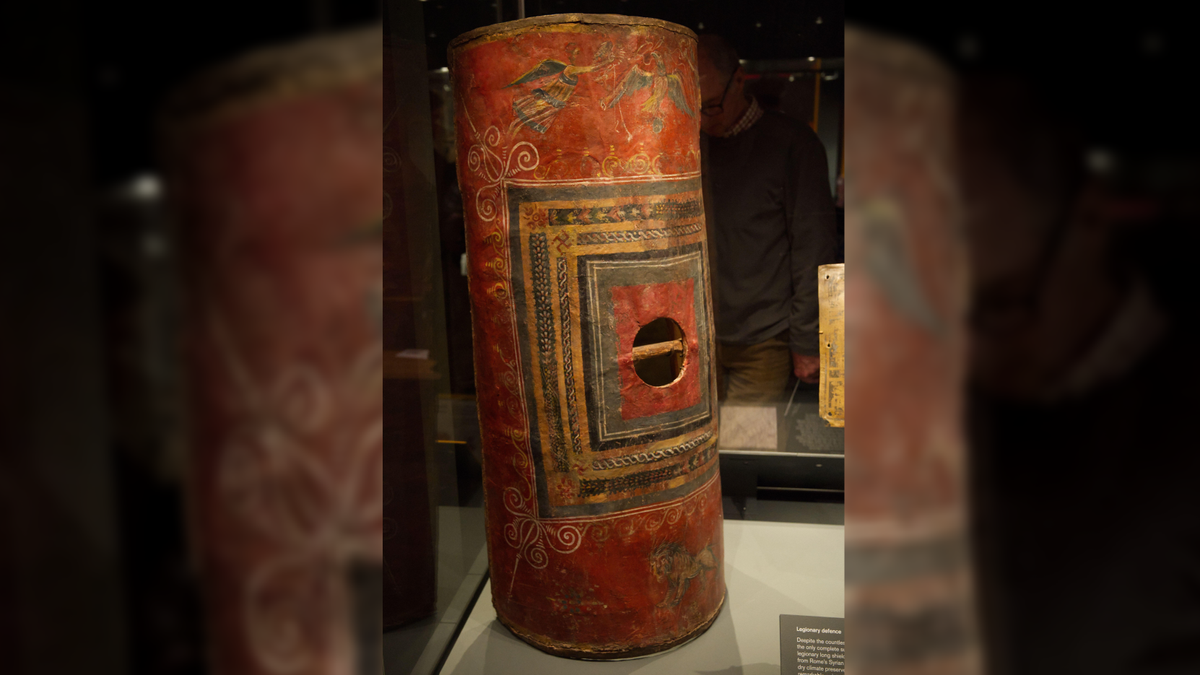
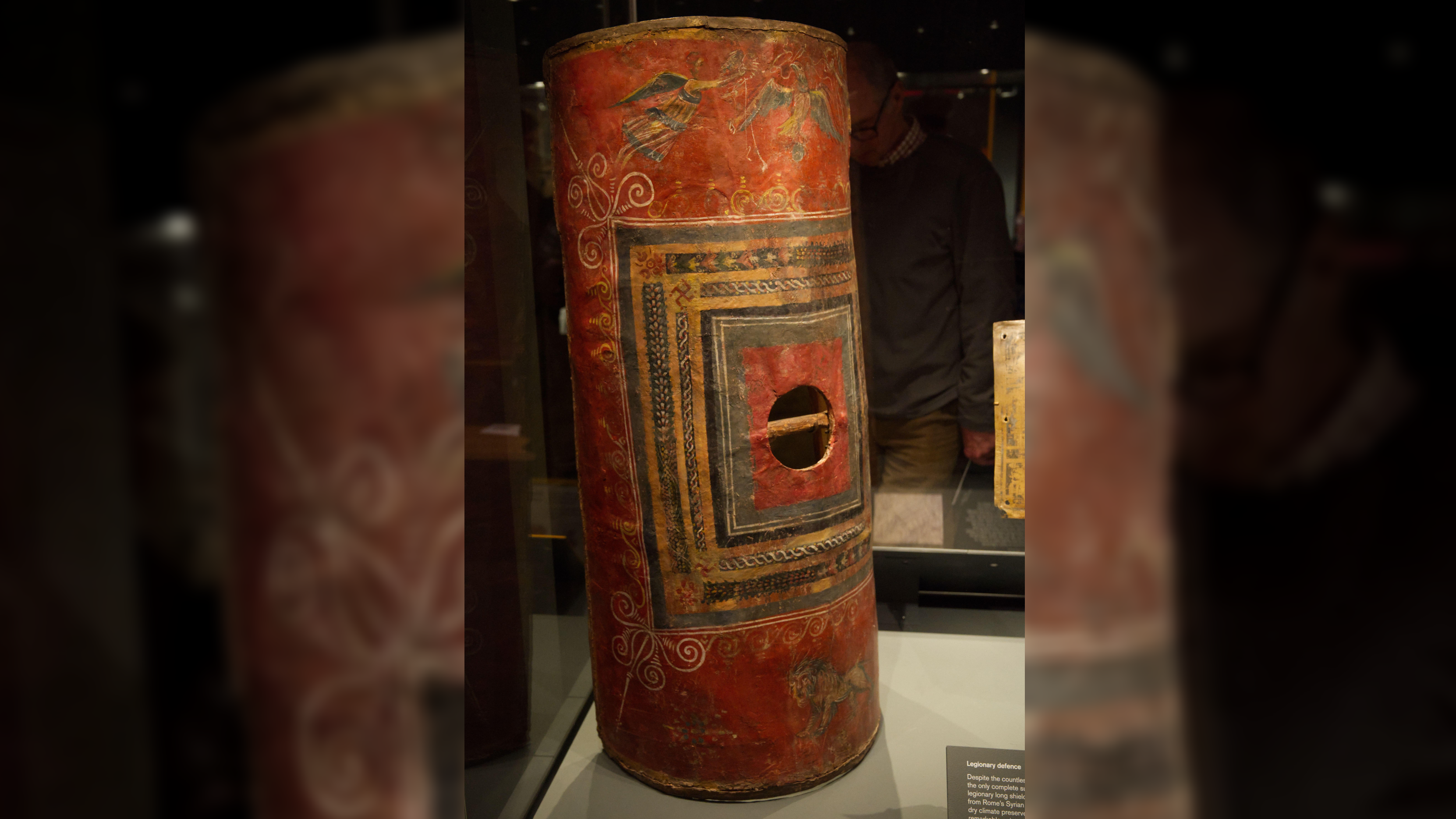
This tall, semi-cylindrical shield, which is in the collection of the Yale University Art Gallery, is one of the few surviving examples of a Roman “scutum,” the most popular shield type from the fourth century B.C. to the third century A.D. It was excavated from the ancient city of Dura-Europos in Syria nearly a century ago, and probably belonged to a Roman soldier who lost his life in battle.

Get the world’s most fascinating discoveries delivered straight to your inbox.

Few examples of this type of shield have survived over the millennia, even though it is well known from depictions in art. The Dura-Europos shield gives archaeologists a huge amount of information about how this piece of armor was made. Several layers of wood strips were laminated together to make a surface that was 41.5 inches (105.5 centimeters) tall, 16 inches (41 cm) wide, and about 0.2 inches (6 millimeters) thick. It had been shattered into 13 pieces and was missing its “umbo” or boss — a cup-shaped piece of material that would have protected the central hole where the soldier held onto the shield.

The front of the shield was covered with kidskin, then painted. According to the Yale University Art Gallery, “the painted decoration reflects Roman iconography of victory, including an eagle with a laurel wreath, winged Victories and a lion.”

The shield was discovered by archaeologists in 1933 under a fortification tower during excavations at Dura-Europos. The Romans made Dura-Europos part of their empire in A.D. 165, using it as an eastern trading post. But the city was abandoned in A.D. 256 after being besieged by soldiers from the Sasanian Empire of ancient Iran.

MORE ASTONISHING ARTIFACTS

Archaeologists found the skeletons of 19 Roman soldiers, complete with all their weapons and armor — including the scutum — in a tunnel under a fortification tower. While these soldiers may have simply been trapped by a collapsed tunnel, some experts think that the Sassanids were waiting for the Romans to break through. When they did, the Sassanids used naphtha — an ancient chemical weapon — to suffocate them.

After the battle with the Sassanids, residents fled, and Dura-Europos was swiftly reclaimed by the desert sands. It was not found until 1920, when American archaeologist James Henry Breasted recognized the name “Dura” on a Greek inscription on the ancient city’s main gate.

Source link

Share. Facebook Twitter Pinterest LinkedIn Tumblr Email
Previous ArticleDemocratic lawmaker open to ‘bipartisan cooperation’ in Elon Musk’s DOGE plans
Next Article Black Harris staffers say they were mistreated on the campaign, blames leadership for taking base for granted
Editor
  • Website

Related Posts

Lifestyle

‘80% chance of a go,’ launch weather officer says at NASA’s Artemis II prelaunch conference

April 1, 2026
Lifestyle

Moving to Florida: Relocation Guide for 2024

April 1, 2026
Lifestyle

Living in Canada: The Definitive Guide

March 31, 2026
Add A Comment

Comments are closed.

Categories
  • Entertainment
  • Lifestyle
  • News
  • Sports
  • Tech
  • Travel
Recent Posts
  • Spitzer’s Office Faces $18M in Settlements and Judgements
  • ‘80% chance of a go,’ launch weather officer says at NASA’s Artemis II prelaunch conference
  • Florida Supreme Court keeps James Duckett’s execution on hold
  • Lawsuit over calories in David protein bars is dropped
  • Moving to Florida: Relocation Guide for 2024
calendar
April 2026
M T W T F S S
 12345
6789101112
13141516171819
20212223242526
27282930  
« Mar    
Recent Posts
  • Spitzer’s Office Faces $18M in Settlements and Judgements
  • ‘80% chance of a go,’ launch weather officer says at NASA’s Artemis II prelaunch conference
  • Florida Supreme Court keeps James Duckett’s execution on hold
About

Welcome to Baynard Media, your trusted source for a diverse range of news and insights. We are committed to delivering timely, reliable, and thought-provoking content that keeps you informed
and inspired

Categories
  • Entertainment
  • Lifestyle
  • News
  • Sports
  • Tech
  • Travel
Facebook X (Twitter) Pinterest WhatsApp
  • Contact Us
  • About Us
  • Privacy Policy
  • Disclaimer
  • UNSUBSCRIBE
© 2026 copyrights reserved

Type above and press Enter to search. Press Esc to cancel.