
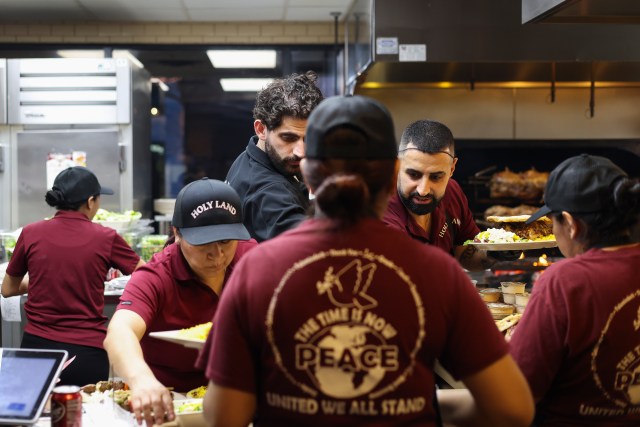
Customer after customer moved through the aisles Thursday at Holy Land Grocery and Deli in Minneapolis, filling carts with halal meats, dates and trays of syrup-soaked pastries ahead of Eid al-Fitr.
There were familiar patterns — families buying in bulk, shoppers comparing brands of rice and spices, last-minute additions tossed in near the register. But when it came to conversation, there was a noticeable restraint.
“Ask me again in a few days,” said Ahmed Hassan, 34, when asked about the recent immigration enforcement surge. He paused, allowing for a soft smile, then added, “Right now, we’re just trying to enjoy this” before returning his attention to a list on his phone.
In the final days of Ramadan, as Muslims across the Twin Cities prepare to mark one of their most important holidays of the year, many are making a deliberate choice: to set aside, at least temporarily, the anxiety and disruption caused by months of heightened immigration enforcement.
The federal surge — which earlier this winter rattled immigrant communities and reshaped routines for workers and business owners — hasn’t been forgotten. But for Muslims busily preparing for one of the holiest days of the year, it is not the dominant topic.
Instead, the focus has shifted to celebration.

That shift reflects both exhaustion and intention. In interviews, several community members described a kind of emotional fatigue after weeks of navigating uncertainty — changes to work schedules, hesitancy about public spaces, and the constant calculation of risk. In the months since enforcement activity ramped up, some workers stayed home, businesses scaled back, and everyday routines became less predictable.
At the same time, Ramadan has provided a counterweight.
The month’s rhythms — fasting during the day, gathering for iftar meals at night, increased attendance at mosques — have pulled people back into shared spaces. Even in a tense moment, those routines hold.
Related: At this St. Paul restaurant, the front door is no longer locked, but the fear isn’t gone either
Muslims from across Minneapolis and the broader metro are say evenings have felt busier again as families continue to host meals. Attendees say mosques are full. People describe the community lingering after prayers, catching up in a way that feels familiar.
“There’s a closeness that always comes during Ramadan,” said Samira Mohamed, 42, who was shopping with her two children. “This year, people needed that even more.”
Some said the timing, while stressful, had an unexpected side effect. At a moment when people might have otherwise pulled back or kept to themselves, Ramadan pushed them together.
There’s also been support from outside the community — from neighbors, from interfaith groups, from local organizations — that people mentioned without much prompting. Not in a grand or abstract way, but in small things: checking in, showing up, paying attention.
Still, that’s not what this week is about, either.

“There’s a time to talk about those things,” said Khalid Warsame, 29, who had stopped by after work. He gestured toward the crowded aisles. “This isn’t it.”
That distinction — between what people are experiencing and when they choose to talk about it — is shaping how the moment is unfolding.
For some, that means drawing a line around spaces like this one. A grocery store in the days before Eid is for preparation, for anticipation, for seeing people you haven’t seen in a while — not for revisiting months of stress.
For others, it’s about giving themselves permission to pause.
After weeks of tension, there is a sense that not every moment needs to carry the full weight of what’s happened. That there is value, even briefly, in tightening the aperture of their attention to better focus on their spiritual and communal well-being.
Children weave through the aisles as parents finalize purchases. Phones buzz with last-minute plans. People double back for items they forgot.
The pressures of the past few months haven’t disappeared. Many acknowledged that the questions raised by the enforcement surge — about safety, stability and what comes next — are still there, just below the surface.
But for now, they can wait.
“Eid comes once a year,” Hassan said, shifting bags in his cart as he moved toward the register. “We’ll deal with everything else after.”
